
"Write five pages." "No more than 1,500 words." Teachers, journals and application forms use pages and words as if they were the same thing. They are not, and the gap between them is easy to measure. This guide gives you the rule everybody uses, shows how well it works against real pages and teaches you how to convert in both directions.
The rule everybody uses
A standard academic page is US Letter or A4 with 1-inch margins and 12-point Times New Roman. MLA and APA both ask for double spacing. With that set-up, the common rule is:
- Double-spaced: about 250 words per page.
- Single-spaced: about 500 words per page.
- 1.5 spacing: about 330 to 350 words per page, between the two.
With 250 words per page, a 1,000-word essay is 1,000 ÷ 250 = 4 pages double-spaced and 2 pages single-spaced. A 5-page paper is 5 × 250 = 1,250 words. Publishers use the same 250 figure when they count manuscript pages, and some websites give a range of 250 to 300 words for the same page.
A short history of the 250-word page
- Publishing. Publishers count a manuscript page as 250 words (double-spaced, 12-point Courier or Times), whatever a particular page happens to hold.
- Style guides. MLA, APA and Chicago all ask for 12-point type, double spacing and 1-inch margins, so teachers who write "five pages" generally mean that set-up.
- Word processors. They count words for you, but they do not convert words to pages for a layout you have not yet written. The rule of thumb survived because it is easy to remember.
Our measurement below shows that fixed-width Courier fits close to 250 words per page, while proportional fonts such as Times New Roman fit more.
How a page really fills up
A page has a text area (here 6.5 × 9 inches) and the letters are laid out line by line. The number of lines is set by the line spacing and the font size; the number of characters per line is set by the font and the size. So a page holds a roughly fixed number of characters, and the number of words follows from how long your words are:
words per page = characters per page ÷ characters per word
Characters per word means letters plus the space after the word and a little punctuation. The average English word is about 4.7 letters, so with a space and punctuation we use about 5.8 characters per word for ordinary text, and about 6.6 for heavy academic prose with 5.5-letter words.
What we measured
We generated long documents and read the text of each full page. For double-spaced 12-point Times New Roman with 1-inch margins, one page held about 1,998 characters (including spaces). That is the number to remember: about 2,000.
| Font and size | Spacing | Characters per page | Words per page at 5.8 characters per word |
|---|---|---|---|
| Times New Roman 12 pt | Double | 1,998 | 344 |
| Times New Roman 12 pt | 1.5 | 2,742 | 473 |
| Times New Roman 12 pt | Single | 4,020 | 693 |
| Times New Roman 10 pt | Double | 2,918 | 503 |
| Times New Roman 11 pt | Double | 2,477 | 427 |
| Times New Roman 14 pt | Double | 1,526 | 263 |
| Arial 12 pt | Double | 1,782 | 307 |
| Calibri 12 pt | Double | 1,913 | 330 |
| Courier New 12 pt | Double | 1,410 | 243 |
Two things stand out. First, Courier New at 12 pt double-spaced fits about 243 words, which is where the 250-word rule comes from. Second, a proportional font like Times New Roman fits roughly 340 words of ordinary text on the same double-spaced page. The convention is therefore on the cautious side for modern fonts.
Worked example 1: 1,000 words
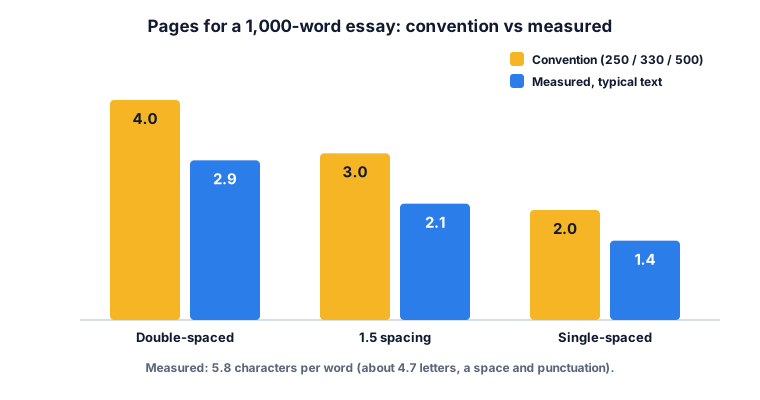
By the convention: 1,000 ÷ 250 = 4 pages double-spaced. By our measurement for typical text: 1,000 ÷ 344 = 2.9, so about 3 pages. For dense academic text with longer words (6.6 characters per word, so 1,998 ÷ 6.6 = 303 words per page): 1,000 ÷ 303 = 3.3 pages.
So the honest answer is "between 3 and 4 pages, depending on your words". The calculator gives the cautious figure, 4 pages. Your word processor gives the true one.
Worked example 2: which way is the safe side?
The limit's direction tells you which figure to use.
- Maximum ("no more than 5 pages"). Use the lower words-per-page figure. At 250 words per page you must stay under 5 × 250 = 1,250 words. If you stay under 1,250 you will certainly fit.
- Minimum ("at least 5 pages"). Use the higher figure. At 344 words per page, 5 pages needs 5 × 344 = 1,720 words; with denser text (303 words per page) it needs 1,515 words. Writing only 1,250 words would leave you around 3.6 pages and short of the target.
Pages are what the teacher checks, so before you submit, open the file and look at the real page count.
Why word length matters
Because a page holds characters, longer words mean fewer words. We repeated the test with two different texts. One had short words (about 4.1 letters on average) and one had very long words (about 9.3 letters). The first gave 384 words on a page and the second 191. The number of characters on the page was almost the same (1,998 and 1,996).
The same page holds this many words for different average word lengths (characters per word is the letters plus 1.1):
| Average word length | Words per page |
|---|---|
| 4 letters | 392 |
| 5 letters | 328 |
| 6 letters | 281 |
| 7 letters | 247 |
| 8 letters | 220 |
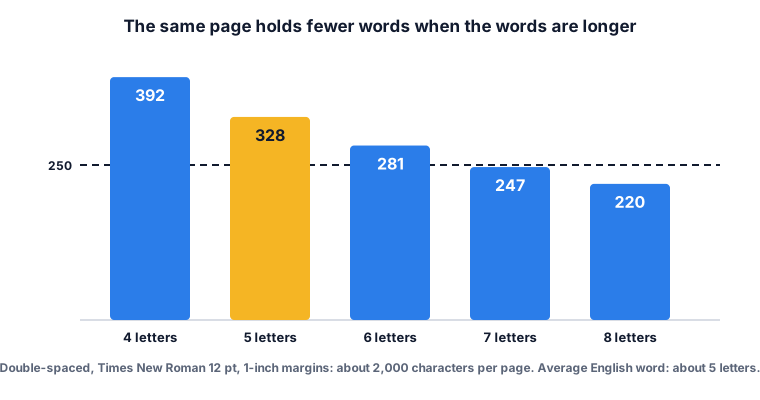
That is why scientific and legal writing, with long words, runs closer to 250 words per page, while a simple story runs closer to 380.
Worked example 3: font and size
The same 1,200-word essay, double-spaced, at 5.8 characters per word:
- 10 pt: 1,200 ÷ 503 = 2.4 pages.
- 11 pt: 1,200 ÷ 427 = 2.8 pages.
- 12 pt: 1,200 ÷ 344 = 3.5 pages.
- 14 pt: 1,200 ÷ 263 = 4.6 pages.
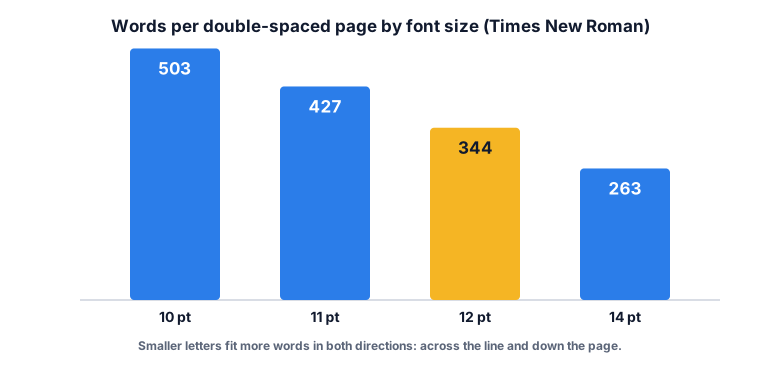
Changing the font size is the quickest way to change the page count, but teachers notice. Use the size the assignment asks for. Margins work the same way: 1.25-inch margins fit fewer characters than 1-inch margins, so the page count rises. Some style guides allow other sizes: APA 7 lists 12-pt Times New Roman, 11-pt Calibri or Arial and 11-pt Georgia, among others, so check which one your instructor requires.
Fonts differ too. At 12 pt double-spaced, Calibri fits about 4% fewer words than Times New Roman, Arial about 11% fewer and Courier New about 29% fewer.
Worked example 4: pages to words
Go the other way when an assignment gives pages. Words needed = pages × words per page.
- 3 pages double-spaced at 250: 3 × 250 = 750 words (cautious). At 344: 1,032 words.
- 2,500 words at 1.5 spacing: by convention 2,500 ÷ 330 = 7.6 pages; by measurement 2,500 ÷ 473 = 5.3 pages.
Things that take space but are not words: the title block, headings, a bibliography, block quotes, tables and pictures. A page of references holds far fewer words than a page of text, so reserve space for it.
Quick lookup: common word counts
The table applies the arithmetic from this guide to word counts people search for most. The first column is the cautious 250-word rule for a double-spaced page; the other three use the words per page we measured for 12 pt Times New Roman with 1-inch margins (344 double-spaced, 473 at 1.5 spacing, 693 single-spaced). Each figure was checked against the Words to Pages Calculator. Pages are shown to one decimal; round up to get printed pages.
| Words | Double-spaced, 250 rule | Double-spaced, measured | 1.5 spacing, measured | Single-spaced, measured |
|---|---|---|---|---|
| 300 | 1.2 | 0.9 | 0.6 | 0.4 |
| 500 | 2.0 | 1.5 | 1.1 | 0.7 |
| 1,000 | 4.0 | 2.9 | 2.1 | 1.4 |
| 1,400 | 5.6 | 4.1 | 3.0 | 2.0 |
| 1,500 | 6.0 | 4.4 | 3.2 | 2.2 |
| 1,750 | 7.0 | 5.1 | 3.7 | 2.5 |
| 2,000 | 8.0 | 5.8 | 4.2 | 2.9 |
| 2,200 | 8.8 | 6.4 | 4.7 | 3.2 |
| 2,400 | 9.6 | 7.0 | 5.1 | 3.5 |
| 2,500 | 10.0 | 7.3 | 5.3 | 3.6 |
| 3,000 | 12.0 | 8.7 | 6.3 | 4.3 |
| 4,000 | 16.0 | 11.6 | 8.5 | 5.8 |
| 6,000 | 24.0 | 17.4 | 12.7 | 8.7 |
| 30,000 | 120.0 | 87.2 | 63.4 | 43.3 |
To go the other way, multiply: 2 pages double-spaced is 2 × 250 = 500 words by the rule or 2 × 344 = 688 measured; 10 pages double-spaced is 2,500 words by the rule or 3,440 measured. Single-spaced, 10 pages is 5,000 words by the rule or 6,930 measured. For a limit that must not be exceeded, use the rule; to be sure you reach a minimum, use the measured figure. Long documents such as a 30,000-word thesis chapter add headings, tables and references, so treat their page counts as rough.
What the ZYSNOR Words to Pages Calculator does
You type a word count and choose line spacing, font and font size. The calculator uses the words per page we measured for 12 pt Times New Roman with 1-inch margins: about 344 double-spaced, 473 at 1.5 spacing and 693 single-spaced. It adjusts that figure for the font (Calibri 0.96, Arial 0.89, Courier New 0.71, taken from the measured table above, and Verdana about 0.84, which we have not measured) and for the size (10, 11 and 14 pt use the measured ratios from the table, so double-spaced it gives 503, 427 and 263 words per page; other sizes fall back on the square of the size change). It then divides your words by the result and shows the pages, with decimals and rounded up to printed pages.
It also shows the cautious rule-of-thumb range (250 words per double-spaced page, 500 single-spaced) for comparison. Use the rule for a maximum limit and the measured figure for a minimum. Check the page count in your word processor for anything that matters.
Mistakes that waste time
- Using the rule for a minimum. At 250 words per page you may be short of the real page count. Check the page count in your word processor.
- Forgetting what is not text. References, headings and figures use space.
- Padding. Making the font or margins slightly larger is easy to spot and can cost marks.
- Mixing up word counts. Some limits include the bibliography and some do not. Read the instruction.
- Trusting any converter blindly. The word processor is the final authority for the file you submit.
Words you may meet
- Double spacing: a line gap of twice the normal line height.
- Single spacing: the normal line height for the font.
- Margin: the empty border between the text and the paper's edge.
- Point (pt): a unit for font size; 72 points make an inch.
- Proportional font: a font in which letters have different widths (Times New Roman).
- Monospaced font: a font in which every letter has the same width (Courier New).
- MLA, APA: citation styles that also set the page layout.
Check your answer in 10 seconds
- Do the spacing, font, size and margins match the assignment?
- Is the limit a maximum or a minimum, and did you use the right side of the estimate?
- Did you leave space for headings, references and figures?
- Does your word processor show the page count you expect?
Practice problems
Problem 1. An essay must be at most 6 pages double-spaced. What is the safe word count using the 250-word rule?
Show the worked answer
6 × 250 = 1,500 words. With ordinary text you will probably use about 4.4 pages (1,500 ÷ 344), so you have room.
Problem 2. A paper must be at least 4 pages double-spaced in 12 pt Times New Roman. What word count makes sure you pass?
Show the worked answer
Use the higher words per page: 4 × 344 = about 1,380 words. If your writing has long words (303 per page) it needs 1,212. To be safe, write about 1,400 and check the page count.
Problem 3. You have 2,000 words. How many pages is that at 12 pt single-spaced, using the measured 693 words per page?
Show the worked answer
2,000 ÷ 693 = 2.9 pages. By the 500-word convention it would be 4 pages.
Problem 4. An assignment asks for at least 8 double-spaced pages in 12 pt Times New Roman. How many words are safe?
Show the worked answer
By the cautious rule, 8 × 250 = 2,000 words fill 8 pages. By our measured 344 words per page, 8 × 344 = 2,752 words. If 8 pages is a minimum, aim for the measured figure (about 2,750 words) or more; the Words to Pages Calculator shows exactly 8.00 pages at 2,752 words. If 8 pages is a maximum, the rule is the safer guide.
Ready to estimate your own essay? The free Words to Pages Calculator does the arithmetic, and now you know how to read its answer.