
A readability score tells you roughly how hard a text is to read. The Flesch Reading Ease score is the best known. This guide shows exactly how it is calculated, how to read the result and what to change to improve it.
The formula
Rudolf Flesch published the Reading Ease formula in 1948. It uses two averages:
- ASL, the average sentence length: words ÷ sentences.
- ASW, the average syllables per word: syllables ÷ words.
Reading Ease = 206.835 − 1.015 × ASL − 84.6 × ASW
Higher scores mean easier text. The scale is usually drawn from 0 to 100, but the formula itself has no limits, so very simple text can score above 100 and very heavy text below 0.
Reading the score
The commonly published bands match score ranges to US school levels. A score of 60 to 70 is called plain English, roughly grades 8 and 9.
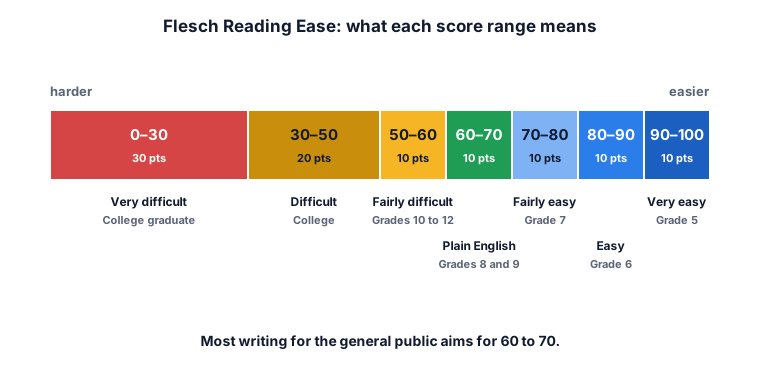
The same source puts the plain-English minimum at about 20 words per sentence and 1.5 syllables per word. Check: 206.835 − 1.015 × 20 − 84.6 × 1.5 = 206.835 − 20.3 − 126.9 = 59.6, which is the edge of the band.
The grade-level version
In 1975 a team led by J. Peter Kincaid, working for the US Navy, turned the same two averages into a school grade:
Grade = 0.39 × ASL + 11.8 × ASW − 15.59
The Navy report also gives a rounded version, 0.4 × ASL + 12 × ASW − 16, which it says differs from the exact one by about 0.1 grade. The ZYSNOR Readability Checker uses the exact constants above, and shows 0 when the formula gives a negative grade.
A result of 8 means roughly that an 8th grader could read the text. The two scores use the same inputs with different weights, so they move in opposite directions: when reading ease goes up, the grade goes down.
Worked example 1: a very simple sentence
"The cat sat on the mat." has 6 words, 1 sentence and 6 syllables. ASL = 6 and ASW = 1.
206.835 − 1.015 × 6 − 84.6 × 1 = 206.835 − 6.09 − 84.6 = 116.1. The score is above 100 because the sentence is shorter and simpler than the scale was designed for. The grade formula gives 0.39 × 6 + 11.8 − 15.59 = −1.45, which a tool shows as 0.
Worked example 2: two sentences
"The quick brown fox jumps over the lazy dog. It was a bright cold day in April." Count words: 9 + 8 = 17. Count syllables: 11 + 9 = 20 ("over" and "lazy" have two, "April" has two, the rest one). Two sentences.
- ASL = 17 ÷ 2 = 8.5
- ASW = 20 ÷ 17 = 1.176
- Reading Ease = 206.835 − 8.6275 − 99.53 = 98.7
- Grade = 3.315 + 13.88 − 15.59 = 1.6
Worked example 3: the same idea, two ways
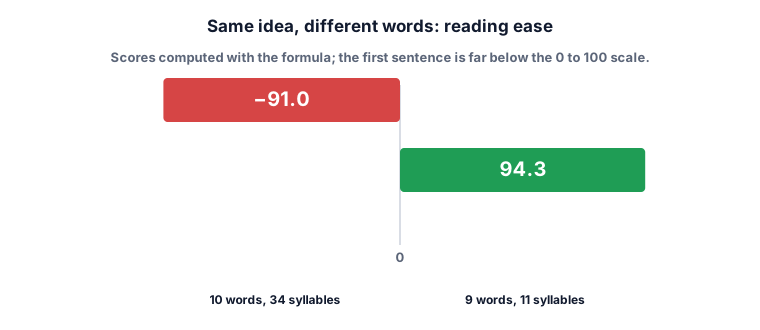
Heavy: "Utilization of comprehensive documentation facilitates the examination of administrative procedures." It has 10 words and 34 syllables in one sentence. Reading Ease = 206.835 − 10.15 − 84.6 × 3.4 = −91.0 and the grade is 28.4. The score is far below the scale, which tells you the sentence is extremely dense.
Plain: "Good records help us check how the office works." It has 9 words and 11 syllables. Reading Ease = 206.835 − 9.135 − 84.6 × 1.222 = 94.3 and the grade is 2.3.
What moves the score
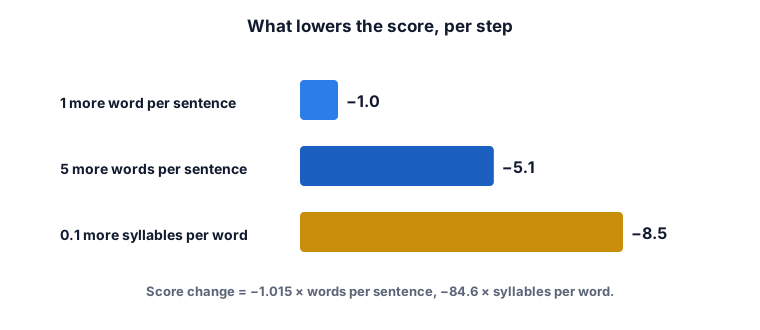
Because the formula is linear, you can see what each change costs. Adding one word to every sentence lowers the score by 1.015. Adding 0.1 syllables per word lowers it by 8.46. Word length matters much more than sentence length per step, but a sentence length change is easier to make.
- Split long sentences. Aim for most sentences under about 20 words.
- Swap long words for short ones where the meaning stays: "use" for "utilise", "help" for "facilitate".
- Do not give up needed words. A technical term your reader needs is better than a vague short one.
Worked example 4: a normal paragraph
"We tested the new form with ten students. Most finished it in two minutes, and nobody asked for help." There are 19 words in 2 sentences and 25 syllables. ASL = 9.5 and ASW = 1.316. Reading Ease = 206.835 − 9.64 − 111.3 = 85.9, and the grade is 3.6. Easy to read, as the wording is plain.
How syllables are counted
By hand you count the beats in each word. Software uses rules: count groups of vowels, then adjust for silent endings such as the final e, "-ed" after most consonants and "-es". The ZYSNOR Readability Checker does the same. Rules are not perfect: words with two vowel sounds side by side (such as "created") and some names are miscounted, and different tools can differ by a point or two on the same text. Use the score to compare drafts in the same tool, not as an exact measurement.
What the ZYSNOR Readability Checker does
You paste your text and it reports:
- Flesch Reading Ease and the Flesch-Kincaid grade level;
- Gunning Fog, Coleman-Liau, Automated Readability Index and SMOG grades (SMOG is most reliable with 30 or more sentences);
- word and sentence counts, words per sentence, and how many long words (3 or more syllables) the text contains;
- a list of sentences with 25 words or more, so you can see where to split.
It works on English text and runs in your browser; your text is not sent anywhere.
Limits of the formula
- It sees length, not meaning. Short nonsense can score well.
- It ignores layout, headings, examples and the reader's background knowledge.
- It was designed for English prose, not for lists, code, tables or other languages.
- Very short samples give unstable results. Use at least a few paragraphs.
Words you may meet
- ASL: average sentence length in words.
- ASW: average syllables per word.
- Syllable: a unit of sound with one vowel sound, as in "rea-der".
- Plain English: clear writing aimed at the general reader; the Flesch band for it is 60 to 70.
- Grade level: the US school grade a text is estimated to suit.
Practice problems
Problem 1. A passage has 100 words, 5 sentences and 140 syllables. Find the Reading Ease and the grade.
Show the worked answer
ASL = 20 and ASW = 1.4. Reading Ease = 206.835 − 20.3 − 118.44 = 68.1 (plain English). Grade = 7.8 + 16.52 − 15.59 = 8.7.
Problem 2. You shorten the sentences in problem 1 so that ASL falls from 20 to 15 and ASW stays 1.4. What is the new score?
Show the worked answer
The score rises by 5 × 1.015 = 5.075, so 68.1 + 5.1 = 73.2 (fairly easy).
Problem 3. One sentence has 12 words and 18 syllables. Find the Reading Ease and the grade.
Show the worked answer
ASL = 12 and ASW = 1.5. Reading Ease = 206.835 − 12.18 − 126.9 = 67.8. Grade = 4.68 + 17.7 − 15.59 = 6.8.
Problem 4. In problem 1 (ASL 20, ASW 1.4, score 68.1), you keep the sentences as they are but swap long words for short ones, so ASW falls to 1.3. What is the new Reading Ease, and which change helps more per step: 5 fewer words per sentence or 0.1 fewer syllables per word?
Show the worked answer
Reading Ease = 206.835 − 1.015 × 20 − 84.6 × 1.3 = 206.835 − 20.3 − 109.98 = 76.6 (easy). The rise is 8.5 points (84.6 × 0.1 = 8.46), compared with 5.1 points for cutting 5 words from each sentence (1.015 × 5 = 5.075). Short words move the score more per step, but 0.1 syllables per word is also a bigger change than it sounds, so both levers are worth using.
To check your own text, paste it into the free Readability Checker and compare it with what you now know the formula does.