
You finish a typing test and see a number. This guide explains what it means, how it is calculated and how to check it yourself.
The five-character word
Real words vary in length, so a test cannot simply count them. The standard is to treat every five characters as one word. Spaces and punctuation count as characters.
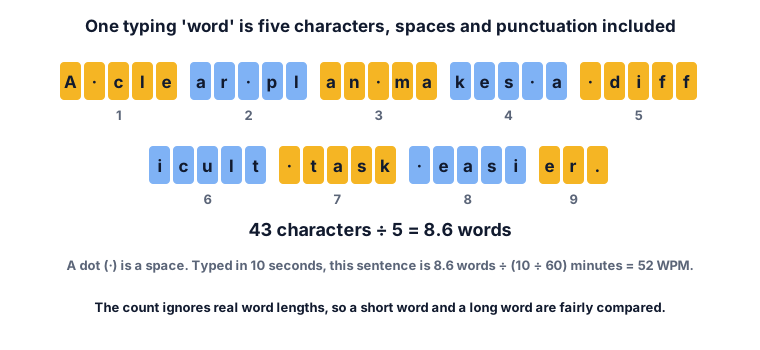
The formula
- Count the characters you typed (the test does this for you).
- Divide by 5 to get words.
- Divide by the time in minutes. Thirty seconds is 0.5 minutes.
WPM = (characters ÷ 5) ÷ minutes
Gross and net speed
Gross (raw) WPM counts everything you typed. Net WPM counts only the correct characters, so mistakes lower it. Accuracy is correct characters ÷ characters typed.
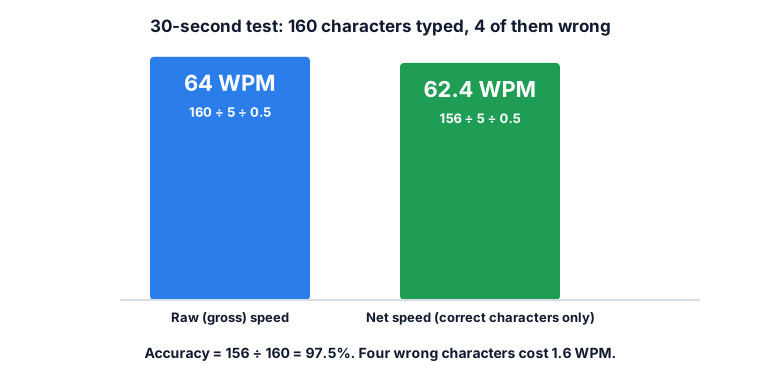
Example: in a 30-second test you type 160 characters and 4 are wrong.
- Gross: 160 ÷ 5 ÷ 0.5 = 64 WPM
- Net: 156 ÷ 5 ÷ 0.5 = 62.4 WPM
- Accuracy: 156 ÷ 160 = 97.5%
The ZYSNOR test reports net speed as its main result and shows the raw speed next to it. It rounds speeds to whole numbers, so the 62.4 above appears as 62 WPM and the 68.6 in the next example as 69 WPM. It also compares each character with the same position in the sample, so a skipped or extra letter makes the characters after it count as errors. Fix mistakes with Backspace as you go.
Worked example: a one-minute test
You type 350 characters in one minute and 7 are wrong. Words: 350 ÷ 5 = 70, so gross is 70 WPM. Correct characters: 343, so net is 343 ÷ 5 = 68.6 WPM. Accuracy is 343 ÷ 350 = 98%.
What is a typical speed?
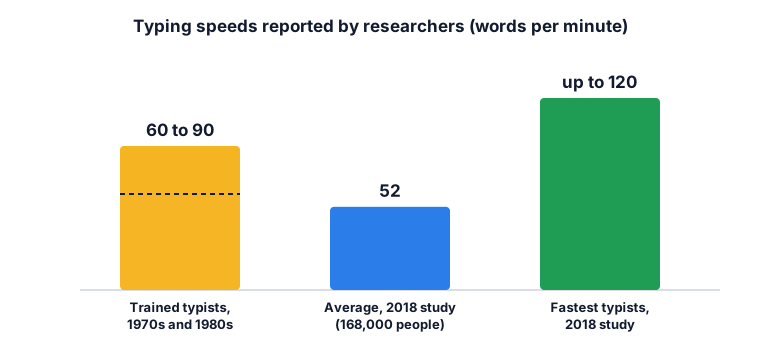
The largest study so far collected 136 million keystrokes from 168,000 volunteers. The average was 51.56 WPM (standard deviation 20.2), which the press material rounds to 52. In the paper, speed is the characters transcribed divided by 5 and by the time from the first to the last keypress. Professionally trained typists studied in the 1970s and 1980s typically reached 60 to 90 WPM, and the fastest people in the 2018 study typed 120 WPM. Faster typists also made fewer mistakes.
The study also found that many fast typists press the next key before releasing the last one, and that you do not have to touch-type with ten fingers to be fast.
How to improve
- Accuracy first. Errors are costly to correct, so slowing down slightly often makes you faster overall.
- Look at the screen, not your hands. You spot mistakes sooner.
- Practise deliberately in short regular sessions and compare net WPM, not raw.
Mistakes when comparing scores
- Comparing gross speed on one site with net speed on another.
- Comparing a short test with a long one. Short tests usually give higher numbers.
- Counting words instead of characters ÷ 5.
Practice problems
Problem 1. You type 275 characters in 1 minute. What is the gross WPM?
Show the worked answer
275 ÷ 5 = 55 WPM.
Problem 2. In 3 minutes you type 600 characters and 15 are wrong. What is the net WPM and the accuracy?
Show the worked answer
Correct: 585. Net: 585 ÷ 5 ÷ 3 = 39 WPM. Accuracy: 585 ÷ 600 = 97.5%.
Problem 3. You want a net speed of 60 WPM in a 2-minute test with 98% accuracy. About how many characters must you type?
Show the worked answer
Net 60 WPM over 2 minutes means 60 × 2 × 5 = 600 correct characters. If 98% of what you type is correct, you must type 600 ÷ 0.98 = 612.2, so about 612 characters, of which about 12 may be wrong. Check: 600 ÷ 5 ÷ 2 = 60 WPM net, and 612 ÷ 5 ÷ 2 = 61.2 WPM gross.
When you are ready, try the free Typing Speed Test and check the number against your own arithmetic.