

Many free checkers either miss everything or change too much. This guide explains exactly what a rule-based checker can fix safely, what it only points out, and what you still have to read yourself.
What it fixes automatically
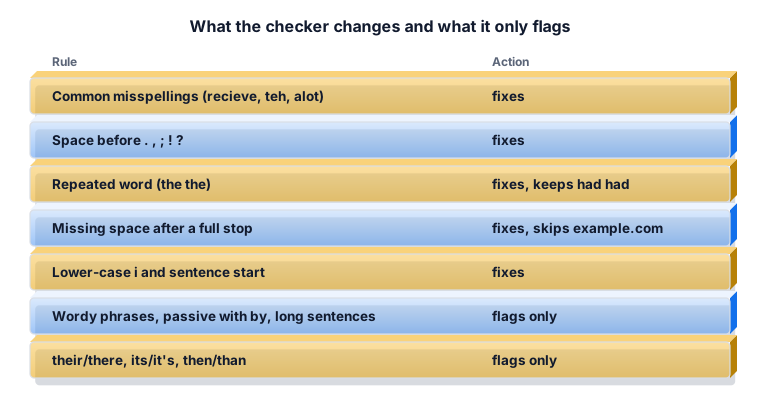
Common misspellings (recieve, teh, alot, definately), a space before a comma or full stop, repeated spaces, a repeated word such as "the the" (but not "had had" or "that that", which can be correct), a missing space after a full stop, a lower-case "i", and a lower-case letter at the start of a sentence.
What it only flags
Wordy phrases ("in order to" → "to"), passive sentences with "by", sentences of 40 words or more, and commonly confused pairs (their/there/they're, its/it's, then/than, loose/lose, affect/effect). These need judgement, so the tool lists them and leaves your text alone.
What it cannot catch
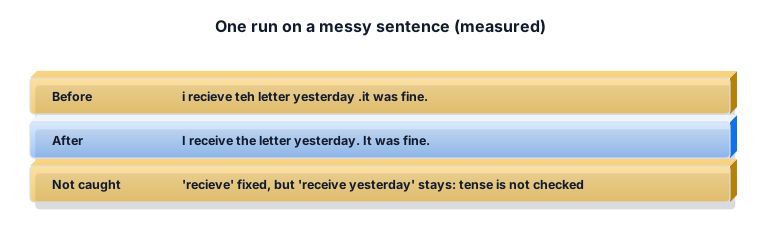
It does not understand meaning. "I receive the letter yesterday" keeps the wrong tense. "Their going to lose it" is only flagged as a pair to check, not corrected. A missing word or a sentence that makes no sense passes. Treat it as a first pass, not proofreading.
Worked example 1: a quick email
"i will send the the file tommorow ,thanks" becomes "I will send the file tomorrow, thanks". Four suggestions explain the changes.
Worked example 2: an essay paragraph
The checker notes "in order to" twice and a 45-word sentence. Shorten the phrase, split the sentence, and run it again until only the notes you agree with remain.
Worked example 3: web addresses and file names
"Visit example.com today. See report.pdf now." is left as it is, because .com and .pdf are web and file endings. "We met in the park.it rained" becomes "We met in the park. It rained."
What the ZYSNOR checker does
- English only, rule-based, no AI and no account.
- Returns the corrected text plus a numbered list of suggestions.
- Runs in your browser; your text is not uploaded.
Mistakes that waste time
- Copying without reading the suggestions. A rule can be wrong for your sentence.
- Expecting tense or meaning checks. Read the text aloud; the Text to Speech tool helps.
- Checking non-English text. The rules are English only.
Practice problems
Problem 1. Will "I had had enough" be changed?
Show the worked answer
No. "had had" is on the list of repeats that are often correct.
Problem 2. Will "Their going home" be corrected to "They're going home"?
Show the worked answer
No. It is flagged as a their/there/they're pair to check; you must fix it.
Ready to try it? The free tool works in your browser, and the button in the page header takes you straight to it.