
Finals week. You have a grade, you know what you want, and you are asking one question: what do I have to score? This guide gives you the formula, shows why it works (so you can trust it and adapt it) and walks through worked examples, including what to do when the answer is more than 100%.
The idea in one picture
A course grade is a weighted average. Each part of the course counts for a share of the whole, and the shares add up to 100%. Before the final, the finished work counts for (100% − the final's weight) of the course. The final counts for its weight. So the course grade has two parts:
course grade = current × (1 − w) + final score × w
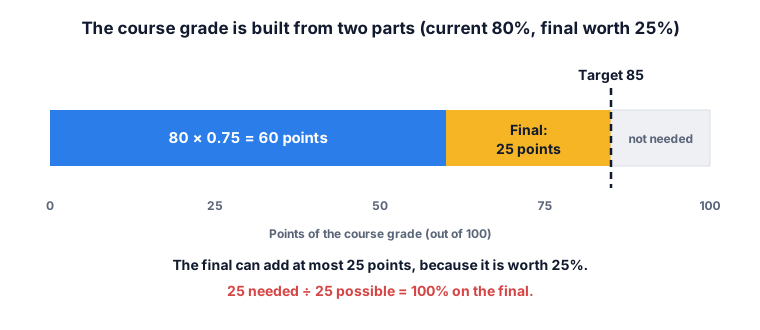
Say you have 80%, the final is worth 25% (w = 0.25) and you want 85%. The finished work contributes 80 × 0.75 = 60 points. You need 85 − 60 = 25 more points. The final can give at most 25 points (100% of its 25% share), so you need 25 ÷ 25 = 100% on the final.
Solving for the score you need
Start from the two-part equation and get the final score alone:
- target = current × (1 − w) + F × w (F is the score you need on the final)
- Subtract the first part from both sides: target − current × (1 − w) = F × w
- Divide by w: F = (target − current × (1 − w)) ÷ w
The ZYSNOR calculator and the published calculators we checked use this rearrangement. The college handouts reach the same answer in a different order: they add up the points already earned, subtract that from the target and divide what is left by the final's weight. Some write the weight as a percent and some as a decimal. Whichever you use, be consistent: either 25 and 100 − 25, or 0.25 and 1 − 0.25.
A short history: where percent grades and letter grades come from
- 1785. The first official record of grading in the United States comes from Yale: the first grades handed out in America went to 58 students, of whom 20 earned Optimi, 16 second Optimi, 12 Inferiores and 10 Pejores.
- 1830s. Harvard experiments with public rankings of students, and some Harvard professors use a 100-point system by 1837. In 1837 Yale records credit for individual classes on a four-point scale, with "merit marks" kept in code and hidden from students.
- 1884 to 1898. Mount Holyoke College grades with letters A to E tied to percentage ranges (below 75% is an E, a fail). The research paper dates this to 1884 and says an F was added in 1898; a popular article dates the letter system to 1897, so sources differ by a year or so.
- Early 1900s. Percentage grading is very common. Studies find it unreliable: in one study 142 teachers marked the same English paper and gave it anything from 50% to 98%.
- 1940s and after. The A to F letter system becomes dominant, though four-point scales and percentages stay in use. As late as 1971, only 67% of US primary and secondary schools used them.
The formula in this guide is much younger and much simpler than the history. It only relies on the fact that your grade is a weighted mean of percentages, which is true whether the school calls the result a percent or a letter.
Worked example 1: the standard case
You have 85% in a statistics class and want at least 90%. The final is worth 40%.
- Write the weight as a decimal: 40 ÷ 100 = 0.40, so 1 − w = 0.60.
- Finished work contributes 85 × 0.60 = 51 points.
- You still need 90 − 51 = 39 points, and the final gives 0.40 per point of score.
- F = 39 ÷ 0.40 = 97.5%.
Check: 51 + 97.5 × 0.40 = 51 + 39 = 90. A published final-grade calculator uses the same example and gives the same 97.5.
Worked example 2: how the weight changes the answer
The same 85% and the same target of 90%, but different weights of the final:
| Weight of the final | Calculation | Score needed |
|---|---|---|
| 10% | (90 − 85 × 0.9) ÷ 0.1 | 135% (impossible) |
| 20% | (90 − 85 × 0.8) ÷ 0.2 | 110% (impossible) |
| 30% | (90 − 85 × 0.7) ÷ 0.3 | 101.7% (impossible) |
| 40% | (90 − 85 × 0.6) ÷ 0.4 | 97.5% |
| 50% | (90 − 85 × 0.5) ÷ 0.5 | 95% |
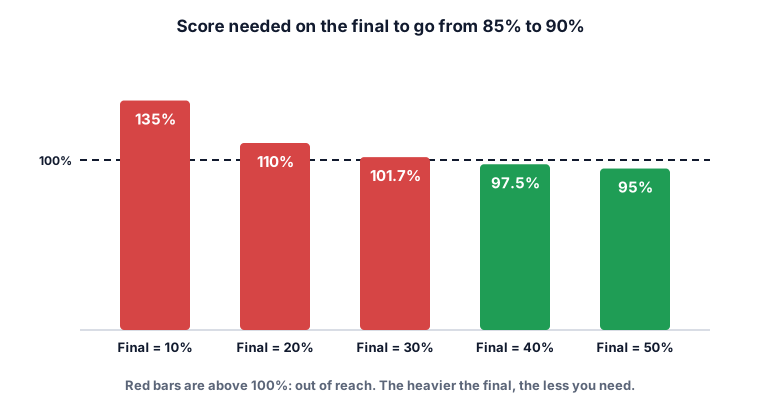
Reading the table: a light final cannot move your grade much, so a 5-point climb needs an impossible score. A heavy final has more power, so the same climb is possible.
Worked example 3: when the points are not percentages
Some courses use total points. Suppose the course is 500 points, you have earned 330 of the 400 points graded so far, and the final is worth the last 100 points. You want 80% of the course, which is 400 points.
- You need 400 − 330 = 70 points from the final.
- 70 ÷ 100 = 70% on the final.
Check with the formula. Your current grade is 330 ÷ 400 = 82.5%, and the final's weight is 100 ÷ 500 = 20%. Then F = (80 − 82.5 × 0.8) ÷ 0.2 = (80 − 66) ÷ 0.2 = 70. The shortcut is: points still needed ÷ points the final is worth.
Worked example 4: a target you cannot reach
You have 70%, the final is worth 15% and you want 85%. F = (85 − 70 × 0.85) ÷ 0.15 = (85 − 59.5) ÷ 0.15 = 25.5 ÷ 0.15 = 170%.
That is not a score you can earn. The highest course grade you can reach is 59.5 + 100 × 0.15 = 74.5%. The honest options are: aim for a lower target, ask whether extra credit or a retake exists, or put the effort into the courses where the target is still within reach. Finding this out a few weeks before the exam, not the night before, is the whole point of doing the calculation early.
Worked example 5: what will my grade be for each score?
Sometimes the target is unclear and you simply want to know what each result gives. With 82% before the final and a final worth 30%, the course grade is 82 × 0.7 + F × 0.3 = 57.4 + 0.3 × F:
| Score on the final | Course grade |
|---|---|
| 50% | 72.4% |
| 60% | 75.4% |
| 70% | 78.4% |
| 80% | 81.4% |
| 90% | 84.4% |
| 100% | 87.4% |
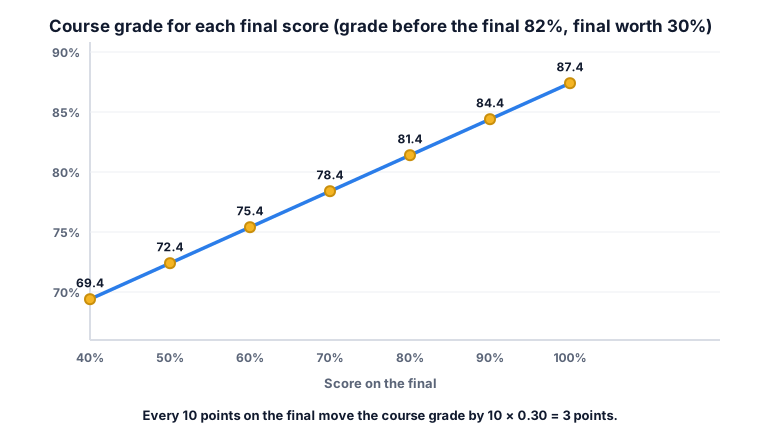
The slope is the weight: every 10 points on the final move the course grade by 10 × 0.30 = 3 points. And the best possible result here is 87.4%, so an A at 90% is out of reach in this course.
The same numbers answer the question "what do I need for each letter?" With the usual cut-offs (A 90, B 80, C 70, D 60) the score needed is (cut-off − 57.4) ÷ 0.3:
| Target | Score needed |
|---|---|
| A (90%) | 108.7% (not reachable) |
| B (80%) | 75.3% |
| C (70%) | 42% |
| D (60%) | 8.7% |
Your school's cut-offs may be different, so use the ones in your syllabus.
Finding the right numbers
- Current grade. Use the grade for the work that is finished, as a percent of the finished work, not of the whole course. If your portal shows a grade that already includes zeros for unmarked work, correct it first. If your syllabus uses categories such as homework and quizzes, work out the weighted grade first with the Weighted Grade Calculator.
- Weight of the final. It is in the syllabus. If exams are a category and the final is one of several equal exams, divide the category's weight by the number of exams. For example, an exam category of 60% with four equal tests gives each test 60 ÷ 4 = 15%.
- Target. Check your school's cut-off for the letter you want. Many schools use 90 for an A, but not all.
- Special rules. If the final replaces your lowest exam, drops the lowest quiz, or is capped, the simple formula is only an estimate. Ask your teacher.
What the ZYSNOR Final Grade Calculator does
You enter three numbers: your grade before the final (%), the weight of the final (%) and the course grade you want (%). The calculator:
- shows the score you need on the final using the formula in section 2;
- tells you when the target is already secured (the answer is 0% or below) or above 100%;
- lists the score needed for A, B, C and D, and the course grade for final scores from 100% down to 50%.
It runs in your browser and nothing is sent anywhere.
Mistakes that waste time
- Mixing percent and decimal. Using 25 for the weight in one place and 0.25 in another gives nonsense.
- Using the whole-course grade as the current grade. The formula expects your grade on the finished part of the course.
- Forgetting the final's own weight in a category. A final that is one of four exams is not worth the full exam category.
- Trusting a result without a sense check. After you compute F, plug it back in: current × (1 − w) + F × w should equal the target.
- Waiting too long. A calculation that says 100% or more is useful only if you have time to act on it.
Words you may meet
- Weighted average: an average in which each part counts for a share you choose.
- Weight: the share of the course grade that a part is worth.
- Current grade: your grade on the work finished so far.
- Target grade: the course grade you want.
- Syllabus: the course outline that states the weights and the grading scale.
- Extra credit: optional work that can add points above the normal maximum.
Check your answer in 10 seconds
- Do current × (1 − w) + F × w equal the target?
- Is F between 0 and 100? If not, the target is secured or unreachable.
- Does the weight you used match the syllabus?
- Is your current grade the grade on finished work only?
Practice problems
Problem 1. You have 78%, the final is worth 20% and you want 80%. What do you need?
Show the worked answer
F = (80 − 78 × 0.8) ÷ 0.2 = (80 − 62.4) ÷ 0.2 = 17.6 ÷ 0.2 = 88%. Check: 62.4 + 88 × 0.2 = 62.4 + 17.6 = 80.
Problem 2. You have 91% going into a final worth 15%. You score 88.6% on it. What is your final course grade?
Show the worked answer
91 × 0.85 + 88.6 × 0.15 = 77.35 + 13.29 = 90.64%.
Problem 3. The final is worth 30% and you have 95%. You want 90%. Is a score of 0 enough?
Show the worked answer
F = (90 − 95 × 0.7) ÷ 0.3 = (90 − 66.5) ÷ 0.3 = 78.3. No: you still need about 78%. Even with 95% before the final, a zero would drop you to 66.5%.
Problem 4. You have 72% before the final, the final is worth 35% and you want 80% overall. What score do you need?
Show the worked answer
F = (80 − 72 × 0.65) ÷ 0.35 = (80 − 46.8) ÷ 0.35 = 33.2 ÷ 0.35 = 94.86%. Check: 46.8 + 94.86 × 0.35 = 46.8 + 33.2 = 80. The ZYSNOR Final Grade Calculator shows 94.86% for these numbers. Note how a heavy final (35%) asks for a very high score when you start 8 points below the target.
Ready to check your own numbers? The free Final Grade Calculator does the arithmetic in your browser, and now you know exactly what it is doing.