

Glossary · Writing and literature
What is Plagiarism? Meaning, Examples and How to Avoid It
In simple words
Plagiarism is presenting someone else's words, ideas or work as your own without giving them full credit. It counts whether it is done on purpose or by accident, and whether you copy exactly or only change some words.
Plagiarism is about credit, not only copying. Using other people's work is normal in study and research; the rule is to show clearly which words and ideas came from whom, both in the text and in the reference list.
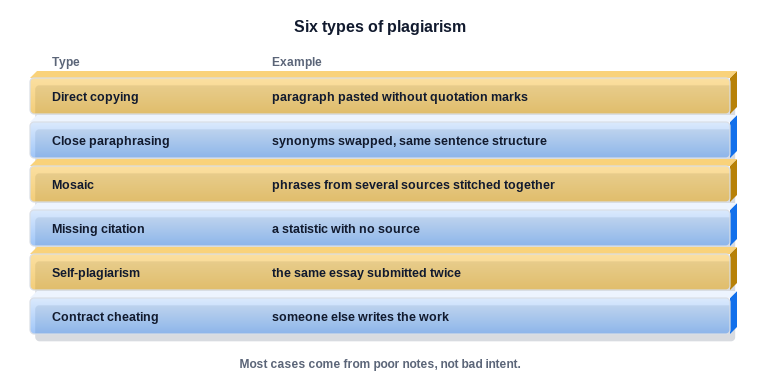
Common types of plagiarism
| Type | What happens | Example |
|---|---|---|
| Direct copying | exact words used without quotation marks and a citation | a paragraph pasted from a website |
| Close paraphrasing | source reworded sentence by sentence, with no citation | synonyms swapped, same structure |
| Mosaic (patchwriting) | phrases from several sources stitched together | one sentence from three articles |
| Missing citation | ideas or data used without saying where they came from | a statistic with no source |
| Self-plagiarism | reusing your own earlier work without saying so | the same essay handed in twice |
| Contract cheating | someone else writes the work | a paid essay submitted as your own |
Quote, paraphrase or summarise
All three need a citation in the text and an entry in the reference list:
- Quote: exact words in quotation marks, with the page number where the style asks for it.
- Paraphrase: the idea in your own words and sentence structure.
- Summarise: the main points of a longer passage, much shorter than the original.
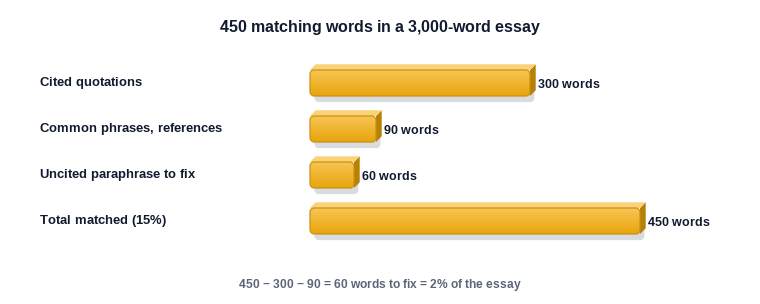
Worked example: reading a similarity report
Similarity checkers match text against other sources; the score shows matching text, not proof of plagiarism. A 3,000-word essay gets a report with 450 matching words (figures are an example).
- Similarity score: 450 ÷ 3,000 × 100 = 15%
- Of the 450 words, 300 are quotations in quotation marks with citations, and 90 are common phrases and reference-list entries.
- Words left to check: 450 − 300 − 90 = 60
- Share of the essay to fix: 60 ÷ 3,000 × 100 = 2%
Those 60 words are a close paraphrase without a citation. Rewriting them in your own words and adding the citation fixes the problem; the 15% score on its own was not the problem.
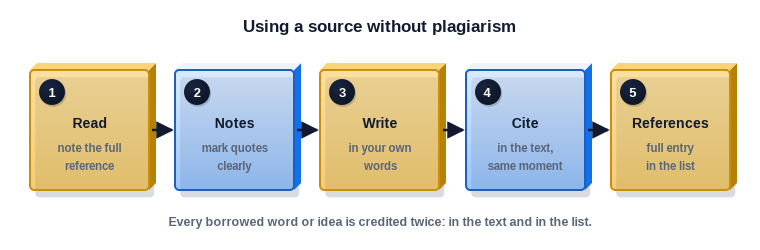
Step by step: writing without plagiarism
- Record the full reference for each source when you first read it.
- Mark quotations in your notes so you never mistake them for your own words.
- Write paraphrases with the source closed, then check them against it.
- Add the in-text citation in the same moment you write the sentence.
- Build the reference list as you go, in the style your course requires.
- Check your own work before submitting, and fix any uncited match.
Common mistakes
- Changing a few words and treating the sentence as your own.
- Citing a source in the reference list but never in the text.
- Forgetting to cite tables, images and data, not only words.
- Trusting a similarity score instead of reading what actually matched.
Related terms
Frequently asked questions
Is paraphrasing plagiarism?
Not if you cite the source; it is plagiarism if you paraphrase without credit.
Can I plagiarise my own work?
Many universities count re-using your own earlier work without citation as plagiarism.