
The syllabus says "homework 20%, quizzes 20%, midterm 25%, final 35%", your portal shows four different scores, and you want to know your grade. This guide gives you the formula, shows why a weighted grade is not the same as a plain average, and walks through worked examples, including unfinished courses, dropped scores and the most common mistakes.
What a weighted grade is
In a simple average every score counts the same. In a weighted grade each part has a share. Gradebook software works the same way: instructors set up categories, give each category a weight that matches the syllabus, and the system combines the category averages. College guides stress one point: the weights in the gradebook must match the syllabus exactly, so the first step is always the syllabus.
Weights are shares of the course, so they total 100%. If yours do not, ask your teacher before you calculate: the numbers either are incomplete or contain a mistake.
The formula
Write each weight as a decimal (35% is 0.35). Then:
- Multiply each category score by its weight. The product is the number of points that category adds to your course grade.
- Add the products.
- If some categories are not graded yet, divide the sum by the total weight that has been graded.
course grade = (score₁ × w₁ + score₂ × w₂ + …) ÷ (w₁ + w₂ + …)
When all the weights are included, they add up to 1 (100%) and the division changes nothing. The division matters only for a grade "so far".
A short history: from percentages to categories
- Early 1900s. Grading on a 100-point scale becomes common in American schools and colleges. Researchers soon find that teachers disagree widely when they give a percentage to the same paper.
- 1940s and after. Letter grades spread. They still rest on percentages underneath, with cut-offs such as 90 for an A.
- Learning-management systems. Gradebooks such as Blackboard, Moodle and Sakai let instructors group assignments into categories and weight the categories to match the syllabus.
The arithmetic behind all of it is the weighted mean: an average in which some values count more than others.
Worked example 1: weights change the answer
Four categories: homework 95% (weight 20%), quizzes 80% (20%), midterm 70% (25%) and final 60% (35%).
| Category | Score | Weight | Calculation | Points added |
|---|---|---|---|---|
| Homework | 95% | 20% | 95 × 0.20 | 19 |
| Quizzes | 80% | 20% | 80 × 0.20 | 16 |
| Midterm | 70% | 25% | 70 × 0.25 | 17.5 |
| Final | 60% | 35% | 60 × 0.35 | 21 |
| Total | 100% | 73.5 |
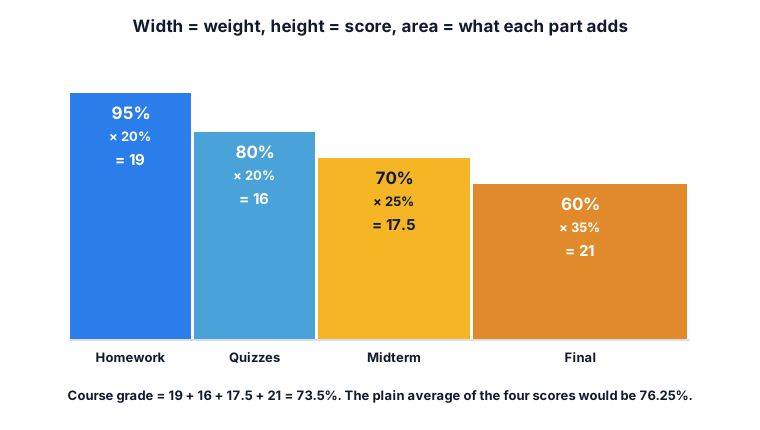
The course grade is 73.5%. The plain average of the four scores is (95 + 80 + 70 + 60) ÷ 4 = 76.25%, which is 2.75 points too high, because the weakest score has the biggest weight.
Worked example 2: what is a category's score?
A category often contains many items. Suppose homework has five assignments: 18/20, 9/10, 45/50, 8/10 and 19/20. There are two common ways to get the category score:
- Total points: (18 + 9 + 45 + 8 + 19) ÷ (20 + 10 + 50 + 10 + 20) = 99 ÷ 110 = 90%. Bigger assignments count more.
- Average of percentages: (90 + 90 + 90 + 80 + 95) ÷ 5 = 89%. Every assignment counts the same.
Both are used. The syllabus or the gradebook settings tell you which one your teacher applies. Use the category score the portal shows if it is available, and keep the rule consistent.
Worked example 3: your grade so far
Only homework (95%) and quizzes (80%) are graded, each worth 20%, so 40% of the course is done. The sum of products is 95 × 20 + 80 × 20 = 3,500, and the grade so far is the sum divided by the weight graded:
3,500 ÷ 40 = 87.5%.
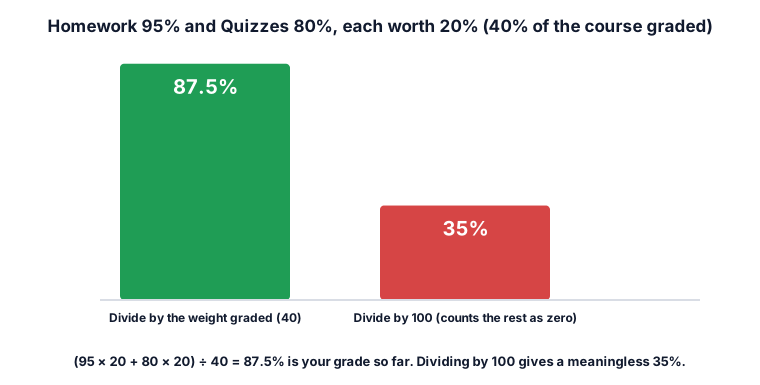
Now the target. You want 80% for the course. The finished 40% contributes 87.5 × 0.40 = 35 points, so you need 80 − 35 = 45 points from the remaining 60% of the course, which is 45 ÷ 0.60 = 75% on average. The ZYSNOR calculator gives the same answer when you enter a target.
Worked example 4: which part is worth the most effort?
Improving a category by 10 points raises the course grade by 10 × its weight. With the weights above: homework +2 points, quizzes +2, midterm +2.5 and the final +3.5.
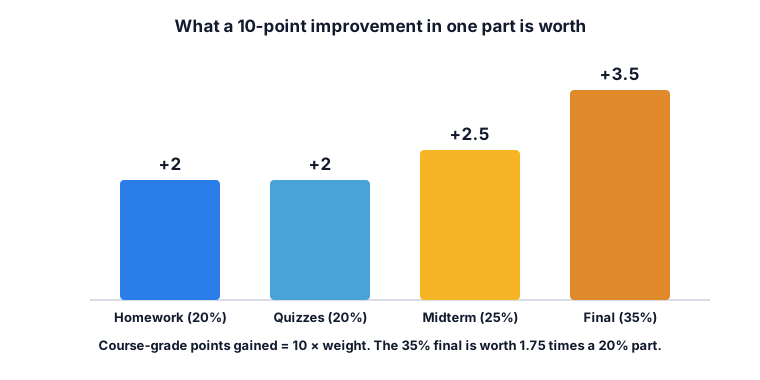
This is how to plan: time spent on the heaviest category that you can still change gives the biggest return. It does not mean you should ignore small categories, because they add up.
Worked example 5: a dropped score
Some teachers drop the lowest score in a category. Quiz scores are 70, 85, 90 and 60. Without dropping: (70 + 85 + 90 + 60) ÷ 4 = 76.25%. With the lowest (60) dropped: (70 + 85 + 90) ÷ 3 = 81.7%. If the quizzes are worth 20% of the course, the dropped score raises the course grade by (81.7 − 76.25) × 0.20 = about 1.1 points. If your syllabus allows drops, remove the lowest score from the category before applying the weight.
What the ZYSNOR Weighted Grade Calculator does
You enter pairs of score and weight (in percent) for the items you have. The calculator:
- divides the sum of score × weight by the weight you entered, so the result is your grade across the work that is graded;
- shows the points each item adds. When all weights are entered, these are the same points as in the table above (19, 16, 17.5 and 21). When only part of the weight is entered, each item is shown out of the weight entered, so the points add up to the grade so far;
- accepts weights that total 100% or less, because weights above 100% cannot be right;
- shows how much weight is still ungraded and, if you give a target, the average needed on it.
The calculator does not drop scores. If your teacher drops the lowest quiz, work out the category score without it first (example 5) and enter that category score. It runs in your browser and nothing is sent anywhere. For a target on a single final exam, our guide What grade do I need on my final exam? goes through the same idea in detail.
Mistakes that waste time
- Using the plain average. It ignores the weights and is usually wrong.
- Dividing by 100 too early. Unfinished work then counts as zero. Divide by the weight that is graded.
- Using weights that do not total 100%. Fix the list first, or check with your teacher.
- Mixing percent and points. Turn every score into a percentage first, or use points consistently inside a category.
- Forgetting extra credit or drops. Apply the syllabus rules before you weight.
Words you may meet
- Weighted average (weighted mean): an average in which each value counts according to its weight.
- Category: a group of similar items, such as homework or quizzes.
- Weight: the share of the course grade that a category is worth.
- Syllabus: the course outline that states the weights.
- Normalise: divide by the total weight so the result is out of 100.
- Gradebook: the software or sheet where scores are recorded.
Check your answer in 10 seconds
- Do the weights you used match the syllabus and total the weight you graded?
- Is each score a percentage of that category's possible points?
- Does the answer lie between your lowest and highest category scores? A weighted average always does.
- Did you apply drops and extra credit first?
Practice problems
Problem 1. Exams 75% (weight 40%), projects 90% (20%) and participation 60% (40%). What is the course grade?
Show the worked answer
75 × 0.40 + 90 × 0.20 + 60 × 0.40 = 30 + 18 + 24 = 72%.
Problem 2. Only three items are graded: 88% (weight 30%), 72% (weight 20%) and 95% (weight 10%). What is your grade so far, and what do you need on the remaining 40% to finish with 85%?
Show the worked answer
Sum of products: 88 × 30 + 72 × 20 + 95 × 10 = 2,640 + 1,440 + 950 = 5,030. Weight graded: 60. Grade so far: 5,030 ÷ 60 = 83.8%. Points earned on the whole course: 5,030 ÷ 100 = 50.3, so you need 85 − 50.3 = 34.7 points from the remaining 40%, which is 34.7 ÷ 0.40 = 86.75% on average.
Problem 3. The weights in a syllabus are 25%, 25% and 30%. What should you do?
Show the worked answer
They total 80%, not 100%. Ask your teacher what the missing 20% is (for example a final exam or participation) before you rely on any calculation.
Problem 4. Four categories: 84% (weight 30%), 76% (30%), 92% (25%) and 68% (15%). What is the course grade?
Show the worked answer
84 × 0.30 + 76 × 0.30 + 92 × 0.25 + 68 × 0.15 = 25.2 + 22.8 + 23.0 + 10.2 = 81.2%. Check: the weights total 30 + 30 + 25 + 15 = 100%. The ZYSNOR Weighted Grade Calculator gives 81.20% for the same entries.
Ready to check your own grade? The free Weighted Grade Calculator does the arithmetic, and now you know exactly what it is doing.