

 How to calculate a monthly mortgage payment in the US
A mortgage payment is more than the loan repayment. It is the loan, the property tax, the home insurance and sometimes mortgage insurance and association dues. This guide shows how to work out each part by hand, what changes it and what to check with your lender. It uses a $400,000 home with 10% down, a 6.5% rate and a 30-year term as the running example. The rate is an illustration, so use your own quote.
What a monthly mortgage payment includes
The CFPB describes an escrow account as an account set up by your mortgage lender to pay property-related expenses such as property taxes and homeowner's insurance, funded by a portion of your monthly payment. If your mortgage has no escrow account, you pay those expenses directly. A payment can therefore include up to five parts:
- Principal and interest. The repayment of the loan itself and the lender's charge for lending.
- Property tax. The yearly bill divided by 12.
- Home insurance. The CFPB says homeowner's insurance pays for losses and damage to your property, and that it is not the same as mortgage insurance.
- Mortgage insurance. The CFPB says it is typically required if your down payment is less than 20% of the price.
- HOA dues. The CFPB says a homeowners' association is typically formed to manage shared expenses such as landscaping and maintenance in a planned community.
Loan amount and down payment
The loan amount is the home price minus your down payment. On a $400,000 home with $40,000 down (10%), you borrow $360,000. A larger down payment means a smaller loan, a smaller payment and, once it reaches 20%, no PMI in this calculator.
The principal and interest formula
For a fixed-rate loan the monthly principal and interest payment is:
P = L × i ÷ (1 − (1 + i)−n)
- L is the loan amount.
- i is the monthly interest rate, the yearly rate divided by 12.
- n is the number of monthly payments, the term in years times 12.
Example: L = $360,000 and a yearly rate of 6.5% gives i = 0.065 ÷ 12 = 0.0054167, and 30 years gives n = 360. Then (1 + i)−360 = 0.14302, so P = 360,000 × 0.0054167 ÷ (1 − 0.14302), which is $2,275.44 a month with the exact rate (the rounded figures shown here differ by a cent or so).
Where the first payment goes
In the first month the interest is the balance times the monthly rate: $360,000 × 0.065 ÷ 12 = $1,950.00. The rest of the payment, $2,275.44 − $1,950.00 = $325.44, reduces the loan. Interest is charged on a slightly smaller balance each month, so more of the same payment goes to the loan over time. Over 360 payments the interest adds up to $459,164.00.
Adding tax, insurance, HOA dues and PMI
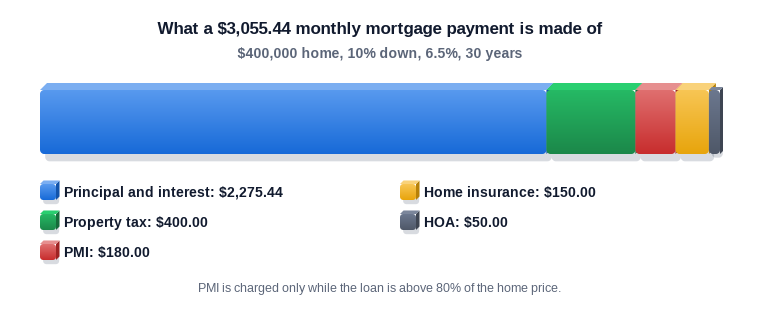
The CFPB's home loan toolkit suggests that if you know the yearly amount of property tax, you divide it by 12 to get the monthly amount, and that the local assessor's or auditor's office can help you estimate property taxes for your area. Home insurance works the same way, and an insurance agent can give you an estimate. In the example, $4,800 of yearly tax is $400.00 a month and $1,800 of yearly insurance is $150.00 a month, with $50.00 of HOA dues.
PMI is charged here as the loan times a yearly PMI rate divided by 12. At an example rate of 0.6%, that is $360,000 × 0.006 ÷ 12 = $180.00 a month. Adding all five parts gives the total payment:
$2,275.44 + $400.00 + $150.00 + $50.00 + $180.00 = $3,055.44 a month.
When PMI can end
The CFPB says you can ask your servicer, in writing, to cancel PMI when your principal balance reaches 80% of the home's original value, or earlier if extra payments get you there. The servicer must grant the request if you have a good payment history and are current, you certify there are no junior liens such as a second mortgage, and you can show, typically with an appraisal, that the home's value has not dropped below its original value.
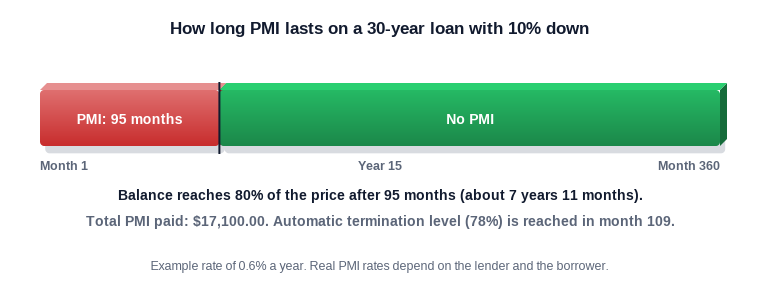
The CFPB also says servicers must automatically end PMI when the balance is scheduled to reach 78% of the original value, if you are current, and that PMI must end the month after the midpoint of the amortization schedule, such as year 15 of a 30-year loan. These rules cover single-family principal residence mortgages closed on or after July 29, 1999, and the CFPB notes that FHA and VA loans have different requirements.
In the example, the balance reaches 80% of $400,000, which is $320,000, after 95 months (7 years 11 months). You pay PMI for 95 months, a total of $17,100.00, and the payment then drops to $2,875.44. The 78% level is reached in month 109.
How the down payment changes the payment
The table uses the same 6.5% rate and the same example 0.6% PMI rate for each down payment so the comparison is simple. Real PMI rates are usually higher for smaller down payments and depend on the lender and the borrower.
| Down payment | Loan | Principal and interest | PMI a month | PMI lasts | Total a month at first |
|---|---|---|---|---|---|
| 5% ($20,000) | $380,000 | $2,401.86 | $190.00 | 10 years 4 months | $3,191.86 |
| 10% ($40,000) | $360,000 | $2,275.44 | $180.00 | 7 years 11 months | $3,055.44 |
| 20% ($80,000) | $320,000 | $2,022.62 | None | None | $2,622.62 |
How the term changes the cost
A shorter term means a higher payment but far less interest, because the balance falls faster. For a $360,000 loan at 6.5%:
| Term | Principal and interest | Total interest |
|---|---|---|
| 15 years | $3,135.99 | $204,477.16 |
| 20 years | $2,684.06 | $284,176.24 |
| 30 years | $2,275.44 | $459,164.00 |
Going from 30 to 15 years raises the payment by $860.55 a month but cuts the interest by $254,686.84.
How the interest rate changes the cost
Small rate changes add up over 30 years. For a $360,000 loan over 30 years:
| Interest rate | Principal and interest | Total interest |
|---|---|---|
| 5.5% | $2,044.04 | $375,854.82 |
| 6% | $2,158.38 | $417,018.84 |
| 6.5% | $2,275.44 | $459,164.00 |
| 7% | $2,395.09 | $502,231.12 |
| 7.5% | $2,517.17 | $546,183.89 |
Extra payments
An extra amount each month goes straight against the balance, so less interest is charged, the loan ends sooner and PMI can end earlier. The CFPB's toolkit says prepayment reduces your overall cost of borrowing and might allow you to cancel PMI early. The CFPB also says a prepayment penalty typically applies only if you pay off the whole balance within a set number of years, usually three or five, and that such penalties do not normally apply to small extra principal payments, but it is always a good idea to check with the lender.
| Extra payment | Paid off in | Total interest | Interest saved | PMI lasts |
|---|---|---|---|---|
| None | 30 years | $459,164.00 | $0.00 | 7 years 11 months |
| $100 a month | 26 years 7 months | $396,254.25 | $62,909.75 | 6 years 5 months |
| $200 a month | 23 years 11 months | $350,245.25 | $108,918.75 | 5 years 4 months |
| $500 a month | 18 years 9 months | $263,030.53 | $196,133.47 | 3 years 8 months |
What your lender gives you
A calculator is not a quote. The CFPB says your lender must send you a Loan Estimate within three business days of receiving your application, and a Closing Disclosure at least three business days before closing. The Closing Disclosure includes the loan terms, your projected monthly payments and your closing costs, and the three days give you time to compare it with the Loan Estimate. Those forms, not a calculator, give the exact figures.
What this guide does not cover
The calculator assumes one fixed rate for the whole term. It does not include closing costs, points, FHA, VA or USDA mortgage insurance, adjustable rates, interest-only loans or yearly changes in tax and insurance bills. Use a lender's quote to compare real offers.