

 How to calculate stamp duty (SDLT) in England and Northern Ireland
Stamp duty is usually the biggest one-off tax when you buy a home, and it is easy to get wrong because the rate changes with the price, with who you are and with what else you own. This guide shows how to work it out step by step for England and Northern Ireland, using the rates that apply from 1 April 2025. Scotland and Wales do not use SDLT.
What Stamp Duty Land Tax is
SDLT is a tax on buying property or land in England and Northern Ireland. The buyer pays it. The SDLT return is due within 14 days of the effective date, which is usually completion, and the tax is paid once the return is sent. Your solicitor or conveyancer normally files it for you.
The slice method
SDLT is not one rate on the whole price. GOV.UK sets bands, and only the part of the price inside a band pays that band's rate. This is the same idea as income tax bands, so a slightly higher price never makes the whole price jump to a higher rate (with one exception, below). For a single property, where the property you buy will be the only residential property you own:
| Slice of the price | Rate |
|---|---|
| Up to £125,000 | 0% |
| £125,001 to £250,000 | 2% |
| £250,001 to £925,000 | 5% |
| £925,001 to £1.5 million | 10% |
| Above £1.5 million | 12% |
GOV.UK's own example is a house bought for £295,000: 0% on the first £125,000 is £0, 2% on the next £125,000 is £2,500, and 5% on the last £45,000 is £2,250, so the tax is £4,750.
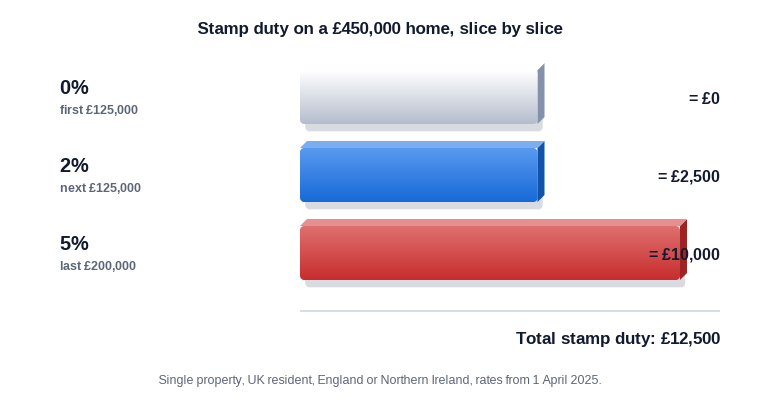
Example: a £450,000 home pays nothing on the first £125,000, 2% of the next £125,000 (£2,500) and 5% of the last £200,000 (£10,000). The total is £12,500, an effective rate of 2.78% of the price.
Rounding
The HMRC Stamp Duty Land Tax Manual says the amount calculated is rounded down to the nearest pound. If the slices add up to £2,500.05, the SDLT is £2,500.
First-time buyers
If you and anyone you buy with are first-time buyers, you can claim First-Time Buyers' Relief when both of these are true: you intend to live in the property as your main home, and the price is no more than £500,000. You then pay:
- 0% on the first £300,000
- 5% on the part from £300,001 to £500,000
A first-time buyer who pays £450,000 owes 5% of £150,000, which is £7,500, compared with £12,500 for someone who is not. At exactly £500,000 the tax is £10,000.
The £500,000 cliff
If the price is more than £500,000, you cannot claim the relief, and you pay the standard rates on the whole price. That creates a jump:
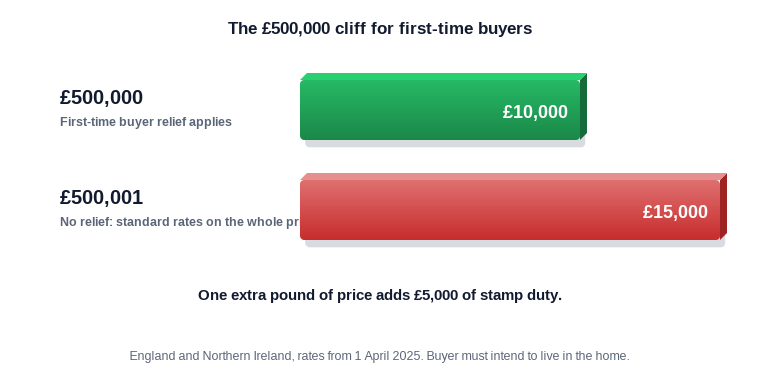
At £500,000 the standard-rate tax is £15,000 (£2,500 plus 5% of £250,000), and the relief lowers it to £10,000. One pound more takes the relief away completely, so the tax is £15,000. If a price negotiation lands just above £500,000, that is worth knowing.
To claim the relief, enter relief code 32 on the SDLT return. GOV.UK advises filing a return to claim relief even if no tax is due.
Second homes and buy-to-let
GOV.UK says you must pay the higher rates when you buy a residential property, or part of one, for £40,000 or more if all of these apply:
- it will not be the only residential property worth £40,000 or more that you own, or part own, anywhere in the world
- you have not sold or given away your previous main home
- no one else has a lease on it with more than 21 years left to run
The higher rates add 5 percentage points to every slice, including the slice that is normally zero:
| Slice of the price | Standard | Additional property |
|---|---|---|
| Up to £125,000 | 0% | 5% |
| £125,001 to £250,000 | 2% | 7% |
| £250,001 to £925,000 | 5% | 10% |
| £925,001 to £1.5 million | 10% | 15% |
| Above £1.5 million | 12% | 17% |
GOV.UK's example is a £300,000 property: 5% of £125,000 is £6,250, 7% of the next £125,000 is £8,750 and 10% of the final £50,000 is £5,000, so the tax is £20,000. The same price for a single home is £5,000.
Who counts, and what does not
- Married couples and civil partners are treated as buying together, even if only one of them is buying. If either would pay the higher rates, the whole purchase does.
- With joint buyers, if any one of them pays the higher rates, the whole purchase does.
- Property held on behalf of children under 18 counts, and so does property you hold an interest in as a trust beneficiary.
- Property worth less than £40,000, and mixed-use property such as a shop with a flat above, are not counted. A moveable home such as a caravan or houseboat is not counted either, unless it has become a permanent fixture.
Replacing your main home
If you buy a new main home before you sell the old one, you pay the higher rates at first. GOV.UK says that if you sell or give away your previous main home within 3 years of buying the new one, you can claim back the higher-rate part. There is no refund if you or your spouse still own any part of the previous home.
Companies and other non-natural persons that buy a home costing more than £500,000 can instead pay 17% on the whole price. The ZYSNOR calculator does not cover this case.
The non-UK resident surcharge
Since 1 April 2021, buyers who are not UK resident pay 2 percentage points more on every slice of a residential purchase in England or Northern Ireland, whether or not they will live in the property. It applies to purchases of £40,000 or more. The surcharge stacks on top of all other residential rates: the standard rates, first-time buyer relief and the higher rates for additional dwellings.
- An individual is non-UK resident if they were not in the UK for at least 183 days in the 12 months before the purchase.
- With joint buyers, if any one buyer is non-UK resident, all buyers are treated as non-UK resident.
- If one of a married couple or civil partners is UK resident, both are treated as UK resident, unless they are separated.
Example: a non-UK resident buys a single £300,000 home. The slices are 2% of £125,000 (£2,500), 4% of the next £125,000 (£5,000) and 7% of the last £50,000 (£3,500). The tax is £11,000, against £5,000 for a UK resident. With both the higher rates and the surcharge the same price costs £26,000.
Tax at common prices
| Price | Only home | First-time buyer | Additional property |
|---|---|---|---|
| £150,000 | £500 | £0 | £8,000 |
| £250,000 | £2,500 | £0 | £15,000 |
| £300,000 | £5,000 | £0 | £20,000 |
| £450,000 | £12,500 | £7,500 | £35,000 |
| £500,000 | £15,000 | £10,000 | £40,000 |
| £600,000 | £20,000 | £20,000 | £50,000 |
| £925,000 | £36,250 | £36,250 | £82,500 |
| £1,500,000 | £93,750 | £93,750 | £168,750 |
First-time buyer figures at £600,000 and above equal the only-home figures, because the relief is lost above £500,000.
What has changed recently
- The temporary zero-rate band of £250,000 ended on 31 March 2025, and the zero-rate band went back to £125,000 on 1 April 2025.
- The first-time buyer limits also went back, to £300,000 for the zero rate and £500,000 for the maximum price.
- The higher rate for additional dwellings rose from 3% to 5% on 31 October 2024.
The rates annex published with Budget 2026 still lists the same residential rates from 1 April 2025. Rates can change at any Budget, so check GOV.UK before you rely on a figure for a purchase.
What this guide does not cover
Leasehold rent, shared ownership, mixed-use and non-residential property, linked purchases, trusts and companies each have their own rules. For those, ask a solicitor or check GOV.UK. Treat the calculator as an estimate and confirm the exact amount with your solicitor before completion.