

Your salary and your payslip are two different numbers. This guide shows, step by step, how to get from one to the other for the 2026/27 tax year (6 April 2026 to 5 April 2027), with the official figures and worked examples. It applies to England, Wales and Northern Ireland.
Start with gross pay
Gross pay is your pay before anything is taken out. For a salary, use the yearly amount. For hourly work, multiply the hourly rate by the hours you work each week and by 52 weeks. At £15 an hour and 37.5 hours a week, gross pay is £15 × 37.5 × 52 = £29,250 a year.
Then divide by the number of pay periods in the year. Monthly pay has 12 and weekly pay has 52. A £50,000 salary is £4,166.67 a month or £961.54 a week.
Take off your pension
Workplace pensions use one of three ways to take your contribution. The method changes which taxes it lowers, so it is worth knowing which one you have.
- Net pay arrangement. GOV.UK says your employer takes workplace pension contributions out of your pay before deducting Income Tax. HMRC adds that this is before tax but not before National Insurance, so only income tax goes down.
- Relief at source. Your contribution comes out of pay after tax, and the pension provider claims 20% tax relief for you. This calculator does not model it.
- Salary sacrifice. You agree to a lower salary and the employer pays the difference into your pension. HMRC guidance for employers says employees may pay, or be treated as paying, less National Insurance, because the lower salary is what both taxes are worked out on.
Work out income tax
Most people have the standard tax code 1257L, which gives the full Personal Allowance of £12,570. Welsh taxpayers have a C at the start of the code (C1257L). LITRG says the rates for Wales are the same as the rest of the UK, excluding Scotland, in 2026/27, so the amount of tax is the same.
Pay up to the Personal Allowance is tax free. The rest is charged in bands:
| Band | Rate | Income (with the full Personal Allowance) |
|---|---|---|
| Personal Allowance | 0% | Up to £12,570 |
| Basic rate | 20% | £12,571 to £50,270 |
| Higher rate | 40% | £50,271 to £125,140 |
| Additional rate | 45% | Over £125,140 |
The bands are really counted on taxable pay, the pay left after the allowance: 20% on the first £37,700, 40% up to £125,140 and 45% above. The table shows the same bands as income for someone with the full allowance.
Above £100,000 the allowance shrinks
GOV.UK says the Personal Allowance goes down by £1 for every £2 of income above £100,000, and it is zero at £125,140. Each £2 earned in that range adds £1 of taxable pay, so the effective rate on that slice is 60%, before National Insurance.
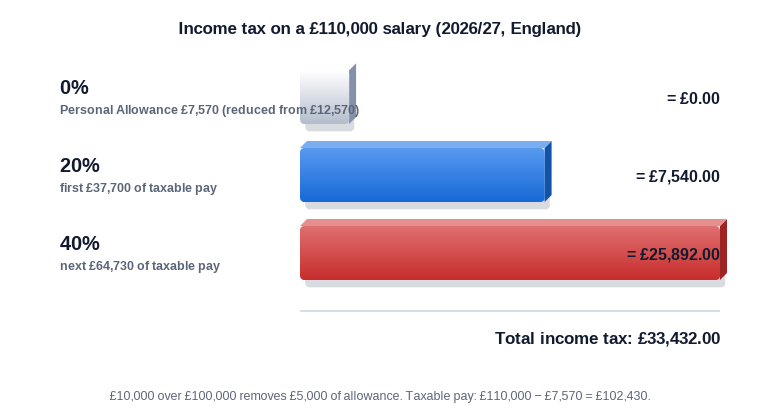
Example: at £110,000 the allowance falls by £5,000 to £7,570, so taxable pay is £110,000 − £7,570 = £102,430. Tax is 20% of £37,700 (£7,540) plus 40% of £64,730 (£25,892), a total of £33,432.
Work out National Insurance
Employee National Insurance is charged on each pay period, not on the year. The rate is 8% on pay between the primary threshold and the upper earnings limit, and 2% on pay above it.
| Pay period | Nothing up to | 8% between | 2% above |
|---|---|---|---|
| Weekly | £242 | £242 and £967 | £967 |
| Monthly | £1,048 | £1,048 and £4,189 | £4,189 |
| Yearly | £12,570 | £12,570 and £50,270 | £50,270 |
Because it is worked out per period, one big month can cost more National Insurance than a smooth year of the same total pay.
Subtract student loan repayments
Your employer works it out on the same pay that National Insurance is charged on, which GOV.UK describes as the gross pay used for employer National Insurance. It takes 9% of pay above the threshold for your plan, or 6% above the threshold for a Postgraduate Loan. If you have both an undergraduate plan and a Postgraduate Loan, both are taken. GOV.UK's example shows the rounding: on £2,750 a month with Plan 1, 9% of £509 is £45.81, and the repayment is £45.
| Plan | Weekly | Monthly | Yearly | Rate |
|---|---|---|---|---|
| Plan 1 | £517 | £2,241 | £26,900 | 9% |
| Plan 2 | £565 | £2,448 | £29,385 | 9% |
| Plan 4 | £649 | £2,816 | £33,795 | 9% |
| Plan 5 | £480 | £2,083 | £25,000 | 9% |
| Postgraduate Loan | £403 | £1,750 | £21,000 | 6% |
Other deductions and Scotland
Amounts such as a union fee or a charity donation come off last and lower no tax. Scotland has different income tax bands and rates, so this guide and the calculator do not apply to Scottish taxpayers.
Worked example: £50,000, paid monthly
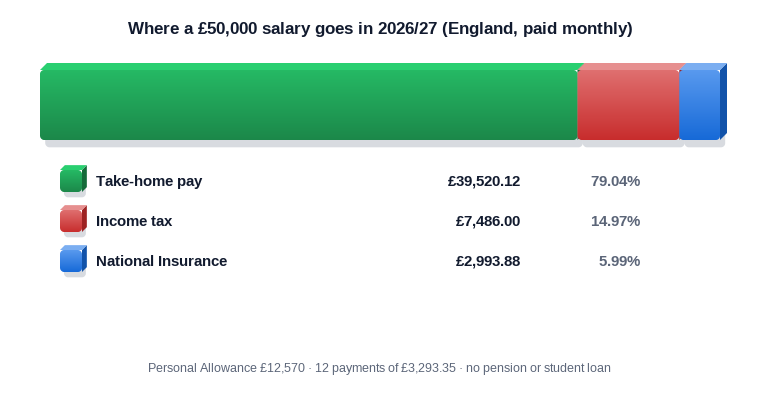
| Line | A year | A month |
|---|---|---|
| Gross pay | £50,000.00 | £4,166.67 |
| Income tax | £7,486.00 | £623.83 |
| National Insurance | £2,993.88 | £249.49 |
| Take-home pay | £39,520.12 | £3,293.35 |
Monthly amounts are rounded to the penny, so twelve of them can differ from the yearly figure by a few pence.
Income tax: £50,000 − £12,570 = £37,430 taxable, and 20% of £37,430 is £7,486. National Insurance each month: 8% of (£4,166.67 − £1,048) = £249.49, which is £2,993.88 over 12 months.
The same salary with a pension and a Plan 2 loan
Now the worker pays 5% into a pension (£208.33 a month) and has a Plan 2 student loan. The two pension types give different results:
| Line | Net pay arrangement a month | Salary sacrifice a month |
|---|---|---|
| Pension | £208.33 | £208.33 |
| Income tax | £582.17 | £582.17 |
| National Insurance | £249.49 | £232.83 |
| Student loan | £154.00 | £135.00 |
| Take-home pay | £2,972.68 | £3,008.34 |
- Income tax is on £47,500 in both cases: £47,500 − £12,570 = £34,930, and 20% is £6,986 a year, £582.17 a month.
- With a net pay arrangement, National Insurance and the student loan are still worked out on the full £4,166.67. The loan is 9% of (£4,166.67 − £2,448) = £154.68, paid as £154.
- With salary sacrifice, they are worked out on £3,958.34. National Insurance is £232.83 and the loan is 9% of £1,510.34 = £135.93, paid as £135.
- Salary sacrifice leaves £35.66 more a month here, but it also lowers the pay that some benefits are based on, so ask your employer before you rely on it.
Why your real payslip can differ
- Your tax code may not be the standard one, for example because of a company car, unpaid tax or a second job.
- Bonuses and overtime raise pay in one period, and National Insurance and student loan are worked out on each period's pay.
- Pensions with relief at source, Marriage Allowance and other deductions change the result.
Use the estimate to plan a budget or compare job offers, and check your payslip for the exact amounts.