

 How to calculate take-home pay in the US (2026 and 2027)
Your salary and your paycheck are two different numbers. This guide shows, step by step, how to get from one to the other for tax years 2026 and 2027, with the official figures and a full worked example.
Start with gross pay
Gross pay is your pay before anything is taken out. For a salary, use the yearly amount. For hourly work, multiply the hourly rate by the hours you work each week and by 52 weeks. At $25 an hour and 40 hours a week, gross pay is $25 × 40 × 52 = $52,000 a year.
Then divide by the number of paychecks in the year:
| Pay schedule | Paychecks a year | $75,000 gross per paycheck |
|---|---|---|
| Weekly | 52 | $1,442.31 |
| Every two weeks (biweekly) | 26 | $2,884.62 |
| Twice a month (semimonthly) | 24 | $3,125.00 |
| Monthly | 12 | $6,250.00 |
Subtract pre-tax deductions
Some deductions come out before tax, and they do not all lower the same taxes:
- Traditional 401(k). Lowers the pay that federal income tax is charged on. The IRS says these deferrals are still wages for Social Security and Medicare, so those two taxes do not go down.
- Health insurance, HSA and FSA through a cafeteria plan. The IRS says qualified cafeteria plan benefits are generally not subject to income tax withholding, Social Security or Medicare, so they lower all three.
Whether these amounts also lower your state tax depends on the state.
Work out federal income tax
From pay after pre-tax deductions, subtract the standard deduction. What is left is taxable income, and it is taxed in slices: each rate applies only to the part of income inside its bracket.
| Filing status | 2026 | 2027 |
|---|---|---|
| Single | $16,100 | $16,600 |
| Married filing jointly | $32,200 | $33,200 |
| Head of household | $24,150 | $24,925 |
| Rate | Single 2026 | Single 2027 | Married filing jointly 2026 | Married filing jointly 2027 |
|---|---|---|---|---|
| 10% | $0 | $0 | $0 | $0 |
| 12% | $12,400 | $12,800 | $24,800 | $25,600 |
| 22% | $50,400 | $52,025 | $100,800 | $104,050 |
| 24% | $105,700 | $109,125 | $211,400 | $218,250 |
| 32% | $201,775 | $208,325 | $403,550 | $416,650 |
| 35% | $256,225 | $264,550 | $512,450 | $529,100 |
| 37% | $640,600 | $661,375 | $768,700 | $793,650 |
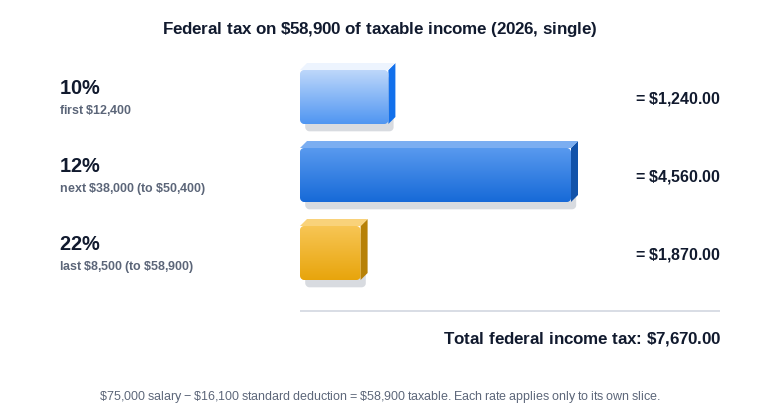
A common mistake is to apply the top rate to all income. A single worker with $58,900 of taxable income in 2026 is in the 22% bracket, but the tax is $7,670, which is 13.0% of taxable income, not 22%.
Work out Social Security and Medicare
- Social Security: 6.2% of pay up to the wage base, $184,500 in 2026 and $192,300 in 2027. Pay above the wage base has no Social Security tax.
- Medicare: 1.45% of all pay, with no limit.
- Additional Medicare Tax: 0.9% more. Employers withhold it on pay above $200,000 in a year, whatever your filing status. On your tax return the threshold is $250,000 for married filing jointly, $125,000 for married filing separately and $200,000 for everyone else, so the final amount can differ from what was withheld.
Subtract state and local tax
State income tax rules differ a lot. Some states tax wages at one flat rate, some use brackets like the federal system, and some do not tax wages at all. Some cities and counties add their own tax. For a quick estimate, use your state's rate as a percentage of pay; for an exact figure, use your state's own tax tables.
Subtract after-tax deductions
Deductions taken after tax, such as Roth 401(k) contributions or union dues, come off last. They do not lower any tax.
Worked example: $75,000, single, paid every two weeks
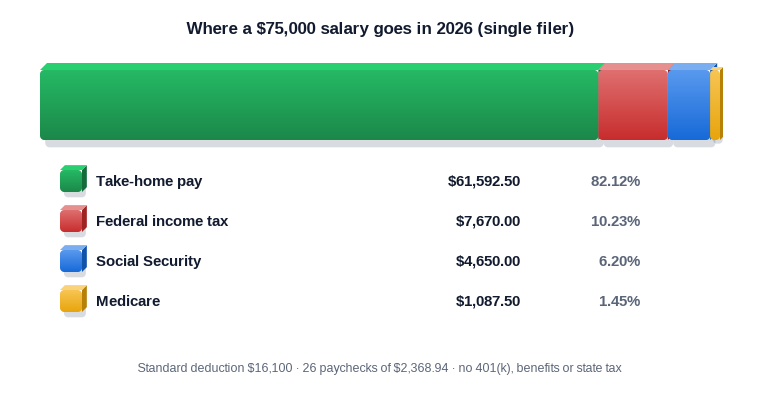
| Line | 2026 a year | 2026 per paycheck (26) | 2027 a year | 2027 per paycheck (26) |
|---|---|---|---|---|
| Gross pay | $75,000.00 | $2,884.62 | $75,000.00 | $2,884.62 |
| Taxable income | $58,900.00 | – | $58,400.00 | – |
| Federal income tax | $7,670.00 | $295.00 | $7,389.50 | $284.21 |
| Social Security | $4,650.00 | $178.85 | $4,650.00 | $178.85 |
| Medicare | $1,087.50 | $41.83 | $1,087.50 | $41.83 |
| Take-home pay | $61,592.50 | $2,368.94 | $61,873.00 | $2,379.73 |
2027 federal tax: $75,000 − $16,600 = $58,400 taxable. 10% of $12,800 is $1,280, 12% of $39,225 is $4,707 and 22% of $6,375 is $1,402.50, a total of $7,389.50. The higher standard deduction and brackets raise take-home pay by $280.50 a year.
The same salary with a 401(k) and health insurance
Now the worker puts 6% of pay into a traditional 401(k) ($4,500 a year) and pays $80 per paycheck for health insurance through a cafeteria plan ($2,080 a year), in 2026:
- Taxable income: $75,000 − $4,500 − $2,080 − $16,100 = $52,320. Federal tax: $1,240 + $4,560 + 22% of $1,920 ($422.40) = $6,222.40.
- Social Security and Medicare wages: $75,000 − $2,080 = $72,920, because the 401(k) does not lower them. Social Security: $4,521.04. Medicare: $1,057.34.
- Take-home pay: $75,000 − $4,500 − $2,080 − $6,222.40 − $4,521.04 − $1,057.34 = $56,619.22 a year, or $2,177.66 per paycheck.
Take-home pay falls by $4,973.28, but $4,500 of that is now in the 401(k): the deductions cost less than they look because they also cut the tax.
Why your real paycheck can differ
- Your employer withholds federal tax from the choices on your Form W-4, not from your final tax bill, so withholding can be a little higher or lower than the yearly tax.
- Tax credits, such as the child tax credit, and deductions such as those for overtime and tips lower your final tax but are not in a simple estimate.
- Bonuses can be withheld at a different rate from regular pay.
- State payroll taxes, local taxes and other employer deductions vary by place and employer.
Use the estimate to plan a budget or compare job offers, and check your pay stub for the exact amounts.