

 How to calculate UK mortgage payments and interest
A monthly mortgage payment is the biggest bill most households have, and it is easy to see what it is made of once you know three things: how much you borrow, the interest rate and the term. This guide shows how to work out the payment by hand, what changes it, and what a lender checks. It uses a £200,000 loan at 5% over 25 years as the running example.
What a mortgage payment is made of
MoneyHelper says a mortgage has two parts: the capital, which is the money you borrow, and the interest, which is the lender's charge on the amount you owe. With a repayment mortgage you pay back both together over an agreed term, so the amount you owe gets smaller every month as long as you keep up the payments. With an interest-only mortgage you pay only the interest each month and repay the capital at the end of the term.
Amount borrowed and loan to value
The amount borrowed is the property price minus your deposit. Loan to value, or LTV, compares that loan with the value of the property. MoneyHelper's example is a £250,000 home with a £25,000 deposit (10%): you borrow £225,000, so the LTV is 90%.
LTV matters because deals are priced on it. MoneyHelper says most deals need a deposit of at least 5% of the property's value, and that the cheapest deals are typically for deposits of at least 40%. To work out your LTV, divide the loan by the property value and multiply by 100.
The repayment formula
For a repayment mortgage with a fixed rate, the monthly payment is:
P = L × i ÷ (1 − (1 + i)−n)
- L is the amount you borrow.
- i is the monthly interest rate, the yearly rate divided by 12.
- n is the number of monthly payments, the term in years times 12.
Example: L = £200,000, a yearly rate of 5% gives i = 0.05 ÷ 12 = 0.0041667, and 25 years gives n = 300. Then (1 + i)−300 = 0.28725, so P = 200,000 × 0.0041667 ÷ (1 − 0.28725) = £1,169.18 a month.
Where the first payment goes
In the first month the interest is the whole balance times the monthly rate: £200,000 × 0.0041667 = £833.33. The rest of the payment, £1,169.18 − £833.33 = £335.85, reduces the loan. Next month the balance is £199,664.15, so the interest is a little lower and a little more goes towards the loan. That is why early payments are mostly interest and late payments mostly loan.
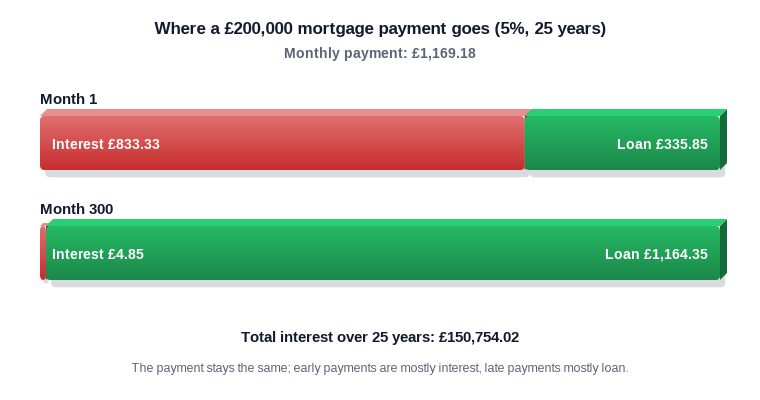
Over all 300 payments you pay £350,754.02, which is the £200,000 loan plus £150,754.02 of interest. After 5 years you have paid £70,150.80, of which £47,311.17 is interest, and you still owe £177,160.37.
Interest-only
With an interest-only mortgage the payment is just the balance times the monthly rate. On £200,000 at 5% that is £833.33 a month for the whole term, and you still owe £200,000 at the end. MoneyHelper says you use savings, investments or other assets to repay the capital, so it is important to have a plan for that. The monthly payment is lower than a repayment mortgage, but the total owed never falls.
How the term changes the cost
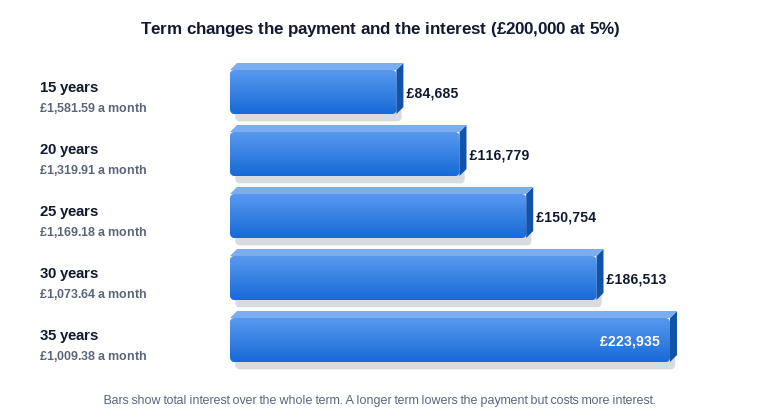
MoneyHelper says a mortgage can last anywhere between 2 and 40 years. A longer term spreads the loan over more payments, so each one is smaller, but you pay interest for longer. For £200,000 at 5%:
| Term | Monthly payment | Total interest |
|---|---|---|
| 15 years | £1,581.59 | £84,685.48 |
| 20 years | £1,319.91 | £116,778.95 |
| 25 years | £1,169.18 | £150,754.02 |
| 30 years | £1,073.64 | £186,513.24 |
| 35 years | £1,009.38 | £223,934.56 |
How the interest rate changes the cost
The rate has a similar effect. For £200,000 over 25 years:
| Interest rate | Monthly payment | Total interest |
|---|---|---|
| 3% | £948.42 | £84,527.18 |
| 4% | £1,055.67 | £116,703.00 |
| 5% | £1,169.18 | £150,754.02 |
| 6% | £1,288.60 | £186,582.07 |
| 7% | £1,413.56 | £224,066.89 |
MoneyHelper says that if your mortgage interest rate changes, so will your repayments. On a fixed rate the rate stays the same for the fixed term, so check what the payment will be when the deal ends.
Overpaying
MoneyHelper says many lenders let you overpay up to 10% a year without penalties, but you could be charged for paying more than your limit or for paying the mortgage off early. Check your deal for early repayment charges before you overpay. Overpaying means you pay less interest and clear the mortgage sooner. Every extra pound goes against the loan, so it saves the interest that pound would have been charged for the rest of the term.
| Overpayment | Paid off in | Total interest | Interest saved |
|---|---|---|---|
| No overpayment | 25 years | £150,754.02 | £0.00 |
| £100 a month extra | 21 years 6 months | £126,248.62 | £24,505.40 |
| £200 a month extra | 18 years 10 months | £108,911.46 | £41,842.56 |
An extra £200 a month is £2,400 a year, which is 1.2% of the original loan and well inside a 10% limit.
What lenders check
A payment on a calculator is not an offer. The FCA says lenders must check you can afford the repayments, and its rules require them to take account of the impact of likely future interest rate increases on affordability for at least 5 years. This is often called a stress test, and each lender sets its own approach within the rule. If your costs have gone up, it might reduce the amount a lender is prepared to lend.
When a lender makes an offer, MoneyHelper says the mortgage illustration document shows the frequency and number of payments, the up-front fees, the overall cost including interest over the full term and what happens if interest rates rise. That document, not a calculator, gives the exact figures.
What this guide does not cover
The calculator assumes one fixed rate for the whole term and equal monthly payments. It does not include fees, stamp duty, insurance, payment holidays, a rate that changes after a deal ends, or part-and-part mortgages. Use the ZYSNOR UK Stamp Duty Calculator for the tax on buying a home in England or Northern Ireland.