

You see 1447 on a document, or you need the date of Eid in your own calendar, and the two calendars do not line up. This guide explains how the Hijri calendar works, why the dates move, what the Umm al-Qura calendar is and where a converter's answer can differ from the day a country announces.
How the Hijri calendar works
The Hijri (Islamic) calendar is a lunar calendar of 12 months. Each month is 29 or 30 days, so a year has 354 or 355 days. The Gregorian year has 365 or 366 days, so the Hijri year is about 11 days shorter. Years are counted from the Hijra, the migration of the Prophet Muhammad from Makkah to Madinah, in 622 CE. Years are written with AH, for the Latin anno Hegirae.
The months in order are Muharram, Safar, Rabi al-Awwal, Rabi al-Thani, Jumada al-Awwal, Jumada al-Akhirah, Rajab, Sha'ban, Ramadan, Shawwal, Dhu al-Qa'dah and Dhu al-Hijjah. Spellings differ between sources; the ZYSNOR converter prints the English names above and the Arabic names.
Traditionally the Islamic day starts at sunset, not at midnight. A converter works with calendar days from midnight, so the evening before a date can already be the new Hijri day for a person who follows the traditional day.
Why the dates move every year
A Hijri year is 10 to 12 days shorter than a Gregorian year, so a Hijri date falls earlier in the Gregorian calendar each year. Over about 33 years it passes through every season.
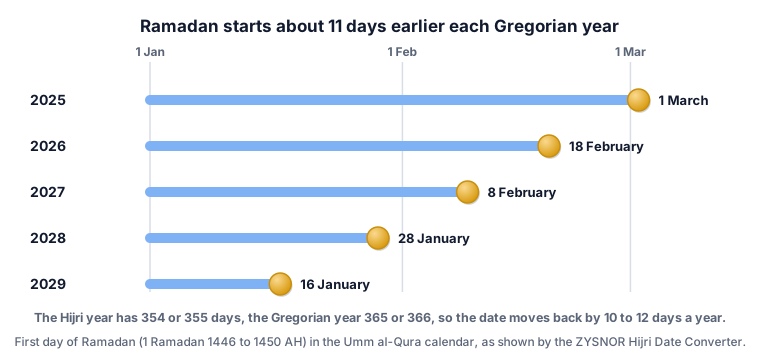
This is why Ramadan was in March in 2025 and in February in 2026, and why the converter must be used again for every year. There is no fixed number of days to add or subtract.
Why there is no simple formula
A month starts when a new crescent moon appears, and the real moon cycle is about 29.5 days. The calendar therefore needs a rule for which months have 29 days and which have 30. Different calendars use different rules, so the same day can have two Hijri dates. A converter has to pick one calendar and use its table of month starts.
The Umm al-Qura calendar
The Umm al-Qura calendar is the calendar the Saudi government uses for civil purposes. R. H. van Gent's reference page explains that its dates are now determined at the King Abdulaziz City for Science and Technology (KACST) in Riyadh from astronomical theories of the sun and the moon. The dates are calculated in advance, so a table of month starts for many years exists.
The browser you use has this calendar built in, and the ZYSNOR Hijri Date Converter reads it. That is why the tool works offline and sends nothing to a server. The range is 1 January 1900 to 16 November 2077, which is 1317 to 1500 AH.
Worked examples
These results come from the ZYSNOR Hijri Date Converter:
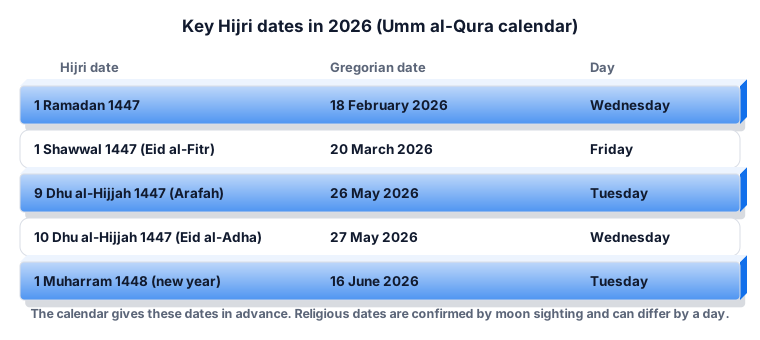
Example 1: a Gregorian date to Hijri. Today, Thursday 19 November 2026, is 9 Jumada al-Akhirah 1448 AH. The tool also says that this month has 29 days.
Example 2: a Hijri date to Gregorian. Enter year 1448, month 2 and day 1. The answer is 15 July 2026, the same date that the official Umm al-Qura calendar site gives for 1 Safar 1448.
Example 3: a date that does not exist. Sha'ban 1447 has only 29 days, so 30 Sha'ban 1447 is not a date. The tool tells you this and asks for a day from 1 to 29. The next day, 29 Sha'ban 1447, was Tuesday 17 February 2026, and the next day was 1 Ramadan.
Calendar date or moon sighting?
A converter answers one question: what the calendar says. The start of a religious month, such as Ramadan or Shawwal, is a different question, decided by looking for the crescent and announced by an authority.
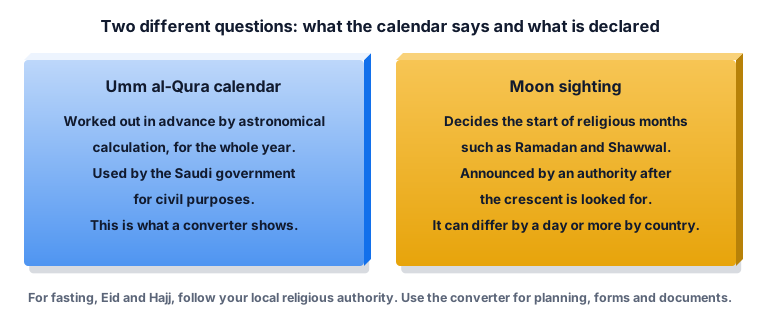
In 2026 the two agreed in Saudi Arabia: the official announcement of 17 February said that Wednesday would be the first day of Ramadan, and the Umm al-Qura calendar gives 18 February. In some years, and in some countries, the declared day is one or more days later than the calendar. Reports before Ramadan 2026 said that South Asian countries would probably start a day or two later, because they depend on sighting in their own country.
Use the converter for planning, forms and documents. For fasting, Eid and Hajj, follow the announcement of your own religious authority.
Mistakes to avoid
- Adding a fixed number of days. There is no fixed offset between the two calendars.
- Treating the converter as a religious ruling. It shows a calculated calendar, not an announcement.
- Forgetting the sunset rule. The Hijri day can begin the evening before the midnight date.
- Mixing Hijri systems. The Solar Hijri calendar used in Iran and Afghanistan is a different, solar calendar with the same starting point.
- Using day 30 in a 29-day month. Check the month length shown by the converter.
Short glossary
- AH: after the Hijra, the label for Hijri years.
- Hilal: the new crescent moon.
- Umm al-Qura: the calculated calendar of Saudi Arabia, used for civil purposes.
- Moon sighting: looking for the crescent to decide the start of a month.