
You sit down to study and an hour disappears into your phone. The Pomodoro Technique is a simple way to stop that: a timer decides when you work and when you rest. This guide explains the method, how to plan your time with it, and what researchers have actually found about breaks.
Where it comes from
The technique was developed by Francesco Cirillo in the late 1980s, when he was a university student who found it hard to focus on his studies. He used a kitchen timer shaped like a tomato. The Italian word for tomato is pomodoro, and that is where the name comes from. One block of focused work is called a pomodoro (plural: pomodori).
The steps
- Pick one task.
- Set a timer for 25 minutes.
- Work on that task only until the timer rings.
- Take a 5-minute break.
- After four pomodori, take a longer break, usually 15 to 30 minutes.
The break is part of the method, not a reward you can skip. Good breaks need little mental effort: stand up, stretch, get some water.
The arithmetic of a plan
Many people forget the breaks when they plan. Always count both.
total time = (pomodoros × focus minutes) + (breaks × break minutes)
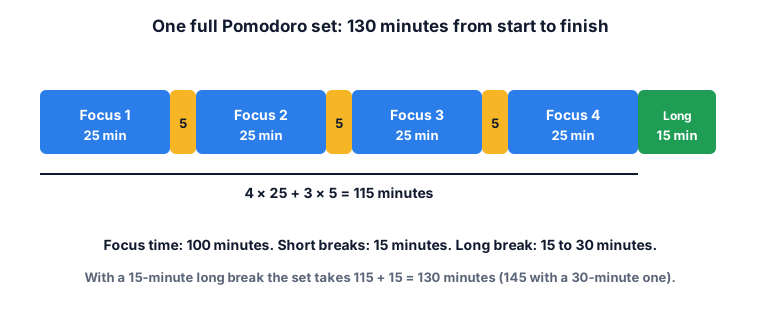
Example 1: one full set. Four pomodoros are 4 × 25 = 100 minutes of focus. There are 3 short breaks between them: 3 × 5 = 15 minutes. That is 115 minutes. Add a 15-minute long break and the set takes 130 minutes. With a 30-minute long break it takes 145.
Worked example: an essay of six pomodoros
You estimate that your essay needs six pomodoros. How long will it really take?
- Focus: 6 × 25 = 150 minutes.
- Breaks: after pomodoros 1, 2 and 3 you rest 5 minutes each (15). After the fourth you take the long break (15). After the fifth you rest 5 more. That is 5 + 5 + 5 + 15 + 5 = 35 minutes.
- Total: 150 + 35 = 185 minutes, which is 3 hours 5 minutes.
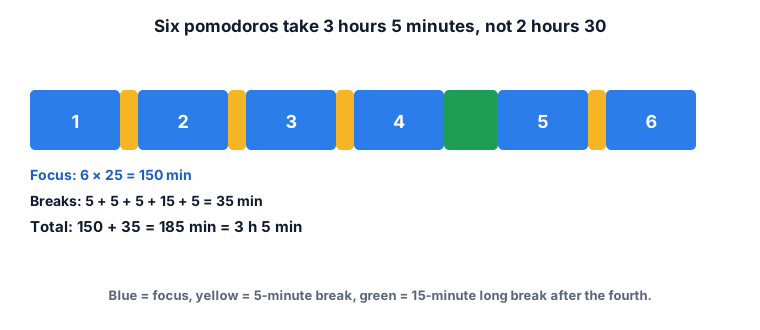
The common mistake. Someone who plans "6 × 25 = 150 minutes, so two and a half hours" is 35 minutes short. Plan with the total, not with the focus time alone.
A harder case: changing the lengths
The 25/5 split is the traditional one, not a law. Because the ZYSNOR timer accepts any focus length, you can adjust it. Compare three patterns that each fill exactly two hours:
- 25 minutes of focus, 5 of rest: a cycle is 30 minutes, so 120 ÷ 30 = 4 cycles and 4 × 25 = 100 minutes of focus (83%).
- 24 and 6, the pattern used in a 2023 study: a cycle is 30 minutes, so 4 cycles and 4 × 24 = 96 minutes (80%).
- 12 and 3, the short pattern in the same study: a cycle is 15 minutes, so 120 ÷ 15 = 8 cycles and 8 × 12 = 96 minutes (80%).
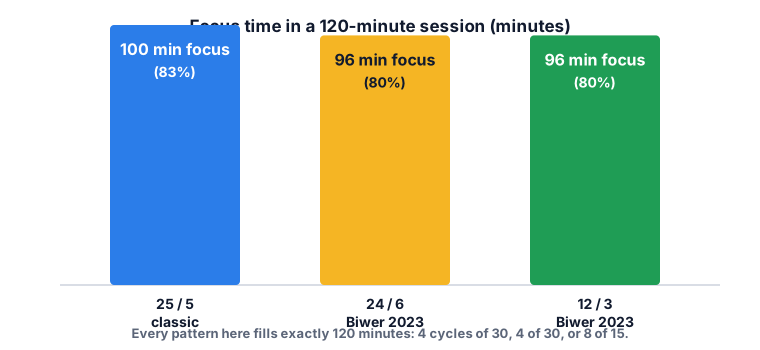
Check your answer. Focus plus rest must equal the session length: 100 + 20 = 120, 96 + 24 = 120, and 96 + 24 = 120. They do.
What research says
Fixed breaks versus your own. Biwer and colleagues (British Journal of Educational Psychology, 2023) had 87 university students study online. One group chose their own break times (35 students), one took a 6-minute break after every 24 minutes (25 students, the "Pomodoro" group) and one took 3 minutes after every 12 (27 students). Their conclusion: planned breaks had mood benefits and appeared to have efficiency benefits, meaning similar task completion in less time.
Breaks and focus. Ariga and Lleras (Cognition, 2011) asked 84 people to do a repetitive computer task for about 50 minutes. People who had no break did worse as time went on. People who took two brief breaks from the main task stayed focused for the whole experiment. The authors suggest that switching your goals off and on again helps you keep paying attention.
Short breaks overall. A 2022 meta-analysis in PLOS ONE (Albulescu and colleagues) combined 22 earlier studies of breaks of 10 minutes or less. It found small but statistically significant gains in vigour (d = 0.36) and lower fatigue (d = 0.35). The effect on performance was not significant overall, and longer breaks gave a bigger boost to performance. The authors suggest that demanding tasks may need longer breaks.
What the research does not say
- The "Pomodoro" group in the 2023 study used 24 minutes and 6 minutes, not the traditional 25 and 5.
- The studies were small or ran for a short time. None of them shows that 25 minutes is the best length for everyone.
- The 2011 task was a repetitive lab task, not real studying.
- Small effects on well-being are not the same as better exam results. Use the technique because it helps you start and stay on track, and adjust it to the work.
Tips that make it work
- One task per pomodoro. If a task needs more than five or six blocks, split it into smaller parts.
- Put your phone away until the timer rings, and write down any stray thought to deal with in the break.
- Take the long break. It is the part people skip most often.
- Adjust when you need to. Hard reading may need a longer block, and a tired day may need a shorter one.
Practice problems
Problem 1. You plan 3 pomodoros of 25 minutes with 5-minute breaks between them. How long will you spend?
Show the worked answer
Focus: 3 × 25 = 75 minutes. Breaks: 2 × 5 = 10 minutes (no break after the last block). Total: 85 minutes.
Problem 2. You study for 2 hours with 50 minutes of focus and a 10-minute break. How many minutes do you focus?
Show the worked answer
A cycle is 50 + 10 = 60 minutes, so 120 ÷ 60 = 2 cycles. Focus: 2 × 50 = 100 minutes.
Problem 3. You finish eight pomodoros in a day, with 5-minute breaks and a 15-minute long break after the fourth. What is the total time?
Show the worked answer
Focus: 8 × 25 = 200 minutes. Breaks: after blocks 1, 2, 3 (5 each = 15), after block 4 (15), after blocks 5, 6, 7 (15), none after block 8. Breaks: 15 + 15 + 15 = 45 minutes. Total: 200 + 45 = 245 minutes, which is 4 hours 5 minutes.
Problem 4. You have 200 minutes free (3 hours 20 minutes). Using 25-minute pomodoros, 5-minute breaks and a 15-minute break after every fourth pomodoro, how many full pomodoros can you finish?
Show the worked answer
Pomodoros 1 to 4 take 4 × 25 + 3 × 5 = 115 minutes, plus the 15-minute long break = 130. Pomodoro 5 ends at minute 155, a 5-minute break takes you to 160, and pomodoro 6 ends at minute 185. A short break takes you to 190, and pomodoro 7 would need until minute 215. So you finish 6 pomodoros with 15 minutes to spare.
When you are ready, start the free Pomodoro Study Timer and try a set yourself.