
Your GPA is one number that has to sum up a whole semester (or a whole degree) of very different courses. To understand it properly, and to calculate it without mistakes, it helps to see why it is built the way it is. Let's go step by step, the way we would in a classroom: first the idea, then the formula, then plenty of worked examples.
What a GPA is really measuring
A GPA answers one question: "On average, at what level did this student perform, across all the work they did?" The important words are all the work. A 4-credit calculus course with five hours of classes a week is a much bigger piece of work than a 1-credit lab. A fair average must let the bigger piece of work count more. That single idea explains almost everything about the formula.
Where GPA and the credit hour come from
Nobody sat down one day and "invented" the GPA formula. It is the meeting of three older ideas: numbers for grades, a unit for measuring course size, and the ordinary weighted average from mathematics. Here is how they came together.
- 1785, Yale. President Ezra Stiles examined 58 seniors and wrote the results in his diary in four Latin ranks: Optimi (best), second Optimi, Inferiores (lesser) and Pejores (worse). Yale historian George W. Pierson reports that, according to tradition, these were the first grades issued at Yale.
- 1792, Cambridge. Tutor William Farish is often named as the inventor of numerical marks. Historian Christopher Stray finds the evidence unconvincing, so treat this as a popular story, not a fact.
- 1837, Yale again. By 1837 Yale had turned its descriptive grades into numbers on a 4-point scale. Some historians see this as the root of today's 4.0 scale.
- 1897, Mount Holyoke College. The first letter grades, A to E, appeared here; F for "fail" was added in 1898.
- 1906, the credit hour. The Carnegie Foundation for the Advancement of Teaching, set up by Andrew Carnegie, built a standard unit of time: roughly one hour of class a week across a 15-week semester. Colleges took it up partly because the Foundation's free pensions for professors required it. Its 1906 report counted "the amount of time spent on a subject, not the results attained", which is exactly why credit hours measure the size of a course, not its difficulty.
- 1940s. Letter grades and the 4.0 scale became the most common system in the US. Combine a 4-point grade with a credit-hour weight, and the GPA formula follows naturally.
Countries that adopted the American semester and credit-hour model, such as Saudi Arabia and Pakistan, kept the same weighted-average idea and only changed the table of grade points. That is why the formula below works everywhere; only the numbers in the table differ.
Why letter grades are turned into numbers
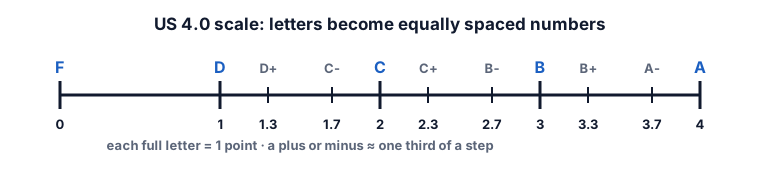
You cannot average letters. "A" plus "C" divided by two means nothing, so schools give each letter a number called grade points. On the common US 4.0 scale:
| Grade | A | A- | B+ | B | B- | C+ | C | C- | D+ | D | F |
|---|---|---|---|---|---|---|---|---|---|---|---|
| Points | 4.0 | 3.7 | 3.3 | 3.0 | 2.7 | 2.3 | 2.0 | 1.7 | 1.3 | 1.0 | 0 |
Notice the pattern: each full letter is exactly one point apart (A = 4, B = 3, C = 2, D = 1, F = 0), and a plus or minus moves you about a third of the way to the next letter (0.3 or 0.33). The steps are equal on purpose: moving from C to B is treated as the same amount of improvement as moving from B to A. This is a convention, not a law of nature, which is why some schools use different numbers (for example A+ = 4.3) and why other countries use other scales. Always use the table in your handbook.
Why credit hours decide how much each course counts
Credit hours roughly measure the size of a course: usually the number of class hours per week. Think of a 4-credit course as four 1-credit "units" of work, all with the same grade. If you earned an A in it, you produced four units of A-level work.
So when we average, we do not average courses, we average units of work. That is why the formula multiplies by credit hours.
Quality points: the "total score" idea
Multiply a course's grade points by its credit hours and you get its quality points: the total "score" that course contributes.
quality points = grade points × credit hours
An A (4.0) in a 3-credit course gives 4.0 × 3 = 12 quality points. A C (2.0) in the same course gives only 6. Add up the quality points of all your courses and you have your total score for the term. Divide that score by the total number of units (credit hours) and you get the average per unit. That average is the GPA.
GPA = total quality points ÷ total credit hours = Σ (grade points × credit hours) ÷ Σ credit hours
Worked example 1: two courses, to see the idea clearly
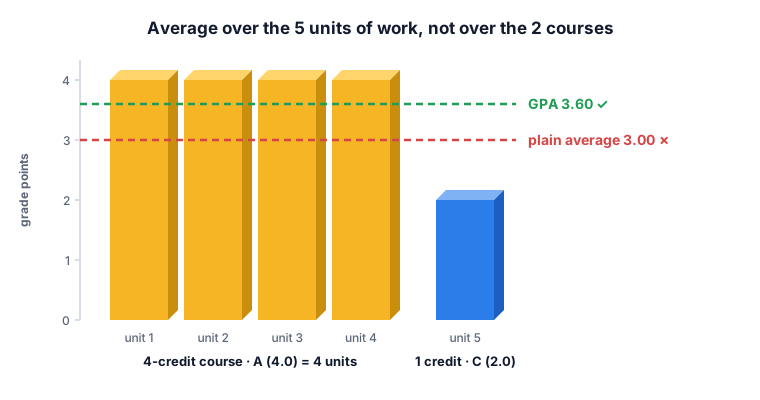
Suppose you take a 4-credit course and earn an A (4.0), and a 1-credit course and earn a C (2.0).
- Quality points for the big course: 4.0 × 4 = 16
- Quality points for the small course: 2.0 × 1 = 2
- Total quality points: 16 + 2 = 18
- Total credit hours: 4 + 1 = 5
- GPA = 18 ÷ 5 = 3.60
Does 3.60 make sense? Four out of your five units of work (80%) were A-level, and only one unit was C-level, so your average should sit much closer to 4.0 than to 2.0. It does. If you had simply averaged the two grades, (4.0 + 2.0) ÷ 2 = 3.0, you would be pretending the tiny course was as big as the large one.
Worked example 2: a full semester
| Course | Credits | Grade | Points | Quality points |
|---|---|---|---|---|
| English Composition | 3 | A- | 3.7 | 3 × 3.7 = 11.1 |
| Calculus I | 4 | B+ | 3.3 | 4 × 3.3 = 13.2 |
| Chemistry Lab | 1 | A | 4.0 | 1 × 4.0 = 4.0 |
| World History | 3 | C+ | 2.3 | 3 × 2.3 = 6.9 |
| Total | 11 | 35.2 |
GPA = 35.2 ÷ 11 = 3.2000… = 3.20.
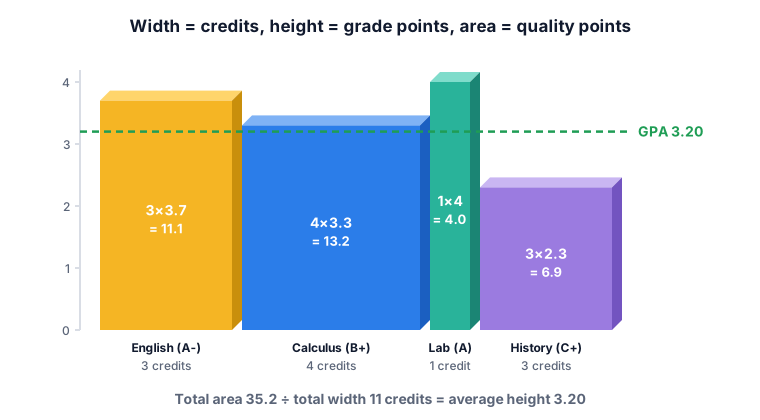
Sense check. A GPA is an average, so it must lie between your lowest grade points (2.3) and your highest (4.0). It does. It also leans towards the grades of your biggest courses: Calculus (4 credits, 3.3) pulls hardest, and 3.20 is close to it. If your answer ever falls outside your lowest and highest grade, you have made an arithmetic mistake.
The most common mistake, worked out
Many students simply average the four grades:
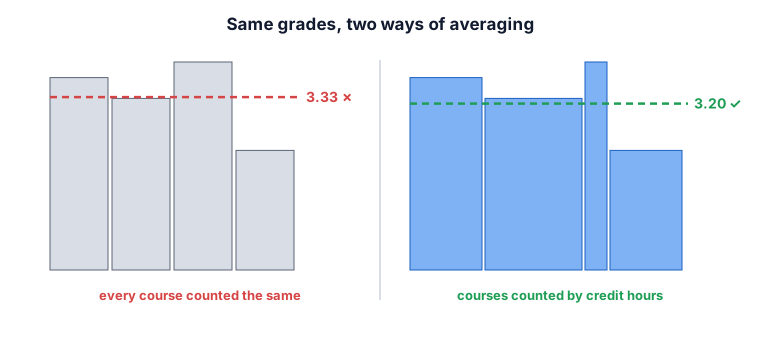
(3.7 + 3.3 + 4.0 + 2.3) ÷ 4 = 13.3 ÷ 4 = 3.325 ≈ 3.33 ✗
Why is it wrong? Because the 1-credit lab (an A) now counts as much as the 4-credit calculus course. The lab "inflates" the result by 0.13 points. With a different mix of courses the error can be much bigger, in either direction. The correct value is 3.20.
Why pass/fail and withdrawn courses are usually left out
A "Pass" has no grade points. If you added its credits to the bottom of the fraction but put 0 points on top, you would be treating the pass exactly like an F. Watch what that would do to example 2 if a 3-credit pass course were wrongly included:
35.2 ÷ (11 + 3) = 35.2 ÷ 14 = 2.51 ✗ (instead of 3.20)
A pass should not cost you 0.69 points, so most schools leave pass/fail and withdrawn (W) courses out of both the top and the bottom of the fraction. Your school's rules decide this, so check them.
Why you should round only at the end
Rounding early throws away small pieces of information, and those pieces add up. Take three 3-credit courses with grade points 3.66, 3.33 and 2.66 (a common Pakistani scale):
- Exact: 3 × (3.66 + 3.33 + 2.66) = 28.95; 28.95 ÷ 9 = 3.2167 → 3.22
- Rounding each grade first to 3.7, 3.3 and 2.7: 3 × 9.7 = 29.1; 29.1 ÷ 9 = 3.2333 → 3.23 ✗
The difference looks small, but a cut-off such as "3.25 for a scholarship" can depend on it. Keep every decimal until the final division.
Cumulative GPA: why you must not average your semester GPAs
Your cumulative GPA (CGPA) uses every graded course you have ever taken, with the same rule: total quality points ÷ total credit hours. The trap is to average the semester GPAs instead.
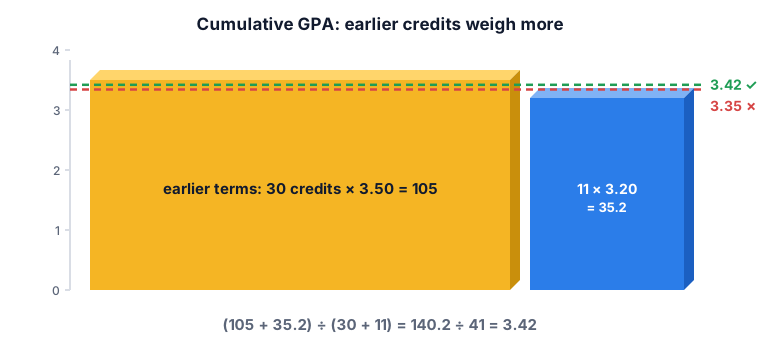
Example: your earlier terms gave a 3.50 GPA over 30 credits; this term gave 3.20 over 11 credits.
- Turn each GPA back into quality points: 3.50 × 30 = 105, and 3.20 × 11 = 35.2.
- Add the points: 105 + 35.2 = 140.2. Add the credits: 30 + 11 = 41.
- CGPA = 140.2 ÷ 41 = 3.4195… = 3.42
The quick average (3.50 + 3.20) ÷ 2 = 3.35 is wrong because the 30 earlier credits carry almost three times as much work as this term's 11. This is the same "units of work" idea from earlier, one level up.
What GPA do I need next term to reach my target?
Let's build the formula instead of memorising it. After next term you will have (current credits + next credits) in total. To have a cumulative GPA equal to the target, your total quality points must be target × total credits. You already have some points, so next term must supply the rest:
needed GPA = (target × total credits after the term − current quality points) ÷ next term's credits
Example: you have 140.2 points over 41 credits (CGPA 3.42) and will take 15 credits.
- Target 3.50: 3.50 × 56 = 196 points needed; 196 − 140.2 = 55.8; 55.8 ÷ 15 = 3.72. Hard but possible.
- Target 3.60: 3.60 × 56 = 201.6; 201.6 − 140.2 = 61.4; 61.4 ÷ 15 = 4.09. That is above 4.0, so it is impossible in one term.
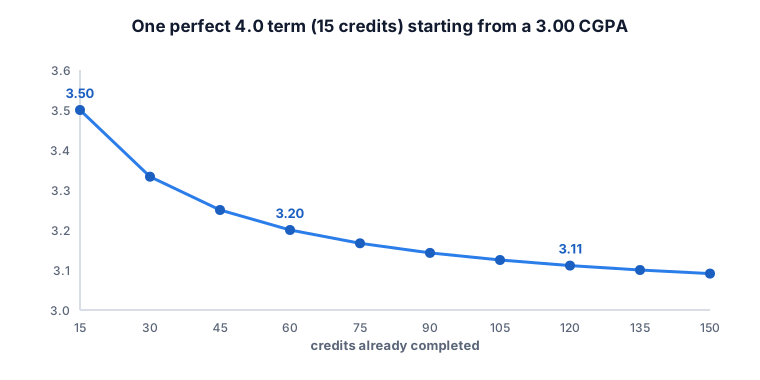
Why does GPA get harder to move over time? Because each new term is a smaller share of all your work. A student with 3.00 over 120 credits who scores a perfect 4.0 in a 15-credit term reaches only (360 + 60) ÷ 135 = 3.11. Early terms matter a lot.
Repeating a course: why the policy changes the answer
Suppose you failed a 3-credit course (F = 0) and also have a 3-credit A (4.0). Your GPA is (0 + 12) ÷ 6 = 2.00. You retake the failed course and earn a B (3.0). Schools handle this in two main ways:
- Grade replacement: the new grade replaces the old one. (9 + 12) ÷ 6 = 3.50.
- Both attempts count: the F stays. (0 + 9 + 12) ÷ 9 = 2.33.
Same student, same grades, very different GPA. That is why you should read your university's repeat policy before planning.
Weighted GPA in US high schools: why harder classes get extra points
Schools want to reward students who take harder classes, so many add extra points: often +0.5 for honors and +1.0 for AP or IB. An A in AP Biology then counts as 5.0.
Example (three 1-credit classes): A in AP (5.0), B in Honors (3.0 + 0.5 = 3.5), A in a regular class (4.0).
- Weighted GPA = (5.0 + 3.5 + 4.0) ÷ 3 = 12.5 ÷ 3 = 4.17
- Unweighted GPA = (4.0 + 3.0 + 4.0) ÷ 3 = 11 ÷ 3 = 3.67
Policies differ between schools, and many colleges recalculate their own GPA from your transcript, so always say which one you are quoting.
Saudi Arabia: the 5-point scale
Many Saudi universities use a 5-point scale. King Saud University's student guide gives:
| Mark (%) | Grade | Points (of 5) |
|---|---|---|
| 95–100 | A+ | 5.00 |
| 90 to under 95 | A | 4.75 |
| 85 to under 90 | B+ | 4.50 |
| 80 to under 85 | B | 4.00 |
| 75 to under 80 | C+ | 3.50 |
| 70 to under 75 | C | 3.00 |
| 65 to under 70 | D+ | 2.50 |
| 60 to under 65 | D | 2.00 |
| Under 60 | F (E) | 1.00 |
Two things to notice. First, the lowest value is 1.00, not 0, so even a failed course adds a little; the scale simply starts at 1. Second, the formula does not change at all. KSU's own example:
| Course | Hours | Grade | Value | Points |
|---|---|---|---|---|
| Phys 101 | 4 | D+ | 2.5 | 10 |
| Chem 101 | 4 | C | 3.0 | 12 |
| Eng 121 | 3 | C+ | 3.5 | 10.5 |
| Arab 101 | 2 | B | 4.0 | 8 |
| Total | 13 | 40.5 |
GPA = 40.5 ÷ 13 = 3.115… = 3.12 out of 5. Some Saudi universities use a 4-point scale, so always read the "out of" figure on your transcript.
Pakistan: the HEC 4.0 scale
The Higher Education Commission's semester-system guidelines list this scale:
| Marks (%) | Grade | Points |
|---|---|---|
| 85 and above | A | 4.00 |
| 80–84 | A- | 3.66 |
| 75–79 | B+ | 3.33 |
| 71–74 | B | 3.00 |
| 68–70 | B- | 2.66 |
| 64–67 | C+ | 2.33 |
| 61–63 | C | 2.00 |
| 58–60 | C- | 1.66 |
| 54–57 | D+ | 1.3 |
| 50–53 | D | 1.00 |
| Below 50 | F | 0.00 |
Example: three 3-credit courses with 82%, 76% and 69%. First find the band of each mark: 82% is A- (3.66), 76% is B+ (3.33), 69% is B- (2.66). Then 3 × (3.66 + 3.33 + 2.66) = 28.95 points over 9 credits = 3.22. Note that the HEC document prints D+ as 1.3, not 1.33; we show it exactly as printed. Universities may adjust the table, so use the one in your own prospectus.
United Kingdom: classes instead of GPA
UK universities usually award a degree class from percentage marks: First (70% and above), Upper Second or 2:1 (60–69%), Lower Second or 2:2 (50–59%) and Third (40–49%). These are the bands the University of Bristol publishes as standard across UK higher education; institutions add their own borderline rules, so check yours. There is no GPA in the US sense, and no single official conversion.
Why you cannot convert scales with one simple ratio
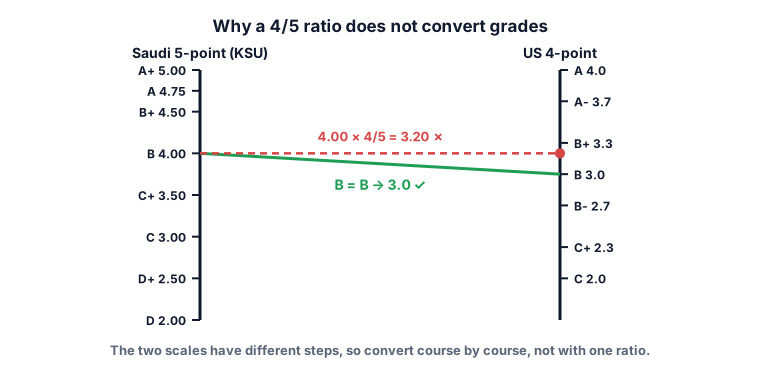
It is tempting to convert a 5-point GPA to a 4-point one by multiplying by 4/5. Let's test it. A KSU student with straight B grades has 4.00 out of 5. The ratio gives 4.00 × 4/5 = 3.20. But a B on the US 4.0 scale is 3.0, not 3.2. The two scales do not have the same steps, so a straight ratio drifts. That is why universities and credential evaluators convert course by course from your transcript. If you need an official figure, ask the institution you are applying to.
Check your answer in 10 seconds
- The GPA lies between your lowest and highest grade points.
- It sits closer to the grades of your biggest courses.
- Total credits in the bottom of the fraction match the courses you counted on top.
- You used the right scale ("out of 4" or "out of 5").
Practice problems
Problem 1. 3 credits B, 3 credits A-, 2 credits C, 1 credit A (US 4.0 scale). What is the GPA?
Show the worked answer
Quality points: 3 × 3.0 = 9; 3 × 3.7 = 11.1; 2 × 2.0 = 4; 1 × 4.0 = 4. Total = 28.1. Credits = 9. GPA = 28.1 ÷ 9 = 3.122 → 3.12. Sense check: between 2.0 and 4.0, and close to the two 3-credit grades.
Problem 2. Your CGPA is 2.80 after 60 credits. You will take 15 credits next term. What term GPA do you need for a 3.00 CGPA?
Show the worked answer
Current points: 2.80 × 60 = 168. Points needed: 3.00 × 75 = 225. Next term must give 225 − 168 = 57 points. 57 ÷ 15 = 3.80.
Problem 3. Four courses on the US 4.0 scale: 3 credits A, 3 credits B+, 3 credits Pass, 4 credits C. What is the GPA, and what would it be if the Pass were wrongly counted as an F?
Show the worked answer
The Pass is left out. Quality points: 3 × 4.0 = 12; 3 × 3.3 = 9.9; 4 × 2.0 = 8. Total = 29.9 over 10 credits = 2.99. If the Pass were counted as 0 points over 3 credits, the result would be 29.9 ÷ 13 = 2.30, a drop of 0.69 for a course that carries no grade. The ZYSNOR GPA Calculator also leaves a Pass out and gives 2.99.
Want to check your own numbers? The free GPA Calculator does all of this for you, and now you know exactly what it is doing and why.