

Em dashes are common in copied, edited and AI-written text, and some readers now see heavy dash use as a sign of machine writing. Some forms and systems also mangle the character. This guide shows how to replace them so each sentence still reads well.
Three dashes
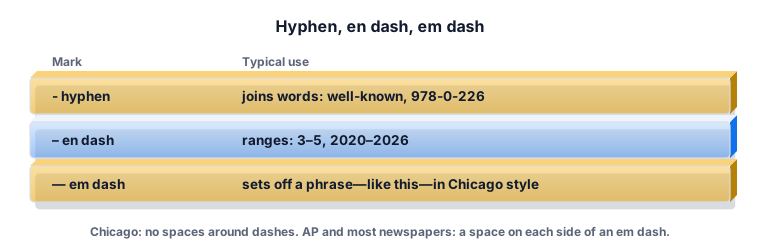
There are three lengths: the hyphen (-), the en dash (–) and the em dash (—). A hyphen joins words, an en dash marks a range such as 3–5, and an em dash sets off a phrase. Chicago style puts no spaces around them; AP style and most newspapers put a space on each side of an em dash.
Which replacement fits
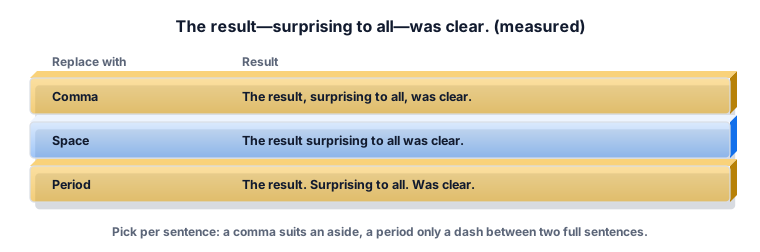
A pair of dashes around an aside works best as a pair of commas. A single dash before a list or explanation can be a colon. A dash between two full sentences can be a period or a semicolon. A period on an aside breaks the sentence badly, as the example shows.
Worked example 1: an aside
"Our results—though early—look strong." with Comma becomes "Our results, though early, look strong."
Worked example 2: an explanation
"One rule matters—check the source." with Colon becomes "One rule matters: check the source."
Worked example 3: mixed text
When a text uses dashes in different ways, run it with Comma, then fix the few sentences where a colon or period reads better. That is faster than editing every dash by hand.
What the ZYSNOR tool does
- Replaces every em dash (U+2014), with or without spaces, in one go.
- Seven replacements; Period capitalises the next word.
- Reports how many dashes it changed. En dashes and hyphens are left alone.
- Runs in your browser.
Practice problems
Problem 1. Which replacement fits "Bring three things—water, food, a map"?
Show the worked answer
A colon: "Bring three things: water, food, a map".
Problem 2. Will "pages 3–5" change?
Show the worked answer
No. That is an en dash; only em dashes are replaced.
Ready to try it? The free tool works in your browser, and the button in the page header takes you straight to it.