ZYSNOR, smart solutions, real impact

Writing guide

How to write numbers in words

By , Founder of ZYSNOR · Updated · Checked · 8 min read

In short

Write numbers in groups of three from the left: 1,234,567 is one million two hundred thirty-four thousand five hundred sixty-seven. British English adds 'and' before the tens (one hundred and one); American English usually leaves it out. In the South Asian system 1,234,567 is twelve lakh thirty-four thousand five hundred sixty-seven. For cheques, write the currency and end with 'only'.

Jump to a section

Cheques, invoices, legal documents and school work often need numbers in words. The rules are simple once you know the groups and the two regional differences.

Groups of three

Read the number in groups of three from the left and name each group: 7,045,300 is seven million forty-five thousand three hundred. Words from twenty-one to ninety-nine take a hyphen: forty-five.

British "and"

British English puts "and" before the tens (nine hundred and ninety-nine thousand), American English usually leaves it out (nine hundred ninety-nine thousand). On the tool, 101 gives "one hundred and one" in British style and "one hundred one" in American style.

Lakh and crore

In the South Asian system 1,00,000 is one lakh and 1,00,00,000 is one crore (ten million). The tool's South Asian setting turns 1234567 into "twelve lakh thirty-four thousand five hundred and sixty-seven" with British style.
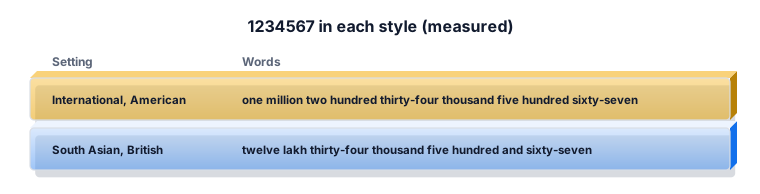
1234567 written in words in the international American style and in the South Asian British style
1234567 in each style, measured.

Cheque amounts

Write the currency, the minor unit and "only" so nothing can be added after. The tool gives "Two Thousand Five Hundred Riyals and Seventy-Five Halalas Only" for SAR 2,500.75 and "One Lakh Fifty Thousand Rupees Only" for PKR 150,000.
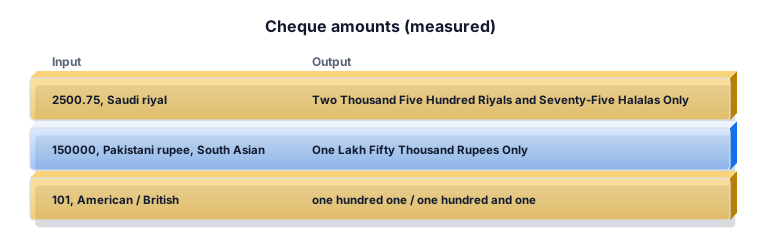
Three cheque and style examples with their word output
Cheque amounts, measured.

Worked example 1: a decimal

-0.05 becomes "minus zero point zero five": each digit after the point is read on its own.

Worked example 2: an ordinal

21 as an ordinal is "twenty-first"; 112 is "one hundred twelfth" (American).

Worked example 3: a very large number

A 19-digit number is refused with "Enter up to 18 digits before the decimal point and up to 12 after it." That covers up to 999 quadrillion or 99 padma... in practice, every real amount.

What the ZYSNOR converter does

  • Plain numbers, negative numbers, decimals, ordinals and cheque amounts.
  • Currencies: US dollar, Indian rupee, Pakistani rupee, Saudi riyal, British pound, euro.
  • International or South Asian; American or British; four letter cases.
  • Runs in your browser.

Practice problems

Problem 1. Write 3,400,000 in the South Asian system.

Show the worked answer

34,00,000 = thirty-four lakh.

Problem 2. Write 250 in British style.

Show the worked answer

two hundred and fifty.

Ready to try it? The free tool works in your browser, and the button in the page header takes you straight to it.

Common questions

How do I write a cheque amount in words?

Choose Cheque amount and the currency. The tool writes the main and minor units and ends with Only, for example Two Thousand Five Hundred Riyals and Seventy-Five Halalas Only.

Should I write 'one hundred and one' or 'one hundred one'?

British English uses and; American English usually leaves it out. Pick the style that matches your document.

How do I write lakh and crore?

Choose South Asian. 1,00,000 is one lakh and 1,00,00,000 is one crore.

How are decimals written?

Each digit after the point is read separately: 0.05 is zero point zero five. On cheques the decimal part becomes the minor unit.

What is the largest number?

Up to 18 digits before the decimal point and 12 after it.

Is my number uploaded?

No. It is converted in your browser.

Sources and how we researched this

Sources (2)

How we researched this

All outputs were measured on the ZYSNOR tool in Chromium: 1234567 (international American and South Asian British), 2500.75 as a Saudi riyal cheque, 150000 as a Pakistani rupee cheque in lakh, 21 as an ordinal, -0.05, 101 in British and American style, and a 19-digit number (refused: up to 18 digits before the decimal point and 12 after). Naming rules for British and American usage and for lakh and crore are from the Wikipedia articles on English numerals and the Indian numbering system, read from search excerpts. Spotted something that does not match your experience? Tell us through the Contact page and we will check it and update this guide.

Related guides

Rules differ between schools and change over time. Always check your own school or university handbook.