

 How to Calculate GPA in the US (Unweighted 4.0 and Weighted 5.0)
This guide is about US schools and colleges. If you study in Saudi Arabia, where GPA is reported out of 5 or out of 4 with different points, read how GPA is calculated on the Saudi 4.0 and 5.0 scales.
The US grade points
Most US colleges and many high schools use a 4.0 scale. Schools with plus and minus grades usually give the values below; this is the table in the Indiana University Kokomo bulletin. Many high schools, including all public high schools in North Carolina, use only A, B, C, D and F.
| Grade | US 4.0 (unweighted) | US 5.0 (weighted) |
|---|---|---|
| A+ | 4.0 | 5.0 |
| A | 4.0 | 5.0 |
| A- | 3.7 | 4.7 |
| B+ | 3.3 | 4.3 |
| B | 3.0 | 4.0 |
| B- | 2.7 | 3.7 |
| C+ | 2.3 | 3.3 |
| C | 2.0 | 3.0 |
| C- | 1.7 | 2.7 |
| D+ | 1.3 | 2.3 |
| D | 1.0 | 2.0 |
| D- | 0.7 | 1.7 |
| F | 0.0 | 0.0 |
The 5.0 column is the same table plus one point, which is what an AP or IB class earns under North Carolina's rule. An F stays at 0: there is no extra point for a failing grade.
Unweighted vs weighted GPA
- Unweighted GPA gives every class the same points, so the maximum is 4.0.
- Weighted GPA adds extra points for harder classes. North Carolina's State Board of Education sets +0.5 for honors and +1.0 for AP, IB and Cambridge (CIE) courses and for transferable college courses, and every student there gets both an unweighted and a weighted GPA.
Other states and districts set their own rules, so the extra points on your transcript may differ. The idea is always the same: the bonus rewards a harder class without changing the letter grade.
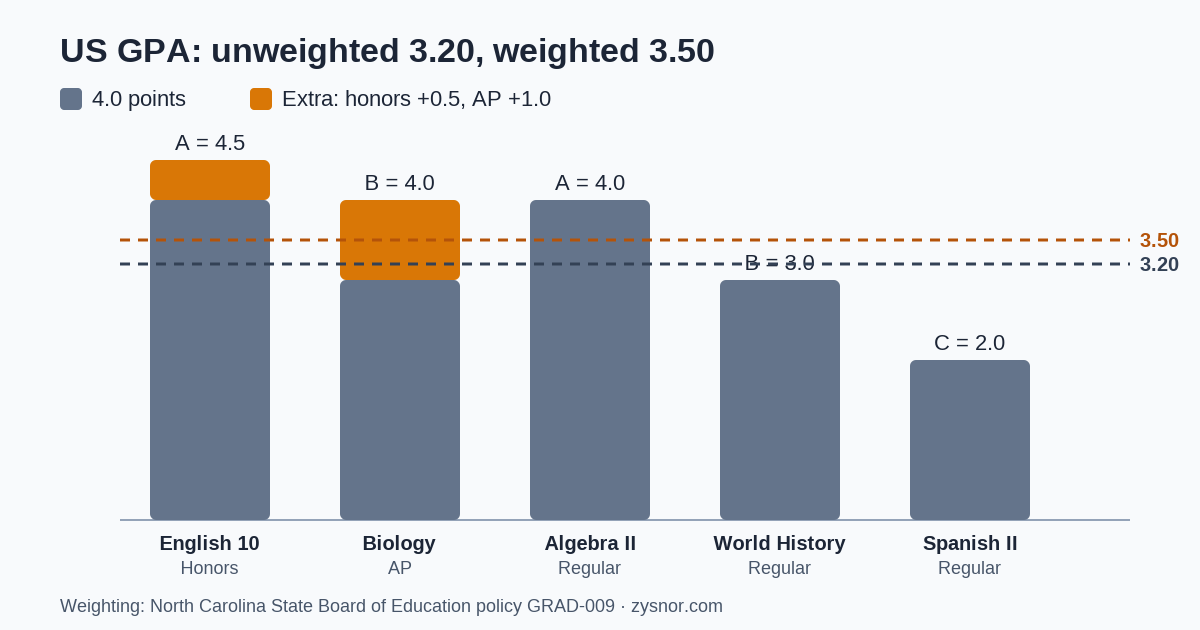
Worked example: one semester
A high school student takes five classes, each worth one credit, and the school uses North Carolina's weighting:
| Class | Level | Grade | Unweighted | Extra | Weighted |
|---|---|---|---|---|---|
| English 10 | Honors | A | 4.0 | +0.5 | 4.5 |
| Biology | AP | B | 3.0 | +1.0 | 4.0 |
| Algebra II | Regular | A | 4.0 | 0 | 4.0 |
| World History | Regular | B | 3.0 | 0 | 3.0 |
| Spanish II | Regular | C | 2.0 | 0 | 2.0 |
| Total | 16.0 | 17.5 |
Unweighted: 16.0 ÷ 5 = 3.20. Weighted: 17.5 ÷ 5 = 3.50. Notice that the C in Spanish counts the same either way; only the honors and AP classes gain.
College GPA with credit hours
In college, classes have different credit hours, so each grade is multiplied by its credits. This is Ohio State University's example:
- A (4.0) × 3 credits = 12.0 quality points
- A- (3.7) × 2 credits = 7.4 quality points
- B+ (3.3) × 4 credits = 13.2 quality points
Total 32.6 quality points ÷ 9 credits = 3.62. A plain average of 4.0, 3.7 and 3.3 would give 3.67, which is wrong because the 4-credit B+ is the biggest class.
Cumulative GPA
Term GPA covers one semester; cumulative GPA is all your quality points divided by all your credit hours, as James Madison University's registrar puts it. Do not average semester GPAs. Say your earlier terms gave 3.50 over 30 credits and this term gave 3.20 over 11 credits:
3.50 × 30 = 105 points, 3.20 × 11 = 35.2 points, so the cumulative GPA is 140.2 ÷ 41 = 3.42. The quick average (3.50 + 3.20) ÷ 2 = 3.35 is wrong, because the 30 earlier credits are almost three times as much work.
What GPA do I need next term?
Needed GPA = (target × total credits after the term − current quality points) ÷ next term's credits.
With 140.2 points over 41 credits and 15 credits next term: for a 3.50 target, 3.50 × 56 = 196, and 196 − 140.2 = 55.8, so you need 55.8 ÷ 15 = 3.72. For 3.60 you would need 61.4 ÷ 15 = 4.09, which is above 4.0 and not possible on an unweighted scale in one term. The target planner in the GPA Calculator does this for you.
Percentages to GPA
If your report card shows percentages, turn each class into a letter first. North Carolina's 10-point scale is:
| Percent | Grade | Points |
|---|---|---|
| 90 to 100 | A | 4.0 |
| 80 to 89 | B | 3.0 |
| 70 to 79 | C | 2.0 |
| 60 to 69 | D | 1.0 |
| below 60 | F | 0.0 |
Convert each class, then average the points. Two classes at 89% and 91% are a B (3.0) and an A (4.0), so the GPA is 3.50, not the 4.0 you would get by averaging the percentages to 90% first. The College Board notes that cut-offs differ between schools and some do not use pluses and minuses, so use your school's own table when you have it.
How colleges recalculate GPA
Your transcript GPA is not always the one a college uses. The College Board says colleges may remove or adjust weighting to compare applicants fairly. The University of California, for example, uses grades from 10th and 11th grade, adds one point for each semester of UC-approved honors, AP or IB work up to a maximum of 8 points, and gives no extra point for a D or F.
When you report a GPA, say which one it is: unweighted, weighted, or a college's own recalculation.