

Your assignment says "use Harvard referencing" and you find that every guide writes it a little differently. That is not you misreading: Harvard is a family of styles. This guide explains the common pattern, the rules for authors and dates, and how to cope with the differences.
What Harvard referencing is
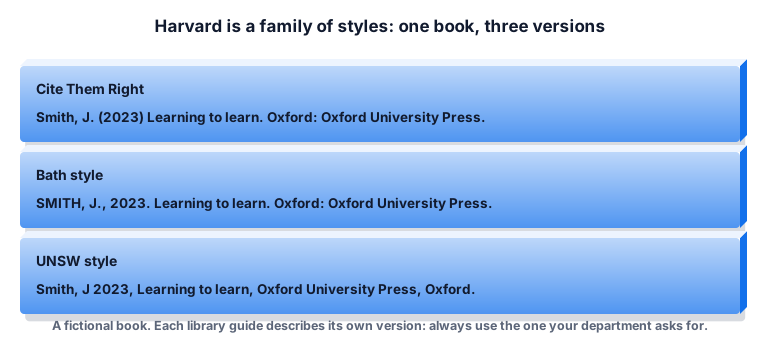
Harvard referencing is an author-date system. The Westminster library guide describes Harvard as a generic term for author-date referencing, and UNSW's guide says there is no single authority on the style, so several variations exist. The University of Bath says the same: its own guide is one interpretation and you should check with your department if you are unsure.
The most common version in UK universities is Cite Them Right. This guide follows it, and says where other versions differ.
The two parts of every citation
Each source you use appears twice: as a short citation in your text and as a full entry in the list of references at the end. If the text says (Smith, 2023), the list must have a Smith entry from 2023, and every entry in the list must be cited in the text.
The four parts of a reference
In Cite Them Right a reference answers four questions in a fixed order: who made it, when, what is it called and where can the reader find it.
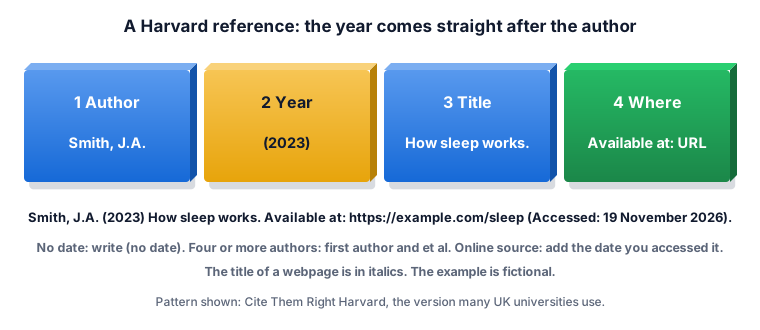
For a web page the last part is the web address and the date you accessed it. For a book it is the place of publication and the publisher. For a journal article it is the journal name, volume, issue and pages.
Citing a web page
The Wolverhampton guide gives the pattern for a web page as author, year, title of the page, then "Available at:" and the address with the date accessed.
Author (Year) Title of page. Available at: URL (Accessed: date).
- No date. Write (no date) in the place of the year.
- Organisation as author. Use the organisation's name where the author would be.
- No author. The title moves to the front, then the year.
- Title. In italics. Many libraries ask for a sentence-case title (capital letters only for the first word and names).
- Date accessed. Pages change, so the date you looked at the page is part of the reference.
Example 1: a page with an author. Fictional page "How sleep works" by John Adam Smith, 2023, visited on 19 November 2026. Typed into the tool as author Smith, John Adam:
Smith, J.A. (2023) How sleep works. Available at: https://example.com/sleep (Accessed: 19 November 2026).
In the text: (Smith, 2023) or Smith (2023) found that...
Example 2: an organisation with no date. Author World Health Organization, no year, page "Sleep facts":
World Health Organization (no date) Sleep facts. Available at: https://example.com/s
In the text: (World Health Organization, no date). In this run the tool printed no access date because none was typed; add one for an online source.
Citing a book
The library guides give the book pattern as author, year, title in italics, the edition if it is not the first, then the place of publication and the publisher. Bradford's guide says the place of publication is optional, so check your version.
Pears, R. and Shields, G. (2022) Cite them right. London: Bloomsbury Academic.
In the text: (Pears and Shields, 2022). The tool prints this when you type the place of publication; the edition has no field yet, so add "12th edn." by hand if it applies.
Citing a journal article
The Westminster guide gives the pattern: surname and initial, year, article title in single quotation marks, journal title in italics, volume and issue, and the page range. An article found online with a DOI ends with Available at: and the address.
Smith, J.A. (2021) ‘Sleep and memory’, Journal of Research Standards, 14(3), pp. 220–238. Available at: https://doi.org/
In the text: (Smith, 2021).
How many authors to name
In Cite Them Right you name up to three authors, both in the text and in the list, and use et al. for four or more. Sheffield's guide adds that for two or three authors you use "and", not an ampersand.
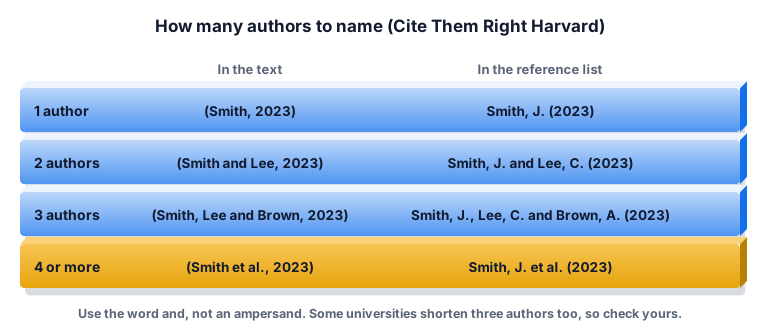
Some universities shorten three authors to et al. as well. The ZYSNOR tool follows the three-name rule of Cite Them Right.
Quotes, page numbers and several works
Cite Them Right advises giving a page number for a direct quotation: (Smith, 2023, p. 14). A page is not needed when you summarize a whole work. Websites often have no page numbers, so cite the author and year alone. The ZYSNOR tool does not add page numbers or a, b letters for two works by the same author in the same year, so add these by hand.
What the ZYSNOR tool does not do
- It does not change a title to sentence case. Type the title the way your style wants it.
- It has no field for the edition of a book, for editors or for book chapters.
- It does not add a, b letters for works by the same author and year.
- It prints a web reference without an access date if you leave that field empty.
Check the result against your department's guide before you submit.
Mistakes to avoid
- Mixing versions. Do not combine Bath punctuation with Cite Them Right order in one list.
- Using an ampersand. Cite Them Right uses "and".
- Leaving out the access date for a web page.
- Listing sources you did not cite. That is a bibliography, not a list of references; some departments want one, some the other.
- Forgetting alphabetical order. Order the list by the first author's surname.
Short glossary
- Author-date system: citations that show the author and year in the text.
- et al.: "and others", used for four or more authors.
- Accessed: the date you viewed an online source.
- List of references: the full list of works cited in the text.