

MLA is the style used mostly in English, languages and humanities courses. The 9th edition no longer has one rule per type of source. It gives one template and asks you to fill in what applies. This guide shows the template, the author rules, the in-text form and the three sources students cite most.
The core elements
The library guides list nine core elements in a fixed order: author, title of source, title of container, other contributors, version, number, publisher, publication date and location. Each one is followed by its own punctuation mark, and you skip any element that does not apply.
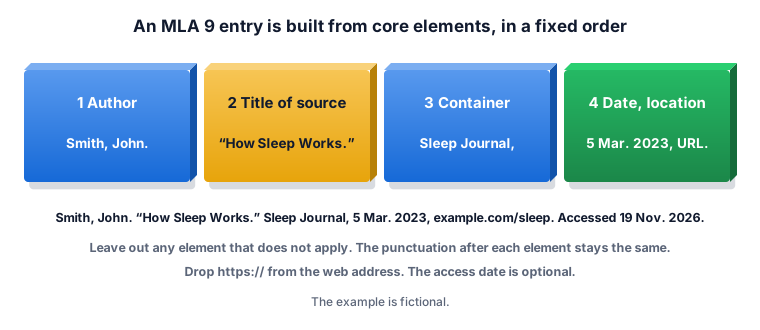
The container idea is the heart of MLA. A web page is the source and the website is the container. A journal article is the source and the journal is the container. A book usually stands alone, so it has no container.
Citing a web page
Author. “Title of Page.” Website, Day Mon. Year, address. Accessed Day Mon. Year.
- Title. Page titles go in quotation marks, in title case. ZYSNOR prints the title exactly as you type it, so type it in title case.
- Web address. The library guides say to leave out http:// or https://. The ZYSNOR tool does this for you.
- Months. Abbreviate months longer than four letters: Jan., Feb., Mar., Apr., Aug., Sept., Oct., Nov., Dec. May, June and July stay in full.
- Access date. Optional. The guides suggest it for pages with no date of their own or pages likely to change. It goes at the end, after the address, as Accessed 19 Nov. 2026.
- No author. Begin with the page title.
- Organisation as author and website. When the organisation is also the website name, skip the author and begin with the title.
Example 1: a page with an author and a date. Typed into the tool as author Smith, John; title How Sleep Works; website Sleep Journal; date 5 March 2023; visited 19 November 2026:
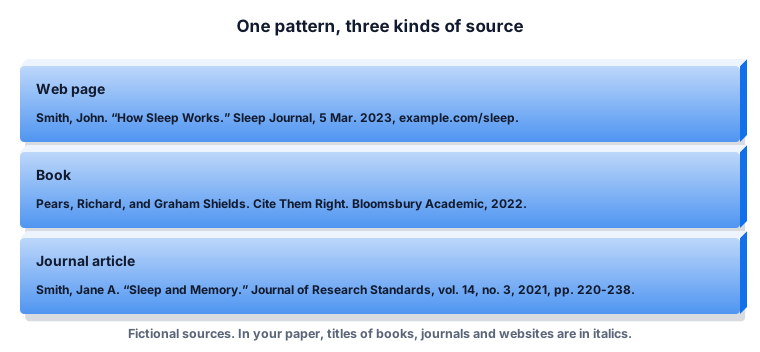
Smith, John. “How Sleep Works.” Sleep Journal, 5 Mar. 2023, example.com/sleep. Accessed 19 Nov. 2026.
In the text: (Smith). A web page has no page number, so the author's surname alone is enough.
Example 2: an organisation. Author and website World Health Organization, year 2022, page Sleep Facts:
“Sleep Facts.” World Health Organization, 2022, who.example.org/sleep.
In the text: (World Health Organization).
Citing a book
Author. Title of Book. Publisher, Year.
Pears, Richard, and Graham Shields. Cite Them Right. Bloomsbury Academic, 2022.
In the text: (Pears and Shields 14) when you cite page 14. In MLA 9 the place of publication is usually left out of a book entry. The tool has no field for the edition or for editors; if your book is a later edition, add it by hand after the title (for example 12th ed.).
Citing a journal article
Author. “Title of Article.” Journal, vol. 14, no. 3, Year, pp. 220-238. DOI.
Smith, Jane A. “Sleep and Memory.” Journal of Research Standards, vol. 14, no. 3, 2021, pp. 220-238. https://doi.org/
In the text: (Smith 220). Use the first page of the range when you cannot say which page you used, or the exact page you quote.
How many authors to name
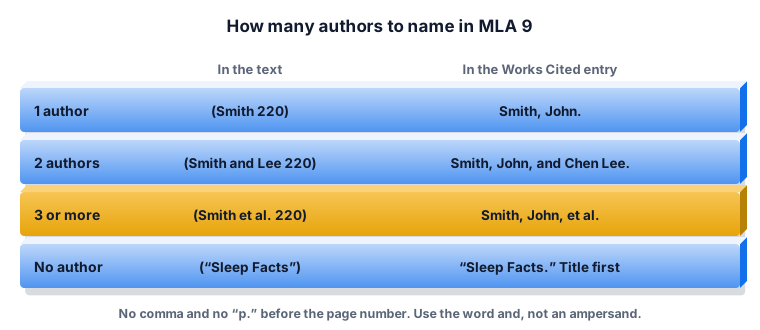
In the list, the first author is written Surname, Given name and the second as Given name Surname: Pears, Richard, and Graham Shields. For three or more authors the guides give only the first, followed by et al.: Smith, John, et al. Use the word and, not an ampersand.
The in-text citation
An MLA in-text citation begins with whatever comes first in the Works Cited entry, usually the author, and adds the page. The guides stress three details: there is no comma between author and page, no p. or pg., and the full stop of the sentence comes after the closing bracket.
Sleep affects memory (Smith 220).
If the author is named in your sentence, put only the page in brackets: Smith argues that sleep matters (220). If the source has no page numbers, as most web pages do, give the author alone. If there is no author, use a short form of the title in quotation marks.
Three kinds of source side by side
What the ZYSNOR tool does not do
- It does not change a title to title case. Type the title the way MLA wants it.
- It has no fields for the edition of a book, for editors or translators, or for a book chapter.
- It does not add page numbers to a web or book in-text citation. Add them by hand.
- It does not handle a second container, such as an article found in a database. Add the database name and address at the end by hand if your instructor asks for it.
Check the result against your instructor's guide before you submit.
Mistakes to avoid
- Using APA habits. MLA has no year in the in-text citation and no comma before the page.
- Printing https:// in the web address.
- Writing a long month in the access date. Write Nov., not November.
- Using an ampersand between authors. MLA uses and.
- Listing sources you did not cite. The Works Cited list holds only the sources you quoted, paraphrased or summarized.
Short glossary
- Works Cited: the list of every source cited in the text, in alphabetical order.
- Container: the larger work that holds the source, such as a website or a journal.
- et al.: “and others”, used for three or more authors.
- Core elements: the nine pieces of information an entry is built from.