

Your teacher says "use APA", you have eleven web pages open, and you do not know where the commas go. This guide explains what a reference is made of, why the rules exist and how to handle the awkward cases. The rules come from the APA Style website; where we used a secondary source we say so.
What APA style is and where it came from
APA style is the writing and citation system of the American Psychological Association. APA's own history page says it began in 1929, when a group of psychologists, anthropologists and business managers agreed a simple set of procedures for scientific writing and published them as a seven-page article in Psychological Bulletin. A 32-page guide followed in 1944, and the first Publication Manual appeared in 1952 as a 61-page supplement to the same journal. Later editions came in 1957, 1967, 1974, 1983, 1994, 2001, 2009 and 2019; the seventh edition was published in October 2019 (these dates come from a historical column in the APS Observer and from Wikipedia, which we treat as secondary).
The reason for the system is consistency. If every author cites the same way, a reader can find the source in seconds. APA chose the author-date system because the year tells a reader how recent a claim is without turning to a footnote.
The two parts of every citation
The APA site explains that each work you use has two parts: an in-text citation and a matching reference-list entry. The two must agree. If the text says (Smith, 2023), the list must contain a Smith entry from 2023, and every entry in the list must be cited somewhere in the text.
The four parts of a reference
Every reference answers four questions in a fixed order: who made it, when, what is it called and where can I find it.
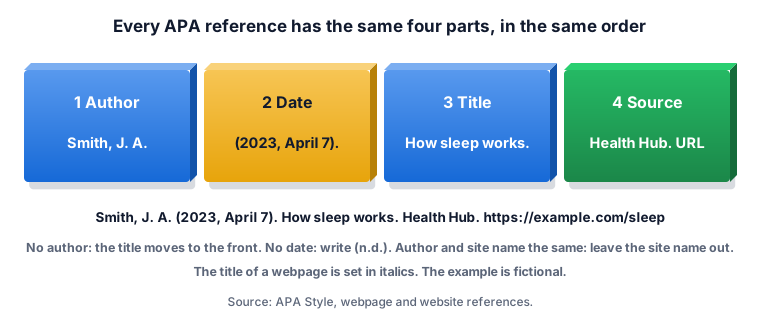
For a webpage the source part is the site name followed by the address. For a book it is the publisher. For a journal article it is the journal name, volume, issue, pages and a DOI link. Since the seventh edition a book reference no longer gives the publisher's city, and a DOI is written as a full link starting https://doi.org/, without the old "DOI:" label (this change is listed in several university guides to the new edition).
Citing a webpage
The general pattern is:
Author. (Year, Month Day). Title of the page. Site Name. URL
The APA webpage page gives these rules, which cause most mistakes:
- Which date. Use the most specific date the page shows. A "last updated" date counts if it clearly belongs to the content you cite and not to the whole site. A "last reviewed" date is ignored, because a review does not mean the content changed. A copyright line in the footer is not a publication date either.
- No date. Write (n.d.), short for "no date".
- Same author and site. If the author and the website name are the same, leave the site name out so the name is not repeated.
- Retrieval date. Add one only when the page is designed to change and is not archived, for example a live statistics page. It goes before the address: Retrieved Month Day, Year, from URL.
- No author. The title moves to the front, then the date.
- Title. In italics and in sentence case: only the first word, the first word after a colon and proper names get capitals.
Example 1: a page with an author and a full date. Fictional page "How sleep works" by John A. Smith on Health Hub, 7 April 2023. Typed into the tool as author Smith, John A., full publication date 2023-04-07, site Health Hub:
Smith, J. A. (2023, April 7). How sleep works. Health Hub. https://example.com/sleep
In the text: (Smith, 2023) or Smith (2023) found that...
Example 2: an organisation with no date, and a page that changes. Author City Planning Department, no publication date, date accessed 19 November 2026, the site name left empty because it equals the author:
City Planning Department. (n.d.). Zoning map. Retrieved November 19, 2026, from https://example.com/map
In the text: (City Planning Department, n.d.).
Example 3: no author. Page titled "Timeline" on the site Example Encyclopedia, no author, no date:
Timeline. (n.d.). Example Encyclopedia. https://example.com/t
In the text the short title is used in place of the author: (Timeline, n.d.). APA asks for long titles to be shortened to the first few words; the ZYSNOR tool prints the full title and does not italicise it in the in-text note, so adjust that by hand.
Citing a book and a journal article
Book. Author. (Year). Title of book. Publisher. A fictional example from the tool, for two authors:
Brown, A., & Cole, D. (2019). Learning to learn. Oxford University Press.
Journal article. Author. (Year). Title of the article. Journal Name, volume(issue), pages. https://doi.org/xxxx. The article title is in sentence case and plain type; the journal name and the volume number are in italics; the issue number is in brackets and not italic; page ranges use an en dash. A fictional example from the tool:
Smith, J. A., & Jones, R. B. (2021). Measuring open-access uptake. Journal of Research Standards, 14(3), 220–238. https://doi.org/
In the text: (Smith & Jones, 2021). The tool italicises the journal name and the volume number.
Authors: how many, and in what form
In a reference an author is written as the surname followed by initials: Smith, J. A. An organisation is written out in full as it appears on the source. With several authors, separate them with commas and put an ampersand before the last: Garcia, M., Lee, C., & Patel, R.
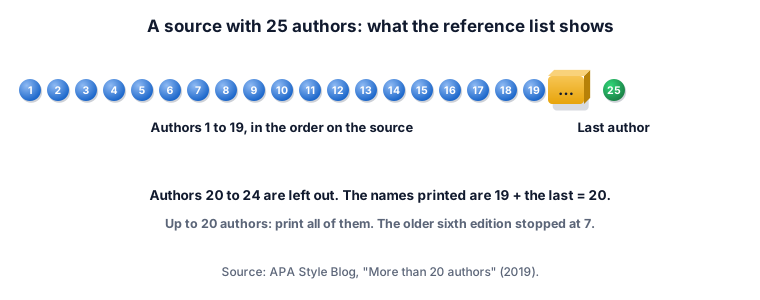
The number of names shown depends on where you are. In the text, one or two authors are always named; for three or more you name only the first author followed by "et al.", from the very first citation (this is a change from the sixth edition, which named all authors the first time a work with three to five authors was cited). In the reference list, APA 7 prints up to 20 authors. For a source with 21 or more, you print the first 19, an ellipsis and the final author.
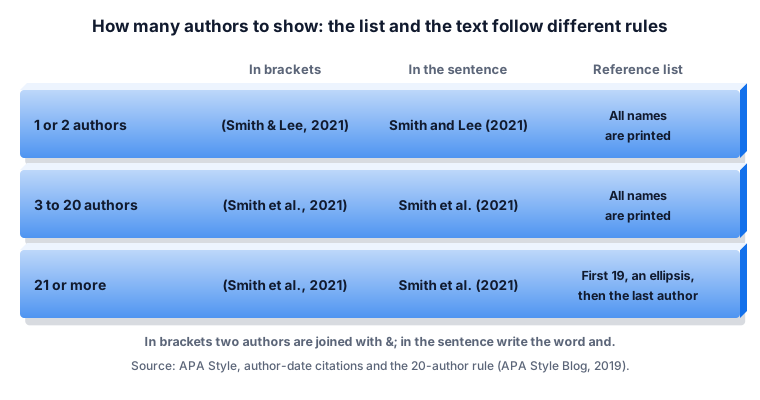
The word "and" and the sign & are not interchangeable. In brackets, between two authors, use the ampersand: (Smith & Lee, 2021). In a sentence, spell out the word: Smith and Lee (2021) found that... The ZYSNOR tool follows this for the in-text note it gives you.
Example 4: three authors. Typed as Garcia, Maria; Lee, Chen; Patel, Raj, year 2021, fictional page "Sleep and study" on Study Blog:
Garcia, M., Lee, C., & Patel, R. (2021). Sleep and study. Study Blog. https://example.com/s
In the text: (Garcia et al., 2021). The reference prints all three names; the text prints one.
One more rule: when two works of three or more authors would shorten to the same form in the text, name as many authors as needed to tell them apart and use "et al." for the rest. If only the last author differs, write all names every time, because "et al." means "and others" and cannot stand for one person.
Group authors and abbreviations
When an organisation is the author, its name is the author. You may abbreviate a well-known group in the text, especially if the name would appear three or more times. The first time, write the full name with the abbreviation: in brackets the abbreviation goes in square brackets, in a sentence it goes in round brackets before the year. After that use the abbreviation only. The reference list always spells the full name out.
- First, in brackets: (World Health Organization [WHO], 2021)
- First, in a sentence: World Health Organization (WHO, 2021)
- Later: (WHO, 2021) or WHO (2021)
If two groups would share one abbreviation and you cite both, write both names in full every time. The ZYSNOR tool treats a name like "Department of Health and Human Services" as one organisation and does not add abbreviations; type the abbreviation into your text yourself.
Citing a source you have not read: secondary sources
Sometimes you find a study only because another author described it. APA says to use this sparingly, for example when the original is out of print or hard to obtain, and to read the original if you can. In the text, name the original and add "as cited in" followed by the source you actually read, for example (Ortiz, 1999, as cited in Hale et al., 2015). In the reference list include only the source you read, Hale et al.; the original does not get an entry.
The reference list
- Start on a new page. The heading is "References", bold and centred. Do not call it Bibliography or Works Cited. With one entry, the singular is accepted.
- Apply a half-inch hanging indent: the first line is at the margin and later lines are indented 0.5 inch.
- Double-space everything and do not add extra space between entries.
- Sort alphabetically by the first word of each entry, usually the first author's surname. An entry with no author is sorted by its title.
- Several works by one author go in order of year, earliest first; an entry with no date comes before dated ones (this ordering comes from university guides to APA 7).
- Two works by the same author in the same year get the letters a, b and so on after the year, ordered by title: (Kim, 2020a), (Kim, 2020b). The same letters are used in the text.
The ZYSNOR tools do not sort in this way for you except in the Bibliography Builder, which sorts alphabetically; they do not add the a and b letters, and they do not format the hanging indent, so set that in your word processor.
Common mistakes
- Using the copyright year as the date. The date belongs to the content, not to the footer of the site.
- Using "last reviewed". APA says to ignore it.
- Repeating the name. "World Health Organization. (2020). Title. World Health Organization." should end after the title.
- A full stop after the web address. A DOI or URL ends the entry without a full stop, because a final dot can break the link (stated in several university guides).
- Title case in the title. Webpage and article titles take sentence case.
- Listing sources you did not cite. A reference list holds only the works cited in the text.
- Citing the secondary source as if you read the original. Use "as cited in".
- Shortening the reference list with "et al." Up to 20 authors are printed in full; "et al." belongs in the text.
Practice problems
Problem 1. A 2022 article is by Ana Rivera, Li Chen and Ngozi Okafor. Write the in-text citation and the start of the reference.
Answer: (Rivera et al., 2022). Reference begins: Rivera, A., Chen, L., & Okafor, N. (2022).
Problem 2. A page shows "Published 3 May 2021" and "Last reviewed 9 January 2024". Which date goes in the reference?
Answer: 2021, May 3, because the last-reviewed date is ignored.
Problem 3. A page has no publication date, only "© 2024" in the footer. What goes in the date position?
Answer: (n.d.).
Problem 4. A journal article has 25 authors. How many names appear in the reference list entry?
Answer: 20: the first 19, an ellipsis and the last author.
Problem 5. You cite two 2020 articles by S. Kim, titled "Water and light" and "Air and soil". In which order do they go, and how are they cited?
Answer: Sort by title, so "Air and soil" first: Kim, S. (2020a) and Kim, S. (2020b) for "Water and light". Cite them as (Kim, 2020a) and (Kim, 2020b).
Problem 6. You read Hale et al. (2015), who describe a 1999 study by Ortiz. Write the citation and say what goes in the reference list.
Answer: (Ortiz, 1999, as cited in Hale et al., 2015). Only Hale et al. appears in the list.
Limits of this guide and the tool
- This guide follows the seventh edition, the edition in force when we checked. Always follow your instructor or journal if they name another edition or a variant.
- The ZYSNOR tool handles three source types: webpage, book and journal article. Chapters, reports, videos, social posts, conference papers and so on are not covered.
- It does not convert capitals to sentence case, does not handle 21 or more authors, does not add the a and b letters, and does not shorten long titles in the in-text note.
- Page-specific citations (a quotation needs a page or paragraph number) are not added to the in-text note for webpages and books.
- Our page for journal and book formats rests on university guides rather than on APA's own pages, as the method note says.
Glossary
- Author-date system: citing by the author's name and the year.
- Parenthetical citation: the citation sits in brackets after the claim.
- Narrative citation: the author is part of your sentence and the year follows in brackets.
- Et al.: Latin for "and others".
- n.d.: no date.
- DOI: a permanent identifier for a work, written as a https://doi.org/ link.
- Group author: an organisation named as the author.
- Hanging indent: every line after the first is indented.
- Secondary source: a source you read that describes another work.