

Glossary · Environment
What is a Carbon Footprint? Meaning, Building Example and How It Is Measured
In simple words
A carbon footprint is the total amount of greenhouse gases caused by a person, product, building, company or event, counted as tonnes of carbon dioxide equivalent (CO2e). It shows how much that thing adds to climate change.
A carbon footprint is a sum: each activity's amount multiplied by an emission factor, converted into one unit, CO2e, and added up. The hard part is deciding what to include, which is why organisations and buildings follow published accounting rules.
Turning gases into CO2e
Each gas is multiplied by its global warming potential (GWP) over 100 years. In the IPCC Sixth Assessment Report (AR6), carbon dioxide is 1, methane is 27.9 and nitrous oxide is 273. One tonne of methane therefore counts as 27.9 t CO2e.
Scopes for organisations
The GHG Protocol Corporate Standard sorts an organisation's emissions into three scopes:
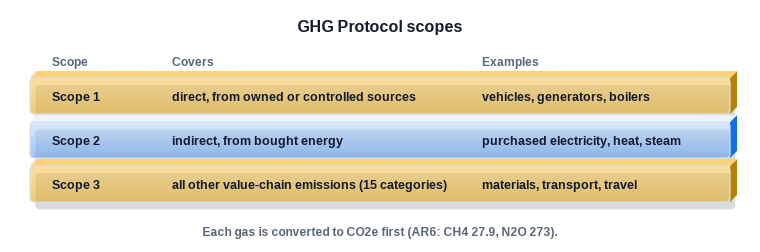
- Scope 1: direct emissions from sources the organisation owns or controls, such as its vehicles, generators and boilers.
- Scope 2: indirect emissions from the electricity, heat or steam it buys.
- Scope 3: all other indirect emissions in its value chain, such as purchased materials, transport, business travel and the use of sold products. The scope 3 standard groups these into 15 categories.
Life-cycle stages for buildings
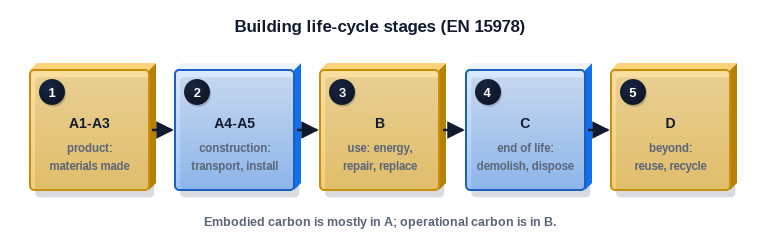
For a building, the standard EN 15978 splits the life cycle into modules: A1 to A3 product stage (raw materials, transport to the factory, manufacturing), A4 to A5 construction (transport to site, installation), B use stage (maintenance, repair, replacement and operational energy and water), C end of life (demolition, transport, waste processing, disposal) and D, benefits beyond the life cycle such as reuse and recycling.
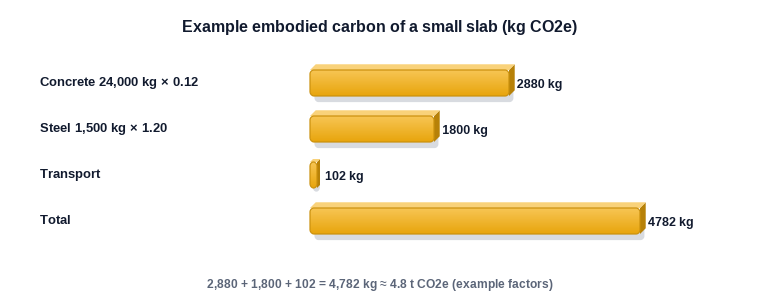
Worked example: embodied carbon of a small slab
The method is quantity × emission factor. The factors below are invented for the example; real projects take them from published databases or product declarations (EPDs).
| Material | Quantity | Example factor | Emissions |
|---|---|---|---|
| Concrete | 24,000 kg | 0.12 kg CO2e/kg | 24,000 × 0.12 = 2,880 kg |
| Reinforcing steel | 1,500 kg | 1.20 kg CO2e/kg | 1,500 × 1.20 = 1,800 kg |
| Transport to site | 25,500 kg × 40 km | 0.0001 kg CO2e/kg·km | 25,500 × 40 × 0.0001 = 102 kg |
| Total | 2,880 + 1,800 + 102 = 4,782 kg ≈ 4.8 t CO2e |
Steel is only 1,500 ÷ 25,500 × 100 ≈ 5.9% of the mass but 1,800 ÷ 4,782 × 100 ≈ 37.6% of the emissions in this example, which is why high-carbon materials get attention first.
Step by step: estimating a footprint
- Set the boundary: which stages, scopes or activities are included.
- List the activities or materials and measure their quantities.
- Pick emission factors from one published, dated source.
- Multiply each quantity by its factor and add the results.
- Record every assumption so the result can be checked and repeated.
- Compare options with the same method and boundary.
Common mistakes
- Mixing factors from different databases or years in one total.
- Comparing two footprints with different boundaries.
- Counting only energy use and leaving out materials.
- Mixing up kilograms and tonnes of CO2e.
- Treating purchased offsets as the same as reducing emissions.
Related terms
- Engineering and constructionGlossary term
Concrete
Concrete is a building material made by mixing cement, water, sand and gravel or crushed stone. The cement and water form a paste that coats the stones and, through a chemical reaction called hydration, hardens into a strong, rock-like mass.2 min read · Added 20 Nov 2026 - EnvironmentGlossary term
Sustainability
Sustainability means meeting today's needs without harming the ability of future generations to meet theirs. In practice it means using energy, water and materials carefully, cutting pollution and waste, and keeping people and the economy healthy over the long term.4 min read · Added 20 Nov 2026
Frequently asked questions
What does CO2e mean?
Carbon dioxide equivalent: other gases converted to the amount of CO2 with the same warming effect.
What is embodied carbon?
The emissions from making, transporting and installing building materials, before the building is used.