

Glossary · Engineering and construction
What is Concrete? Meaning, Ingredients and Worked Example
In simple words
Concrete is a building material made by mixing cement, water, sand and gravel or crushed stone. The cement and water form a paste that coats the stones and, through a chemical reaction called hydration, hardens into a strong, rock-like mass.
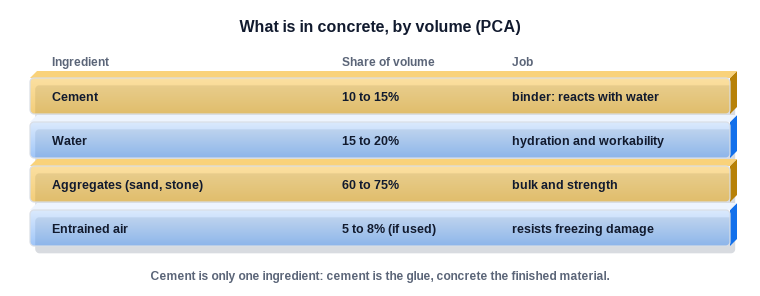
By volume a typical mix is roughly 10 to 15 percent cement, 60 to 75 percent aggregates and 15 to 20 percent water, plus entrained air where it is used. Cement is only one ingredient: cement is the glue, concrete is the finished material.
How it works
When water meets cement, a chemical reaction called hydration starts. The paste stiffens within hours and keeps gaining strength for weeks, as long as it stays moist. The aggregates make up most of the volume and give the mass its bulk; the hardened paste binds them together. Steel reinforcement is added where the concrete must resist tension, which concrete alone resists poorly.
What is in concrete
From mix to hard concrete
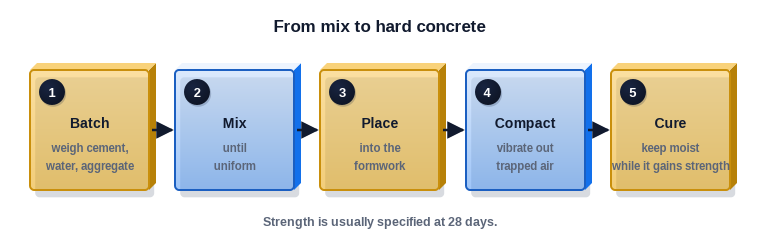
- Batch: weigh the cement, water, sand and stone to the mix design.
- Mix: until the concrete is uniform, at a plant or on site.
- Place: into the formwork soon after mixing, before it starts to set.
- Compact: vibrate to remove trapped air, which would leave voids.
- Cure: keep it moist and protected so hydration continues, especially in hot, dry or windy weather.
Water-cement ratio
The strength and durability of the paste depend mostly on the water-cement ratio: the weight of water divided by the weight of cement. Less water, while still workable, generally means stronger, more durable concrete. Adding water on site to make concrete flow raises the ratio and weakens it.
Strength
Concrete is specified by its compressive strength, usually measured on test cylinders or cubes at 28 days, in megapascals (MPa). Strength classes such as C25/30 in EN 206 give the cylinder and cube strengths: 25 and 30 MPa.
Worked example: one example mix and a slab
An example mix for 1 m³ uses 360 kg of cement, 180 kg of water, 750 kg of sand and 1,050 kg of coarse aggregate.
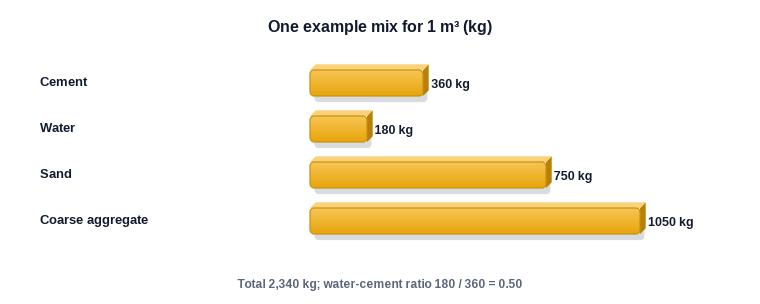
- Water-cement ratio: 180 / 360 = 0.50
- Mass of 1 m³: 360 + 180 + 750 + 1,050 = 2,340 kg
- Slab 6.00 × 4.00 × 0.15 m: 6.00 × 4.00 × 0.15 = 3.60 m³, measured net in the BOQ
- Cement in the slab: 360 × 3.60 = 1,296 kg
- Ordered with a 5% site allowance (an example figure): 3.60 × 1.05 = 3.78 m³
The mix figures are an example only; real mixes are designed for the strength, exposure and materials of each project.
Common mistakes
- Calling concrete "cement".
- Adding water on site to make it flow, which weakens it.
- Poor curing in hot weather, causing cracks and low strength at the surface.
- Not compacting, so honeycombing and voids are left near the formwork.
- Measuring the BOQ volume with the slab and beam overlap counted twice.
Related terms
- Construction and QSGlossary term
Concrete volume (cubic metre)
Concrete volume is the space a concrete element fills, measured in cubic metres (m³). For a simple shape it is length × width × thickness (or depth). Concrete is priced and ordered by the cubic metre.2 min read · Added 20 Nov 2026 - Construction and QSGlossary term
Bar bending schedule (BBS)
A bar bending schedule (BBS) is a table that lists every reinforcement bar in a concrete element: its mark, diameter, shape, cut length and number. It is used to cut and bend the steel and to work out its total weight for ordering and billing.2 min read · Added 20 Nov 2026 - Construction and QSGlossary term
Bill of Quantities (BOQ)
A Bill of Quantities (BOQ) is a document that lists every item of work in a construction project with a description, a unit and a measured quantity. Contractors price each line, so every bidder prices exactly the same work.2 min read · Added 20 Nov 2026 - Construction and QSGlossary term
Quantity takeoff (QTO)
Quantity takeoff (QTO, also "taking off") is the process of measuring quantities, such as areas, lengths, volumes and counts, from drawings, models and specifications, mainly to work out construction cost. The word "takeoff" is also used for the list of quantities the process produces.2 min read · Added 20 Nov 2026
Frequently asked questions
What is the difference between cement and concrete?
Cement is a powder that acts as the binder; concrete is cement, water and aggregates mixed together and hardened.
Why must concrete be cured?
Hydration needs water over time; keeping it moist lets it gain its full strength.