

Glossary · Construction and QS
What is a Bill of Quantities (BOQ)? Meaning, Example and How It Works
In simple words
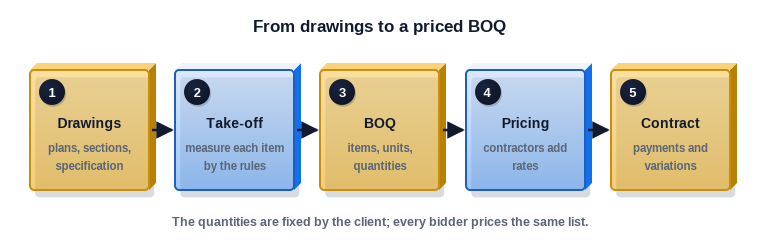
A Bill of Quantities (BOQ) is a document that lists every item of work in a construction project with a description, a unit and a measured quantity. Contractors price each line, so every bidder prices exactly the same work. It is usually prepared by a quantity surveyor from the drawings and the specification, before the project goes to tender.
Why it matters
A BOQ makes tenders comparable, gives the client a firm basis for the contract price and becomes the reference for valuing variations and interim payments. When a wall is added or removed during construction, the agreed rate for that item is used to value the change.
Types
- Firm BOQ: quantities are measured from a complete design, and the contract price is fixed unless the design changes.
- Approximate BOQ: used when the design is not complete; the work is re-measured as it is built and paid at the tendered rates.
How a BOQ is organised
- Preliminaries: site set-up, supervision, insurance, temporary works and other costs that are not part of one building element.
- Measured work, in bills: usually one bill per trade or element (substructure, concrete, masonry, finishes, doors, MEP). Each line has an item code, a description, a unit, a quantity and empty Rate and Amount columns.
- Provisional sums and prime cost sums: allowances for work that cannot be measured yet, for example a sum for specialist lighting.
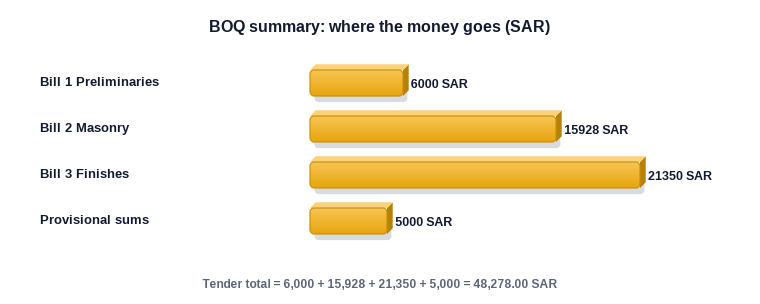
- Collection and summary: each bill total is carried to a summary page that gives the tender total.
Measurement rules
The quantities follow a published method of measurement so that everyone reads them the same way: NRM2 in the UK (it replaced SMM7 in 2013), POMI for many international projects and CESMM4 for civil engineering work. The rules say, for example, which openings are deducted from wall areas and in which unit each item is measured.
Worked example
One masonry bill for a villa in Riyadh, priced in SAR:
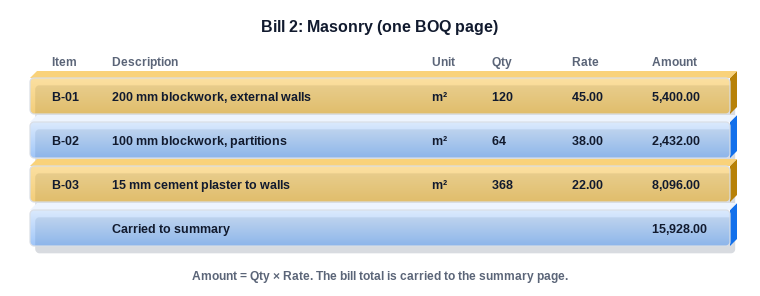
- B-01: 120 m² × 45.00 = 5,400.00
- B-02: 64 m² × 38.00 = 2,432.00
- B-03: 368 m² × 22.00 = 8,096.00
- Bill 2 total: 5,400.00 + 2,432.00 + 8,096.00 = 15,928.00
Step by step: making a simple BOQ
- List the items from the drawings and the specification, trade by trade.
- Measure each item in the unit the rules require (m, m², m³, nr or item).
- Write a clear description: material, size, location and finish.
- Add provisional sums for work that cannot be measured yet.
- Group the items into bills, add a summary page and have another person check the quantities.
Common mistakes
- Mixing units, such as m² in one line and m in the next for the same work.
- Deducting openings differently from the stated measurement rules.
- Vague descriptions that two contractors read differently.
- Forgetting preliminaries and provisional sums.
- Copying quantities from an old project without re-measuring.
Related terms
- Construction and QSGlossary term
Quantity takeoff (QTO)
Quantity takeoff (QTO, also "taking off") is the process of measuring quantities, such as areas, lengths, volumes and counts, from drawings, models and specifications, mainly to work out construction cost. The word "takeoff" is also used for the list of quantities the process produces.2 min read · Added 20 Nov 2026 - Construction and QSGlossary term
Method of measurement
A method of measurement is a published set of rules for how construction work is measured and described in a BOQ, so that everyone measures the same work in the same way and prices are comparable.2 min read · Added 20 Nov 2026 - Construction and QSGlossary term
Rate analysis
Rate analysis is working out the price of one unit of a construction item, such as 1 m³ of concrete or 1 m² of plaster, by adding up the materials, labour and equipment it needs, then adding overheads and profit.2 min read · Added 20 Nov 2026 - Construction and QSGlossary term
Provisional sum
A provisional sum is an amount of money put in a tender or BOQ for work that cannot be fully described or priced yet. When the work is done, the sum is taken out and replaced by the value of the work actually carried out.2 min read · Added 20 Nov 2026 - Construction and QSGlossary term
Variation order
A variation order is a formal instruction, usually from the engineer or architect, that changes the work in a construction contract, such as adding, omitting or changing work. It adjusts the contract price and sometimes the time.2 min read · Added 20 Nov 2026
Frequently asked questions
Who prepares a BOQ?
Usually a quantity surveyor or cost consultant, from the drawings and specifications.
Is a BOQ the same as a quantity takeoff?
No. The takeoff is the measuring; the BOQ is the organised, described and priced list that results from it.
Which rules are used to measure a BOQ?
A method of measurement agreed for the project, for example RICS NRM2 in the UK or POMI in parts of the Middle East.