

Glossary · Construction and QS
What is a Variation Order? Meaning, Example and How It Works
In simple words
A variation order is a formal instruction, usually from the engineer or architect, that changes the work in a construction contract, such as adding, omitting or changing work. It adjusts the contract price and sometimes the time. The quantity surveyor or engineer values it under the contract.
Why it matters
Changes are normal on construction projects. The contract decides who may order them, how they are valued and how the time for completion is adjusted. The variation order is the written record of each change, and the contractor is paid on it.
Types
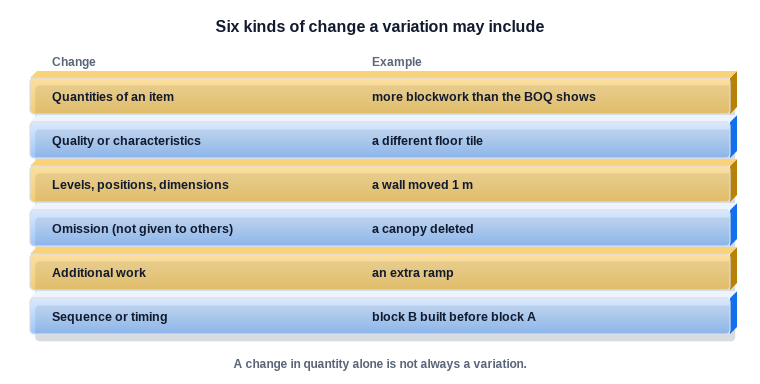
Under the FIDIC 2017 Red Book, a Variation is a change to the Works instructed or approved as a variation under Clause 13. It may include:
- changes to the quantities of an item (these are not always a variation);
- changes to the quality or other characteristics of an item;
- changes to levels, positions or dimensions;
- omission of work, unless it is to be carried out by others without agreement;
- additional work, plant, materials or services needed for the permanent works;
- changes to the sequence or timing of the work.
Other contracts use other names: JCT forms speak of variations, while NEC contracts handle change through compensation events, valued on Defined Cost plus the Fee rather than tender rates.
How a variation is started and valued (FIDIC 2017, in general terms)
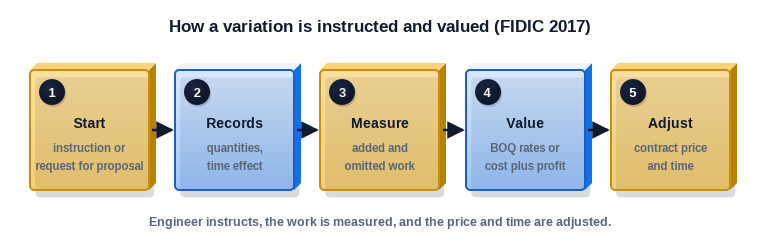
- By instruction: the Engineer instructs the change and the Contractor carries it out, keeping records of costs and time.
- By request for a proposal: the Engineer asks the Contractor for a proposal first. The Contractor replies with a description, a programme and a valuation. A request is not an instruction, so the work continues until the change is confirmed.
- Valuation: BOQ rates are used as far as possible. Where no rate fits, a new rate is built from the reasonable cost of the work plus profit (5% of the cost unless the contract data says otherwise). Sub-Clause 12.3 sets conditions, including a threshold for the change in quantity, before the rate of an existing item may change. Check the exact conditions and percentages in your contract.
- Daywork: valuing work by the time and resources used is the last resort, for short, limited tasks.
Worked example
On a villa in Jeddah, a wall is moved and a canopy finish is reduced (illustrative rates).
- Extra blockwork: 12 m² × SAR 85 = SAR 1,020
- Extra plaster: 24 m² × SAR 22 = SAR 528
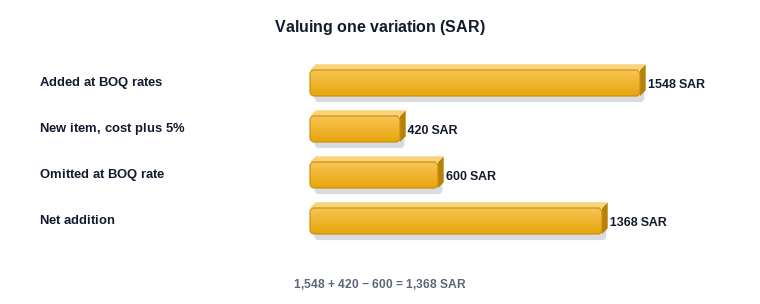
- Added at BOQ rates = 1,020 + 528 = SAR 1,548
- New fixing detail with no BOQ rate: cost SAR 400 + 5% profit (400 × 0.05 = 20) = SAR 420
- Omitted tiling: 10 m² × SAR 60 = SAR 600
- Net value of the variation = 1,548 + 420 − 600 = SAR 1,368
Step by step
- Get the instruction in writing, or confirm a verbal one in writing at once.
- Record the work as found before the change and keep daily records.
- Measure the added and omitted work in the BOQ units.
- Value it at BOQ rates, or build a new rate from cost plus profit.
- Assess the effect on the programme and give notice if time is needed.
- Agree the value and include it in the next payment application.
Common mistakes
- Doing changed work on a verbal instruction.
- Not recording the effect on time.
- Pricing a variation without checking whether a BOQ rate already applies.
- Forgetting the omitted work, so the client pays twice.
- Missing the notice requirements in the contract.
Related terms
- Construction and QSGlossary term
Bill of Quantities (BOQ)
A Bill of Quantities (BOQ) is a document that lists every item of work in a construction project with a description, a unit and a measured quantity. Contractors price each line, so every bidder prices exactly the same work.2 min read · Added 20 Nov 2026 - Construction and QSGlossary term
Rate analysis
Rate analysis is working out the price of one unit of a construction item, such as 1 m³ of concrete or 1 m² of plaster, by adding up the materials, labour and equipment it needs, then adding overheads and profit.2 min read · Added 20 Nov 2026 - Construction and QSGlossary term
Provisional sum
A provisional sum is an amount of money put in a tender or BOQ for work that cannot be fully described or priced yet. When the work is done, the sum is taken out and replaced by the value of the work actually carried out.2 min read · Added 20 Nov 2026 - Construction and QSGlossary term
Quantity takeoff (QTO)
Quantity takeoff (QTO, also "taking off") is the process of measuring quantities, such as areas, lengths, volumes and counts, from drawings, models and specifications, mainly to work out construction cost. The word "takeoff" is also used for the list of quantities the process produces.2 min read · Added 20 Nov 2026
Frequently asked questions
Is a variation order the same as a change order?
Yes, the two names are used for the same idea in different countries and contracts.
Does every change in quantity count as a variation?
Not always. Under FIDIC, a change in quantity on a remeasured contract is not necessarily a variation.
How is a variation valued when no BOQ rate fits?
A fair new rate is built from cost plus profit. Daywork, paid on time and resources used, is the last resort.