

Glossary · Construction and QS
What is Rate Analysis? Meaning, Example and How It Works
In simple words
Rate analysis is working out the price of one unit of a construction item, such as 1 m³ of concrete or 1 m² of plaster, by adding up the materials, labour and equipment it needs, then adding overheads and profit. Contractors' estimators and clients' quantity surveyors prepare it.
Why it matters
Every rate in a priced BOQ is the result of a small calculation. Rate analysis shows that calculation, so a client can spot a tender rate that is too low to be realistic, and a contractor can price a new item fairly in a variation when no existing rate fits.
Types
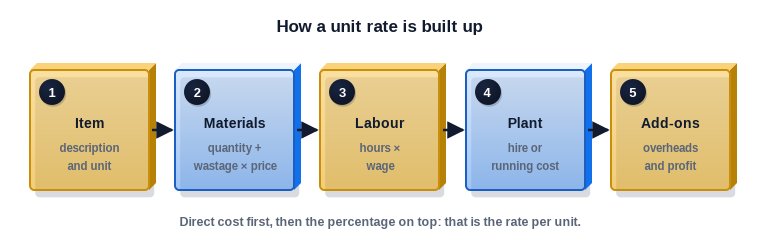
The parts of a rate:
- Materials: quantity per unit plus wastage, times the delivered price.
- Labour: hours of each trade per unit (the output rate) times its hourly cost.
- Plant and equipment: hire, fuel or running cost spread over the output, plus small tools.
- Overheads and profit: a percentage added to the direct cost. Official schedules such as the CPWD analysis of rates give basic rates exclusive of the contractor's profit and overheads, which are added separately.
Worked example
1 m² of 200 mm blockwork (illustrative SAR prices, not current market rates).
| Resource | Working | Cost (SAR) |
|---|---|---|
| Blocks | 1 ÷ (0.40 × 0.20) = 12.50; × 1.04 waste = 13.00 × 3.00 | 39.00 |
| Mortar | 0.02 m³ × 300.00 | 6.00 |
| Mason | 0.80 h × 12.00 | 9.60 |
| Labourer | 0.80 h × 8.00 | 6.40 |
| Small plant and tools | item | 1.00 |
| Direct cost | 39.00 + 6.00 + 9.60 + 6.40 + 1.00 | 62.00 |
| Overheads and profit 15% | 62.00 × 0.15 | 9.30 |
| Rate per m² | 62.00 + 9.30 | 71.30 |
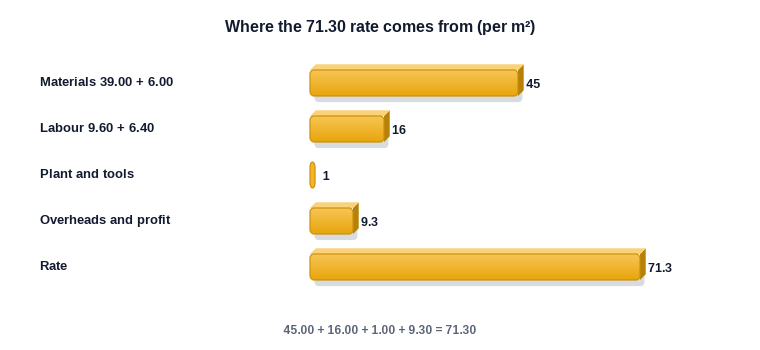
Materials are the largest part: 45.00 of 71.30. A real analysis uses current local prices, measured outputs and the wastage the specification allows.
Common mistakes
- Forgetting wastage or carriage to site.
- Using old material prices.
- Adding overheads twice, in the rate and again in the preliminaries.
- Copying a rate from another city or year without checking it.
Related terms
- Construction and QSGlossary term
Bill of Quantities (BOQ)
A Bill of Quantities (BOQ) is a document that lists every item of work in a construction project with a description, a unit and a measured quantity, so every contractor prices the same work.5 min read · Added 20 Nov 2026 - Construction and QSGlossary term
Quantity takeoff
Quantity takeoff (QTO, also "taking off") is the process of measuring quantities, such as areas, lengths, volumes and counts, from drawings, models and specifications, mainly to work out construction cost. The word "takeoff" is also used for the list of quantities the process produces. Quantity surveyors and estimators do it.3 min read · Added 20 Nov 2026 - Construction and QSGlossary term
Variation order
A variation order is a formal instruction, usually from the engineer or architect, that changes the work in a construction contract, such as adding, omitting or changing work. It adjusts the contract price and sometimes the time.5 min read · Added 20 Nov 2026 - Construction and QSGlossary term
Provisional sum
A provisional sum is an amount of money put in a tender or BOQ for work that cannot be fully described or priced yet. When the work is done, the sum is taken out and replaced by the value of the work actually carried out. It is usually estimated by the client's cost consultant or quantity surveyor.3 min read · Added 20 Nov 2026 - Construction and QSGlossary term
Concrete volume (cubic metre)
Concrete volume is the space a concrete element fills, measured in cubic metres (m³); for a simple shape it is length × width × thickness.5 min read · Added 20 Nov 2026
Frequently asked questions
Is rate analysis the same as a schedule of rates?
No. A schedule of rates lists finished rates; rate analysis shows how each rate is built up.
Who prepares it?
Usually the contractor's estimator or the client's quantity surveyor.
Does ZYSNOR publish material rates?
Yes. The ZYSNOR rates pages show official monthly material rates for Pakistan (PBS) and Saudi Arabia (GASTAT), with the source and date.