

Glossary · Construction and QS
What is Concrete Volume? Meaning, Example and How It Works
In simple words
Concrete volume is the space a concrete element fills, measured in cubic metres (m³). For a simple shape it is length × width × thickness (or depth). Quantity surveyors, site engineers and contractors use it to price, order and check concrete.
Why it matters
Concrete is priced, ordered and paid for by the cubic metre. A small error in units or a double-counted overlap changes the bill and the truck order, and ready-mix concrete that arrives short or in excess costs money and time.
Types
- Measured (net) volume: the volume from the drawings, used in the BOQ. Under RICS NRM2, in-situ concrete is measured net, with no deduction for reinforcement, formwork, chairs or cast-in accessories.
- Order volume: the net volume plus an allowance for waste, spillage and uneven formwork. The allowance belongs in the rate or the order, never in the measured quantity.
Formulas for common shapes
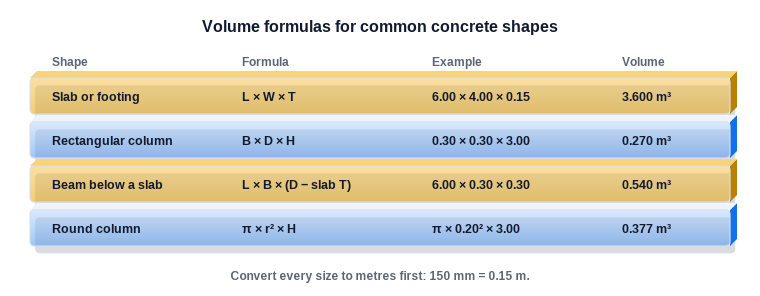
- Slab, wall or footing: length × width × thickness.
- Rectangular column: breadth × depth × height.
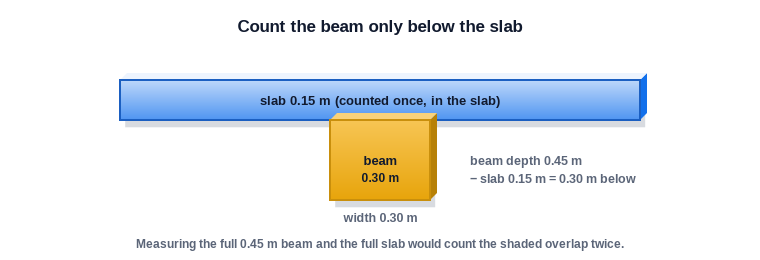
- Beam under a slab: length × width × (beam depth − slab thickness), so the slab part is not counted twice.
- Round column or pile: π × r² × height. For r = 0.20 m and 3.00 m: 3.1416 × 0.04 × 3.00 = 0.377 m³.
Worked example
The frame of a small guard room in Jeddah:
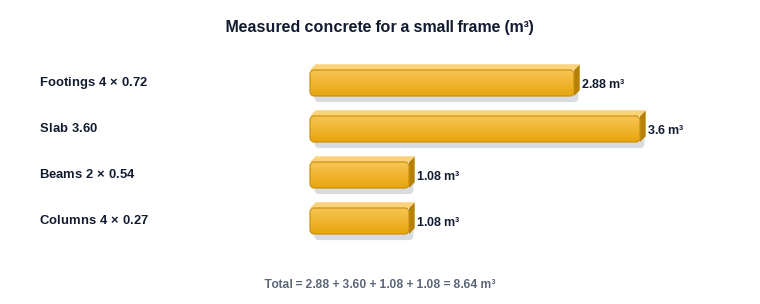
- Footings: 4 × (1.20 × 1.20 × 0.50) = 4 × 0.72 = 2.88 m³
- Slab: 6.00 × 4.00 × 0.15 = 3.60 m³
- Beams: 2 × (6.00 × 0.30 × (0.45 − 0.15)) = 2 × 0.54 = 1.08 m³
- Columns: 4 × (0.30 × 0.30 × 3.00) = 4 × 0.27 = 1.08 m³
- Measured volume: 2.88 + 3.60 + 1.08 + 1.08 = 8.64 m³
- Order quantity with an illustrative 3% allowance set by the estimator: 8.64 × 1.03 = 8.90 m³
Units at a glance
| Size on drawing | In metres | Note |
|---|---|---|
| 150 mm | 0.15 m | divide mm by 1,000 |
| 1 m³ | 1,000 litres | useful for small pours |
| 0.15 m × 6.00 × 4.00 | 3.60 m³ | correct |
| 150 × 6.00 × 4.00 | 3,600 | wrong: 1,000 times too big |
Step by step
- List every concrete element from the drawings and convert all sizes to metres.
- Work out one element with its formula, then multiply by the number of identical elements.
- Remove overlaps so each piece of concrete is counted once.
- Add the elements for the measured (BOQ) volume.
- Add the waste allowance only when you prepare the order.
Common mistakes
- Multiplying millimetres by metres.
- Counting the beam through the slab depth.
- Deducting reinforcement, which NRM2 does not deduct.
- Adding the waste allowance to the BOQ quantity.
- Rounding each element to one decimal before adding them up.
Related terms
- Engineering and constructionGlossary term
Concrete
Concrete is a building material made by mixing cement, water, sand and gravel or crushed stone. The cement and water form a paste that coats the stones and, through a chemical reaction called hydration, hardens into a strong, rock-like mass.2 min read · Added 20 Nov 2026 - Construction and QSGlossary term
Bar bending schedule (BBS)
A bar bending schedule (BBS) is a table that lists every reinforcement bar in a concrete element: its mark, diameter, shape, cut length and number. It is used to cut and bend the steel and to work out its total weight for ordering and billing.2 min read · Added 20 Nov 2026 - Construction and QSGlossary term
Quantity takeoff (QTO)
Quantity takeoff (QTO, also "taking off") is the process of measuring quantities, such as areas, lengths, volumes and counts, from drawings, models and specifications, mainly to work out construction cost. The word "takeoff" is also used for the list of quantities the process produces.2 min read · Added 20 Nov 2026 - Construction and QSGlossary term
Bill of Quantities (BOQ)
A Bill of Quantities (BOQ) is a document that lists every item of work in a construction project with a description, a unit and a measured quantity. Contractors price each line, so every bidder prices exactly the same work.2 min read · Added 20 Nov 2026 - Construction and QSGlossary term
Method of measurement
A method of measurement is a published set of rules for how construction work is measured and described in a BOQ, so that everyone measures the same work in the same way and prices are comparable.2 min read · Added 20 Nov 2026
Frequently asked questions
How many litres are in one cubic metre?
1 m³ = 1,000 litres.
Where do a beam and a slab overlap, which one is counted?
Count the shared part once; the method of measurement and the drawings say which element it belongs to.
Is the reinforcement volume deducted?
Usually no. NRM2, for example, does not deduct the volume of reinforcement from in-situ concrete.