

Glossary · Construction and QS
What is a Method of Measurement? Meaning, Example and How It Works
In simple words
A method of measurement is a published set of rules for how construction work is measured and described in a BOQ, so that everyone measures the same work in the same way and prices are comparable. The client’s quantity surveyor names it in the contract or the BOQ preamble.
The method is named in the BOQ preamble or the contract. Once it is named, it decides how every quantity in that BOQ is measured, so two quantity surveyors measuring the same drawings reach the same figures.
Why it matters
Without an agreed method, two people can measure the same wall and get different quantities, and the difference becomes a dispute about money. The method fixes units, what each item includes, how items are described and which openings are deducted, so tenders can be compared fairly. It does not set prices: contractors still price each item.
Types
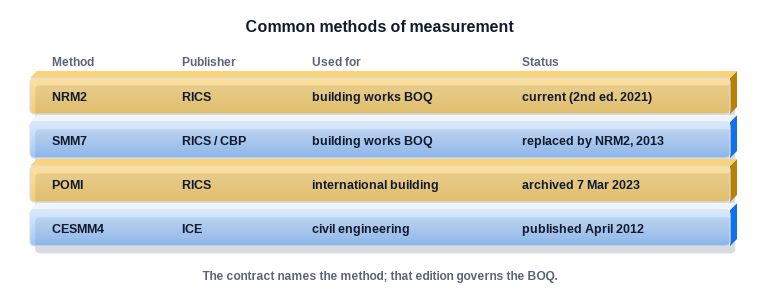
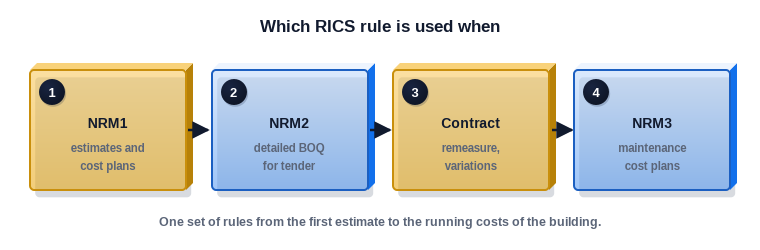
- NRM (RICS New rules of measurement): NRM1 for estimates and cost plans, NRM2 for detailed measurement of building works, NRM3 for maintenance works. The first edition of NRM2 took effect on 1 January 2013. The current editions were published in October 2021 and reissued in October 2022.
- SMM7: the older UK Standard Method of Measurement for building works, still found in existing contracts and textbooks.
- POMI (Principles of Measurement International): an RICS method first published in 1979 for international work, archived by RICS on 7 March 2023, but still named in many older contracts.
- CESMM4: the Civil Engineering Standard Method of Measurement from the Institution of Civil Engineers, fourth edition published in April 2012, used for roads, drainage and other civil work.
What the rules decide
- The unit for each item: m, m², m³, t, nr (number) or item.
- What each item includes, for example whether formwork is part of the concrete item or a separate item.
- How items are described, so contractors read them the same way.
- Which openings and small voids are deducted, and above what size.
- How provisional sums, prime cost sums and preliminaries are set out.
Worked example
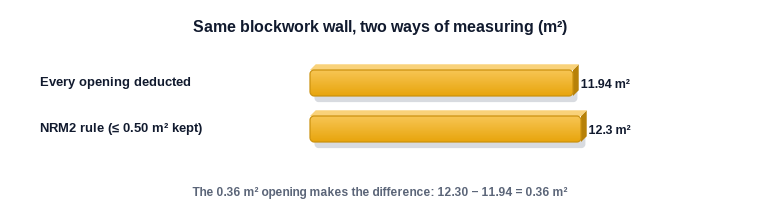
A blockwork wall in a school project in Dammam is 5.00 × 3.00 = 15.00 m², with three openings of 0.36, 0.90 and 1.80 m².
- QS 1 deducts every opening: 15.00 − 0.36 − 0.90 − 1.80 = 11.94 m²
- QS 2 follows NRM2, which keeps voids of 0.50 m² or less in masonry: 15.00 − 0.90 − 1.80 = 12.30 m²
- Difference: 12.30 − 11.94 = 0.36 m², exactly the small opening
Step by step: using a method on a project
- Check which method and edition the contract or client names.
- Set out the BOQ in its order of work sections.
- Measure every item in the unit the method sets.
- Apply its deduction rules and its rules for what each item includes.
- State the method and any departures from it in the BOQ preamble.
Common mistakes
- Not stating the method in the BOQ.
- Mixing rules from two methods in one BOQ.
- Using an archived or old edition without saying so.
- Assuming a method sets prices; it only sets how quantities are measured and described.
Related terms
- Construction and QSGlossary term
Bill of Quantities (BOQ)
A Bill of Quantities (BOQ) is a document that lists every item of work in a construction project with a description, a unit and a measured quantity. Contractors price each line, so every bidder prices exactly the same work.2 min read · Added 20 Nov 2026 - Construction and QSGlossary term
Quantity takeoff (QTO)
Quantity takeoff (QTO, also "taking off") is the process of measuring quantities, such as areas, lengths, volumes and counts, from drawings, models and specifications, mainly to work out construction cost. The word "takeoff" is also used for the list of quantities the process produces.2 min read · Added 20 Nov 2026 - Construction and QSGlossary term
Opening deductions
Opening deductions are the rules that say which doors, windows and voids are taken out of a measured quantity. Small openings below a set size are left in, because working around them costs about the same as the material saved.2 min read · Added 20 Nov 2026 - Construction and QSGlossary term
Provisional sum
A provisional sum is an amount of money put in a tender or BOQ for work that cannot be fully described or priced yet. When the work is done, the sum is taken out and replaced by the value of the work actually carried out.2 min read · Added 20 Nov 2026 - Construction and QSGlossary term
Running metre (linear metre)
A running metre (also called a linear metre, written m, Rm or RMT) is a length measured along an item, whatever its width or height. Items such as skirting, cornice, handrail, pipes and kerbs are measured and priced per running metre.2 min read · Added 20 Nov 2026
Frequently asked questions
Which method is used in Saudi Arabia?
It depends on the contract; POMI and NRM are both common, and the contract documents say which applies.
Is POMI still valid?
RICS archived it in 2023, but a contract can still name it.
Does a method of measurement set prices?
No. It sets how quantities are measured and described; contractors set the rates.