

Glossary · Construction and QS
What are Opening Deductions? Meaning, Example and How They Work
In simple words
Opening deductions are the rules that say which doors, windows and voids are taken out of a measured quantity. Small openings below a set size are left in, because working around them costs about the same as the material saved. Quantity surveyors apply them when measuring walls, floors and finishes for a BOQ.
The rules are part of the method of measurement named in the contract. They exist so that every QS takes out the same openings, and so that the contractor is paid fairly for the extra work of forming and finishing around them.
Why it matters
Deducting the wrong openings changes the measured quantity, and so the price, on every wall. Small openings stay in because cutting blocks or finishing plaster around them takes extra labour that roughly equals the material saved; leaving them in pays for that labour without a separate item.
Types
- Small voids inside the area: at or below the trade's size limit, left in the quantity.
- Larger voids inside the area: above the limit, deducted.
- Openings on the edge of the area: such as a door that starts at floor level, deducted whatever their size.
Typical limits under RICS NRM2
| Trade | Voids not deducted | Note |
|---|---|---|
| Masonry walls | 0.50 m² or less | larger voids deducted |
| Wall, floor and ceiling finishes | 1.00 m² or less, inside the area | voids on the edge deducted at any size |
Other methods such as POMI or national standards set their own limits, so always use the one in your contract.
Worked example
One internal wall of a villa in Riyadh, measured for two trades:
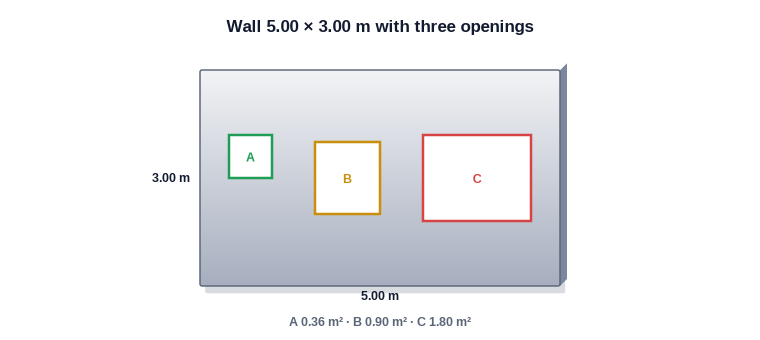
Wall: 5.00 × 3.00 = 15.00 m². Openings: A 0.60 × 0.60 = 0.36 m², B 0.90 × 1.00 = 0.90 m², C 1.50 × 1.20 = 1.80 m².
- Blockwork (limit 0.50 m²): keep A, deduct B and C: 15.00 − 0.90 − 1.80 = 12.30 m²
- Plaster (limit 1.00 m²): keep A and B, deduct C: 15.00 − 1.80 = 13.20 m²
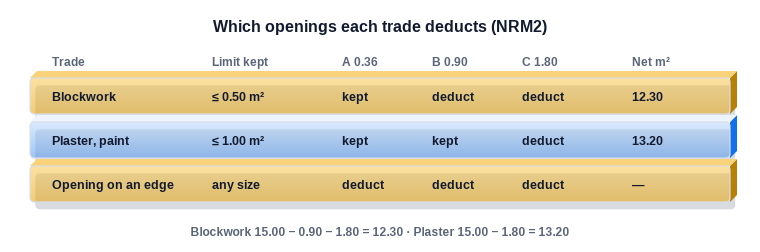
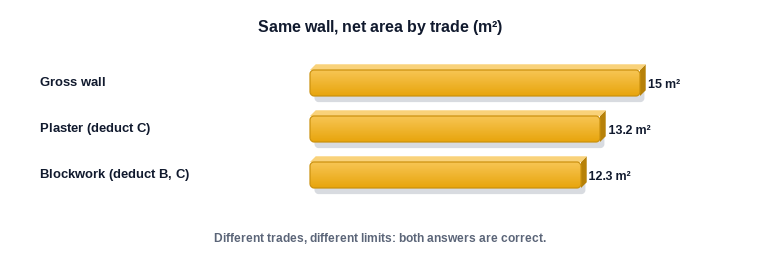
The same wall gives different net areas for different trades. That is how the rules are meant to work, not an error.
Step by step
- Measure the gross area of the surface.
- List every opening with its size and whether it touches the edge.
- Look up the limit for the trade you are measuring.
- Deduct openings above the limit and every opening on the edge.
- Repeat for each trade; do not copy one trade's net area into another.
Common mistakes
- Using one limit for every trade.
- Ignoring the edge rule for doors and floor-level openings.
- Mixing NRM2 limits with another method in one project.
Related terms
- Construction and QSGlossary term
Gross area and net area
Gross area is the full area of a surface before anything is taken out. Net area is what is left after deducting openings and voids that the measurement rules say to deduct. Quantities for pricing usually use the net area.2 min read · Added 20 Nov 2026 - Construction and QSGlossary term
Wall finishing area (plaster and paint)
Wall finishing area is the area of wall surface that receives plaster, paint, tiles or another finish. It is the wall perimeter times the finish height, minus the openings that the measurement rules say to deduct.2 min read · Added 20 Nov 2026 - Construction and QSGlossary term
Method of measurement
A method of measurement is a published set of rules for how construction work is measured and described in a BOQ, so that everyone measures the same work in the same way and prices are comparable.2 min read · Added 20 Nov 2026 - Construction and QSGlossary term
Bill of Quantities (BOQ)
A Bill of Quantities (BOQ) is a document that lists every item of work in a construction project with a description, a unit and a measured quantity. Contractors price each line, so every bidder prices exactly the same work.2 min read · Added 20 Nov 2026
Frequently asked questions
Why are small openings not deducted?
The extra labour to work around them roughly balances the material saved, so the rules keep measuring simple.
Do POMI or IS 1200 use the same limits?
No. Each method sets its own limits; use the one in your contract.
Is a door deducted from a wall finish?
Yes. Under NRM2 a door that starts at floor level touches the edge of the wall area, so it is deducted whatever its size.