

Glossary · Construction and QS
What is a Running Metre? Meaning, Example and How It Works
In simple words
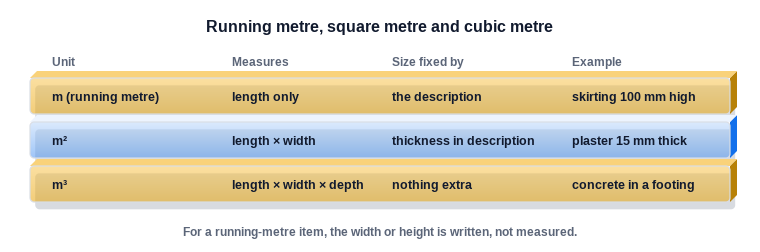
A running metre (also called a linear metre, written m, Rm or RMT) is a length measured along an item, whatever its width or height. Items such as skirting, cornice, handrail, pipes and kerbs are measured and priced per running metre. Quantity surveyors and estimators measure them, and contractors price them per metre.
Why it matters
Running-metre items look small on a bill, but they repeat in every room of a building, so their totals add up quickly. A wrong unit or a missed length is repeated on every floor and carried straight into the price.
How it works
Only the length along the item is measured. Its other dimensions, such as the height of a skirting or the size of a pipe, are written into the item description, so the rate already allows for them. Methods of measurement such as RICS NRM2 list which items are measured in metres and which in m² or m³.
Types
- Finishing trims: skirting, cornice, dado rails and beads.
- Joinery: door and window frames, sills and handrails.
- Services: pipes, cable trays and ducts of a stated size.
- External works: kerbs, edgings, channels and copings.
- Joints: expansion joints and sealant beads.
Worked example
A bedroom in a Lahore house is 4.00 × 3.50 m, with one door 0.90 m wide. The door frame is 2.10 m high.
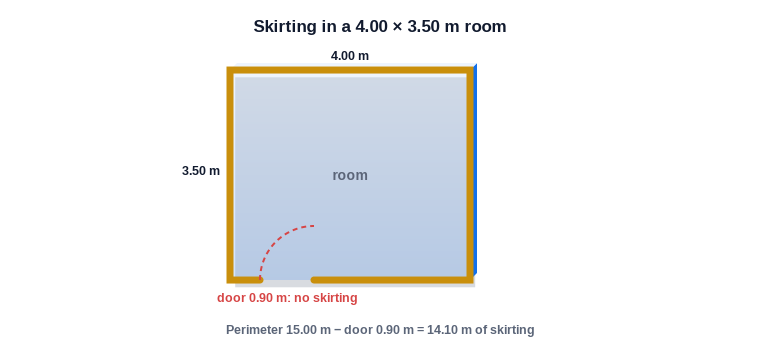
- Perimeter = 2 × (4.00 + 3.50) = 15.00 m
- Skirting is not fixed across the door: 15.00 − 0.90 = 14.10 m
- Cornice runs over the door as well: 15.00 m
- Door frame = 2.10 + 0.90 + 2.10 = 5.10 m
- Total linear items = 14.10 + 15.00 + 5.10 = 34.20 m
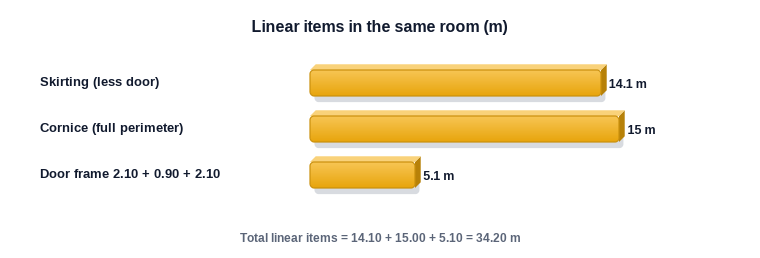
Each item stays a separate BOQ line, because each has its own rate: "Skirting 100 mm high ... 14.10 m", "Cornice ... 15.00 m".
Running metre and square metre
If a skirting 0.10 m high were priced per m², 14.10 m would become 14.10 × 0.10 = 1.41 m². The same work would then need a rate ten times higher. Mixing the two units in one bill is a common source of pricing errors.
Step by step
- Read the method of measurement to confirm the item is measured in metres.
- Fix the size in the description (height, section or diameter).
- Measure along the face where the item is actually fixed.
- Deduct gaps such as door openings where the item is not fixed.
- Total by item and floor, then enter the quantity in the bill.
Common mistakes
- Pricing a running metre as if it were a square metre.
- Forgetting to take out door widths for skirting.
- Measuring along the structural wall instead of the finished face.
- Leaving the size out of the description, so the rate cannot be priced.
- Adding the same length twice at corners.
Related terms
- Construction and QSGlossary term
Quantity takeoff (QTO)
Quantity takeoff (QTO, also "taking off") is the process of measuring quantities, such as areas, lengths, volumes and counts, from drawings, models and specifications, mainly to work out construction cost. The word "takeoff" is also used for the list of quantities the process produces.2 min read · Added 20 Nov 2026 - Construction and QSGlossary term
Bill of Quantities (BOQ)
A Bill of Quantities (BOQ) is a document that lists every item of work in a construction project with a description, a unit and a measured quantity. Contractors price each line, so every bidder prices exactly the same work.2 min read · Added 20 Nov 2026 - Construction and QSGlossary term
Wall finishing area (plaster and paint)
Wall finishing area is the area of wall surface that receives plaster, paint, tiles or another finish. It is the wall perimeter times the finish height, minus the openings that the measurement rules say to deduct.2 min read · Added 20 Nov 2026 - Construction and QSGlossary term
Gross area and net area
Gross area is the full area of a surface before anything is taken out. Net area is what is left after deducting openings and voids that the measurement rules say to deduct. Quantities for pricing usually use the net area.2 min read · Added 20 Nov 2026 - Construction and QSGlossary term
Method of measurement
A method of measurement is a published set of rules for how construction work is measured and described in a BOQ, so that everyone measures the same work in the same way and prices are comparable.2 min read · Added 20 Nov 2026
Frequently asked questions
Is a running metre the same as a metre?
Yes, it is a normal metre of length; "running" only says the item is measured along its length.
What does RMT or Rm mean on a quotation?
Running metre: the price is per metre of length.
Which items are measured in running metres?
Typically narrow items such as skirtings, cornices, kerbs, handrails, pipes and cables; your method of measurement gives the full list.