

Glossary · Environment
What is Sustainability? Meaning, Examples and Green Buildings
In simple words
Sustainability means meeting today's needs without harming the ability of future generations to meet theirs. In practice it means using energy, water and materials carefully, cutting pollution and waste, and keeping people and the economy healthy over the long term.
The best-known definition comes from the 1987 report Our Common Future (the Brundtland Report) of the World Commission on Environment and Development: sustainable development is development that meets the needs of the present without compromising the ability of future generations to meet their own needs. Sustainability is the wider idea behind it: a way of living, building and doing business that can continue for a long time.
How sustainability is organised
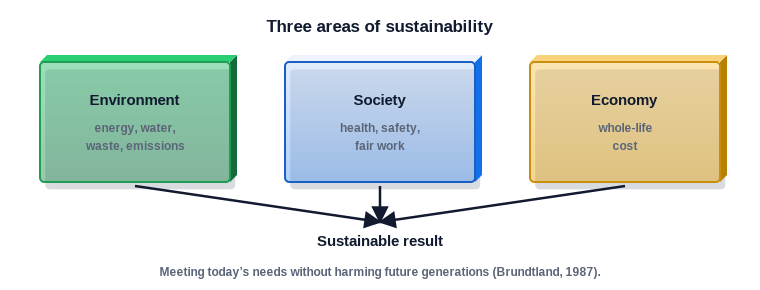
Most plans look at three areas at the same time:
- Environment: less energy, water and raw material used; less pollution, waste and greenhouse gas.
- Society: health, safety, fair work and access to services for the people affected.
- Economy: costs that can be paid over the whole life of a project, not only on the first day.
A project that saves money but pollutes a river, or that is green but too costly to run, is not sustainable in this full sense.
Why buildings matter
UNEP's Global Status Report for Buildings and Construction (press release of 7 March 2024, 2022 data) says the building and construction sector accounted for 37 per cent of global operational energy and process-related CO2 emissions, and that its energy use was more than a third of global demand. Green building is therefore one of the main places where sustainability is put into practice.
Green building examples
- Insulation, shading and good windows so less cooling and heating is needed.
- LED lighting, efficient air conditioning and controls that switch off unused areas.
- Solar panels on the roof.
- Water-saving fittings and reuse of grey water for gardens.
- Materials with a lower carbon footprint, recycled content, and less waste on site.
Worked example (a greener office building)
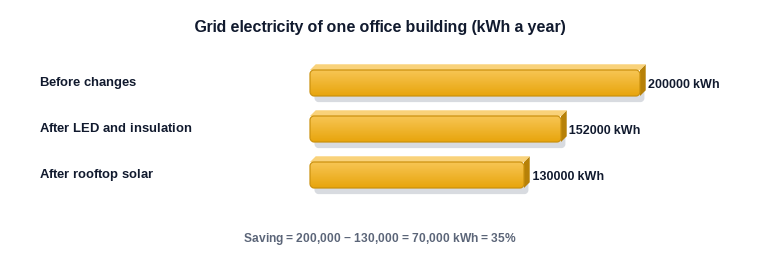
An office building uses 200,000 kWh of electricity a year. The owner makes three changes:
- LED lighting saves 18,000 kWh a year.
- Better insulation and shading cut cooling by 30,000 kWh a year.
- Rooftop solar panels produce 22,000 kWh a year.
- Electricity still used: 200,000 − 18,000 − 30,000 = 152,000 kWh.
- Electricity bought from the grid: 152,000 − 22,000 = 130,000 kWh.
- Saving from the grid: 200,000 − 130,000 = 70,000 kWh, which is 70,000 ÷ 200,000 × 100 = 35%.
Step by step: making a project more sustainable
- Measure the starting point: energy, water, waste and cost.
- Cut demand first (insulation, efficient equipment, good design).
- Supply what is left from cleaner sources, such as solar.
- Choose materials with a lower carbon footprint and less waste.
- Check the effect on people: comfort, health and safety.
- Measure again every year and compare with the starting point.
Common mistakes
Calling a project "green" without any measured figures; adding solar panels to a building that wastes energy; looking only at the construction cost and not the running cost; forgetting water and waste; treating sustainability as only an environmental topic.
Related terms
- EnvironmentGlossary term
Carbon footprint
A carbon footprint is the total amount of greenhouse gases caused by a person, product, building, company or event, counted as tonnes of carbon dioxide equivalent (CO2e). It shows how much that thing adds to climate change.2 min read · Added 20 Nov 2026 - Architecture and interiorGlossary term
Ventilation (in buildings)
Ventilation is supplying air to a room or building and removing air from it, by natural or mechanical means, so that stale air is replaced with fresh air and humidity, temperature and indoor air contaminants are kept under control.2 min read · Added 20 Nov 2026 - Architecture and interiorGlossary term
Renovation
Renovation is the work of returning an old, damaged or worn building to a good state of repair, and often modernising it at the same time, for example new finishes, repaired walls and roofs, or updated services.2 min read · Added 20 Nov 2026
Frequently asked questions
What is the difference between sustainability and sustainable development?
Sustainable development is the process defined in the Brundtland Report; sustainability is the long-term state or goal that it aims for.
What is a green building?
A building designed, built and run to use less energy, water and materials and to cause less pollution, while staying healthy and comfortable for its users.
Is sustainability only about the environment?
No. Plans usually look at the environment, people and cost together.