

Glossary · Architecture and interior
What is Renovation? Meaning, Example and Renovation vs Refurbishment vs Retrofit
In simple words
Renovation is the work of returning an old, damaged or worn building to a good state of repair, and often modernising it at the same time, for example new finishes, repaired walls and roofs, or updated services.
Renovation differs from new building because the starting point is an existing structure, with its own condition, hidden defects and services. Most of the risk in a renovation comes from what cannot be seen until work begins.
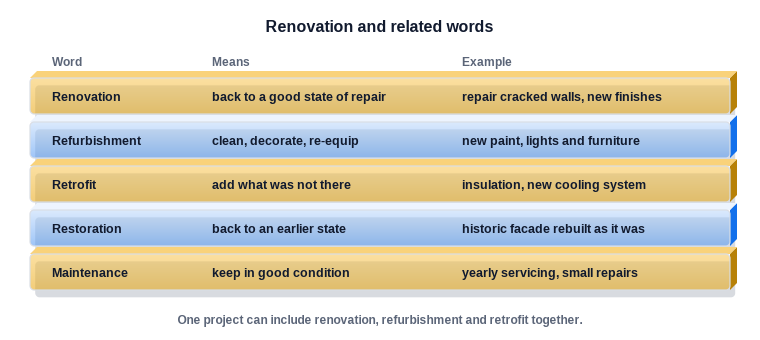
Renovation and related words
Cosmetic and structural
Renovation work is usually grouped as cosmetic (finishes, paint, tiles, fittings) or structural (walls, slabs, beams, roofs). Structural work needs an engineer's design and usually approval from the local authority; cosmetic work often does not, but rules differ from place to place.
Stages of a renovation
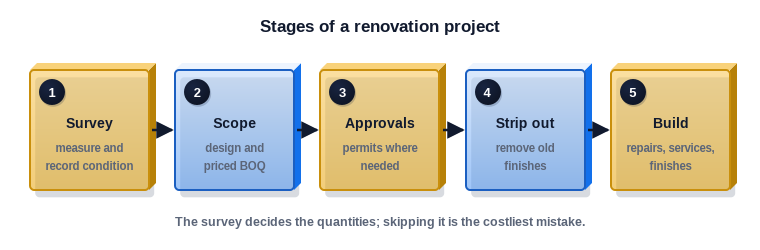
- Survey: measure the existing building and record its condition, including damp, cracks and services.
- Scope: decide what will be repaired, replaced or added; produce drawings and a priced BOQ.
- Approvals: obtain permits where the work needs them.
- Strip out: remove old finishes and fittings; hidden problems often appear now.
- Build: repairs, new services, then finishes, with a contingency for surprises.
Worked example: re-plastering four rooms
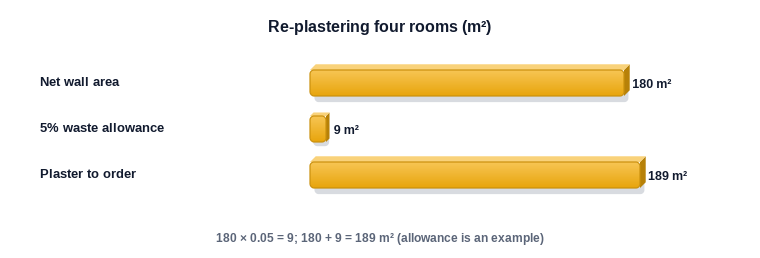
The survey gives a total wall area of 180 m² after opening deductions. A 5% allowance for waste is added when ordering (an example figure).
- Allowance: 180 × 0.05 = 9 m²
- Plaster to order: 180 + 9 = 189 m²
- The BOQ quantity stays 180 m²; the allowance is for ordering, not for measurement.
Old plaster must also come off first, so the BOQ needs a separate item for hacking off and removing the existing finish over the same 180 m².
Why measurement matters
Renovation quantities come from the existing building, not from new drawings. An accurate survey, drawn in CAD or modelled in BIM, avoids surprises in the price and gives a base for variations when hidden defects appear.
Common mistakes
- Pricing without a site survey.
- Forgetting demolition, removal and disposal of old finishes.
- No contingency for hidden defects found during strip-out.
- Assuming renovation needs no permit; check the local rules.
- Confusing renovation with restoration on historic buildings, where different rules may apply.
Related terms
- Architecture and interiorGlossary term
Facade
A facade (façade) is an outside face of a building, usually the front that faces the street, designed with special architectural treatment. In a wider sense, any main vertical outer wall of a building can be called a facade.2 min read · Added 20 Nov 2026 - Architecture and interiorGlossary term
Ventilation (in buildings)
Ventilation is supplying air to a room or building and removing air from it, by natural or mechanical means, so that stale air is replaced with fresh air and humidity, temperature and indoor air contaminants are kept under control.2 min read · Added 20 Nov 2026 - Construction and QSGlossary term
Wall finishing area (plaster and paint)
Wall finishing area is the area of wall surface that receives plaster, paint, tiles or another finish. It is the wall perimeter times the finish height, minus the openings that the measurement rules say to deduct.2 min read · Added 20 Nov 2026 - Construction and QSGlossary term
Opening deductions
Opening deductions are the rules that say which doors, windows and voids are taken out of a measured quantity. Small openings below a set size are left in, because working around them costs about the same as the material saved.2 min read · Added 20 Nov 2026 - Construction and QSGlossary term
Bill of Quantities (BOQ)
A Bill of Quantities (BOQ) is a document that lists every item of work in a construction project with a description, a unit and a measured quantity. Contractors price each line, so every bidder prices exactly the same work.2 min read · Added 20 Nov 2026 - Construction and QSGlossary term
Variation order
A variation order is a formal instruction, usually from the engineer or architect, that changes the work in a construction contract, such as adding, omitting or changing work. It adjusts the contract price and sometimes the time.2 min read · Added 20 Nov 2026
Frequently asked questions
Is renovation the same as refurbishment?
They are often used as if they were, but refurbishment means improving by cleaning, decorating and re-equipping, while renovation means bringing back to good repair.
What is a "major renovation"?
In England's Approved Document L, it is a renovation where more than 25% of the surface area of the building envelope is renovated; other countries use their own definitions.