

Glossary · Construction materials and rates
What is Grade 60 vs Grade 40 Steel? Meaning, Example and How It Works
In simple words
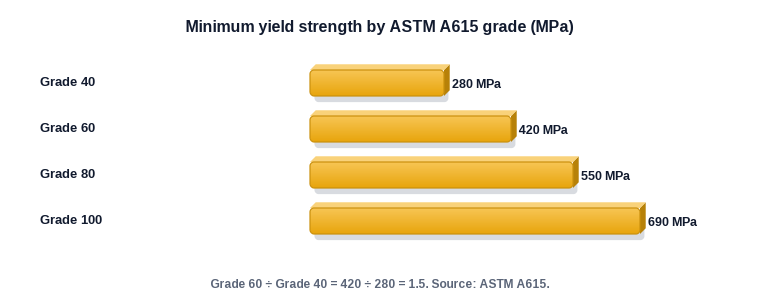
The grade of a steel reinforcing bar (sariya) tells you how much stress it takes before it starts to stretch for good. Grade 40 bars have a minimum yield strength of 40,000 psi (280 MPa) and Grade 60 bars 60,000 psi (420 MPa). The structural engineer specifies the grade on the drawings.
Why it matters
A structure designed for Grade 60 bars counts on that strength. If Grade 40 bars are used instead, beams and columns end up weaker than the design. Price lists quote each grade separately, so the grade must appear on every quote, delivery note and mill certificate.
Types
- Grade 40 [280]: minimum yield strength 40,000 psi (280 MPa). PBS prices this grade in Pakistan, as a 1/2 inch bar.
- Grade 60 [420]: minimum yield strength 60,000 psi (420 MPa).
- Higher grades: ASTM A615 also lists Grade 80 [550] and Grade 100 [690].
Worked example
PBS, October 2026: steel bar 1/2 inch, Grade 40, Pakistan average Rs 237,767.14 per tonne.
| Step | Calculation | Result |
|---|---|---|
| Price per kg | 237,767.14 ÷ 1,000 | Rs 237.77 |
| Steel for a slab, 1.8 tonnes | 1.8 × 237,767.14 | Rs 427,980.85 |
| Strength ratio, Grade 60 to Grade 40 | 60,000 ÷ 40,000 | 1.5 |
A Grade 60 bar carries 50% more stress before yielding than a Grade 40 bar of the same size.
Common mistakes
- Buying on the price per kg alone without checking the grade on the mill certificate.
- Swapping Grade 60 for Grade 40 on site without the engineer's written approval.
- Comparing a Grade 60 quote with the PBS Grade 40 average as if they were the same product.
- Ignoring the standard printed on the bundle tag (ASTM A615, ASTM A706 or BS 4449).
Related terms
- Construction and QSGlossary term
Bar bending schedule (BBS)
A bar bending schedule (BBS) is a table that lists every reinforcement bar in a concrete element: its mark, diameter, shape, cut length and number, used to cut, bend, order and bill the steel.6 min read · Added 20 Nov 2026 - Construction and QSGlossary term
Rate analysis
Rate analysis is working out the price of one unit of a construction item, such as 1 m³ of concrete or 1 m² of plaster, by adding up the materials, labour and equipment it needs, then adding overheads and profit. Contractors' estimators and clients' quantity surveyors prepare it.3 min read · Added 20 Nov 2026 - Engineering and constructionGlossary term
Concrete
Concrete is a building material made by mixing cement, water, sand and gravel or crushed stone. The cement and water form a paste that coats the stones and, through a chemical reaction called hydration, hardens into a strong, rock-like mass.5 min read · Added 20 Nov 2026 - Construction and QSGlossary term
Bill of Quantities (BOQ)
A Bill of Quantities (BOQ) is a document that lists every item of work in a construction project with a description, a unit and a measured quantity, so every contractor prices the same work.5 min read · Added 20 Nov 2026 - Construction and QSGlossary term
Quantity takeoff
Quantity takeoff (QTO, also "taking off") is the process of measuring quantities, such as areas, lengths, volumes and counts, from drawings, models and specifications, mainly to work out construction cost. The word "takeoff" is also used for the list of quantities the process produces. Quantity surveyors and estimators do it.3 min read · Added 20 Nov 2026
- Sooter
Frequently asked questions
Is Grade 60 always better than Grade 40?
It is stronger, but the right grade is the one in the structural design.
Which standard defines these grades?
ASTM A615 for carbon-steel deformed bars; PSQCA lists it as a Pakistan standard reference.
Why does ZYSNOR show only Grade 40 for Pakistan?
PBS publishes only the 1/2 inch Grade 40 bar price.
Sources
- ASTM A615/A615M, Standard Specification for Deformed and Plain Carbon-Steel Bars for Concrete Reinforcement (section 1.2, grades and minimum yield strengths)
- PSQCA, list of Pakistan Standards (deformed bars, ASTM A615)
- Pakistan Bureau of Statistics, Monthly Inflation Report, October 2026 (urban construction items)