

Glossary · Construction materials and rates
What is OPC vs SRC Cement? Meaning, Example and How It Works
In simple words
OPC (Ordinary Portland Cement) is the normal grey cement used for most concrete, plaster and blockwork. SRC (Sulphate Resisting Cement) is a Portland cement made to resist sulphate salts in soil and water. Structural engineers choose the type, and contractors buy it.
Why it matters
Sulphate salts in saline soil, ground water or sea water can make ordinary concrete expand and crack over the years. SRC protects foundations where the soil report shows sulphates. Using it everywhere costs more for no benefit, so the choice should follow the soil test and the engineer's specification.
Types
- OPC: covered in Pakistan by PS 232, Ordinary Portland Cement. PBS prices it as "cement (local)" in a 50 kg bag.
- SRC: covered by PS 612, Sulphate Resisting Portland Cement type A, which is based on British Standard BS 4027.
- ASTM names: government specifications in Pakistan also accept ASTM C150 Type I for ordinary cement and ASTM C150 Type V for sulphate resisting cement.
Worked example (Saudi Arabia)
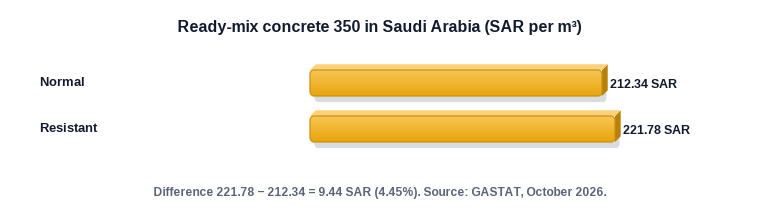
GASTAT publishes ready-mix concrete prices in a normal and a "resistant" version. October 2026, Kingdom average, 350 grade:
| Ready-mix concrete, 350 grade | SAR per m³ |
|---|---|
| Resistant | 221.78 |
| Normal | 212.34 |
| Difference | 9.44 |
The resistant mix costs 9.44 ÷ 212.34 = 4.45% more. For a 30 m³ footing pour the extra is 30 × 9.44 = 283.20 SAR.
Common mistakes
- Using SRC for all work "to be safe" when no sulphate test shows a need.
- Using OPC in footings on saline or water-logged soil without checking the soil report.
- Thinking SRC sets or gains strength faster; it is about chemical resistance, not speed.
- Mixing OPC and SRC bags in one pour.
Related terms
- Engineering and constructionGlossary term
Concrete
Concrete is a building material made by mixing cement, water, sand and gravel or crushed stone. The cement and water form a paste that coats the stones and, through a chemical reaction called hydration, hardens into a strong, rock-like mass.5 min read · Added 20 Nov 2026 - Construction and QSGlossary term
Rate analysis
Rate analysis is working out the price of one unit of a construction item, such as 1 m³ of concrete or 1 m² of plaster, by adding up the materials, labour and equipment it needs, then adding overheads and profit. Contractors' estimators and clients' quantity surveyors prepare it.3 min read · Added 20 Nov 2026 - Construction and QSGlossary term
Bill of Quantities (BOQ)
A Bill of Quantities (BOQ) is a document that lists every item of work in a construction project with a description, a unit and a measured quantity, so every contractor prices the same work.5 min read · Added 20 Nov 2026 - Construction and QSGlossary term
Concrete volume (cubic metre)
Concrete volume is the space a concrete element fills, measured in cubic metres (m³); for a simple shape it is length × width × thickness.5 min read · Added 20 Nov 2026 - Construction and QSGlossary term
Quantity takeoff
Quantity takeoff (QTO, also "taking off") is the process of measuring quantities, such as areas, lengths, volumes and counts, from drawings, models and specifications, mainly to work out construction cost. The word "takeoff" is also used for the list of quantities the process produces. Quantity surveyors and estimators do it.3 min read · Added 20 Nov 2026
- Ready-mix concrete
Frequently asked questions
Is SRC stronger than OPC?
Not necessarily. SRC is made to resist sulphate attack; its strength class is printed on the bag, as for OPC.
Where is SRC used in Pakistan?
Manufacturers list foundations near the sea, canal linings and saline or water-logged soil.
Does PBS publish an SRC price?
No. PBS reports one local cement bag price for each city.
Sources
- PSQCA, list of Pakistan Standards (PS 232 Ordinary Portland Cement; PS 612 Sulphate Resisting Portland Cement type A, based on BS 4027)
- Government of AJK, Planning and Development Department, specification for plain and reinforced concrete (PS 232, ASTM C150 Type I and Type V)
- GASTAT, Average Prices of Goods and Services, October 2026